
Home Room

It’s the place I began my school day, seventh through twelfth grade: art studio, math class, social studies center, history room, physics lab, and English literature classroom. Only twice did I have an actual class in that year’s home room; only once out of those two times was it with my home room teacher. The only effect my home room had was that it governed where my locker was located.

The others sharing my home room changed yearly. Sometimes, I was assigned a seat in alphabetical order; other times, I could choose my seat but could not switch it; once, after the home room teacher had learned everyone’s names, I could sit anywhere I wanted for as many or as few days as I wished. Rarely were any of my friends in my home room. School began with a bell, a settling down in home room, roll call, then announcements, perhaps a short conversation with the person next to me. Eight minutes and a second bell and home room was over.

Home room was the one place, the one time of the day, that I had no common goal or activity with the others in the room. There was no shared subject, homework, common goal, or guidance for conversation or getting along. Home room was a randomly assigned time and place that asked nothing of me beyond acceptable behavior. If any friendships were going to grow, any connections made, I had to work for them. I could engage with whomever was there or keep my distance.

Although it wasn’t really a class, it taught me a lesson. The spaces in between intentional work or study, the times when I found myself among strangers without a common purpose, would be what I made of them.

That stuck with me. It’s the quick conversation in the grocery check-out, the moment passing someone on the sidewalk, eye contact on the subway, or the occasional catching up with the neighbor down the street these days. Some of these lead to deeper connections, most don’t. But each offer a moment, an hour, a day, a lifetime lived better for its happening.
Bus Stop

We moved to Virginia just before my fifth grade year began. The week before school started, my mother took me to Kingston Elementary School for registration and placement testing. An hour and several tests later, the vice principal told me the name of my teacher (Mr. Blake) and asked me if I had any questions. It went something like this:

Where is my bus stop?

What do you mean?

Where do I stand to get the bus to school?

I don’t know. Just ask one of your friends.

Is there anyone else here who knows where the bus stop is?

I don’t know. Ask one of your friends.

I stopped asking. There seemed to be no point in pointing out the obvious: I didn’t yet have any friends to ask. After an hour of testing my language and math skills, the grown-up in charge of registering new students couldn’t answer a very simple and practical question, and didn’t take the time to find someone who could.

On the first day, I found the bus stop by walking up the road until I saw some kids standing together and asking them if this was the bus stop for Kingston Elementary School. A girl named Rita Weimorts said yes, beginning a friendship and helping me get where I needed to go.

The vice principal wasn’t a bad man, but he lacked the ability to put himself in the shoes of a child who was new to the area. He had forgotten how to reason like a child. Since he was in charge of registering new pupils, that shortcoming had consequences for who knows how many children. He could have offered the grace of true hospitality for the time and effort it took to regain his childlike perspective by asking himself: how would I feel if_______________?

In Memoriam: Mosi

She wasn’t impressed with us, which wasn’t surprising – cats have no use for the people next door, especially when they have two felines of their own. But each year of the last thirteen, she’s allowed us to become a bigger part of her life, even leaving a few mice on the doorstep for us to enjoy. In the last couple of years, Mosi was downright affectionate – an unexpected grace from an unlikely source.

Last night, Mosi’s 20 year old body started to shut down. Since her owner is away, we kept her company through her last hours, making sure she was comfortable. This morning, my husband and older son buried her.

As it usually goes, we had no say in Mosi becoming our neighbor. All we could do was choose to enjoy or ignore her. We chose to enjoy her, and she chose to do the same with us – neighbors by choice as well as circumstance.

Thank you, Mosi, for making love thy neighbor a joyful adventure.

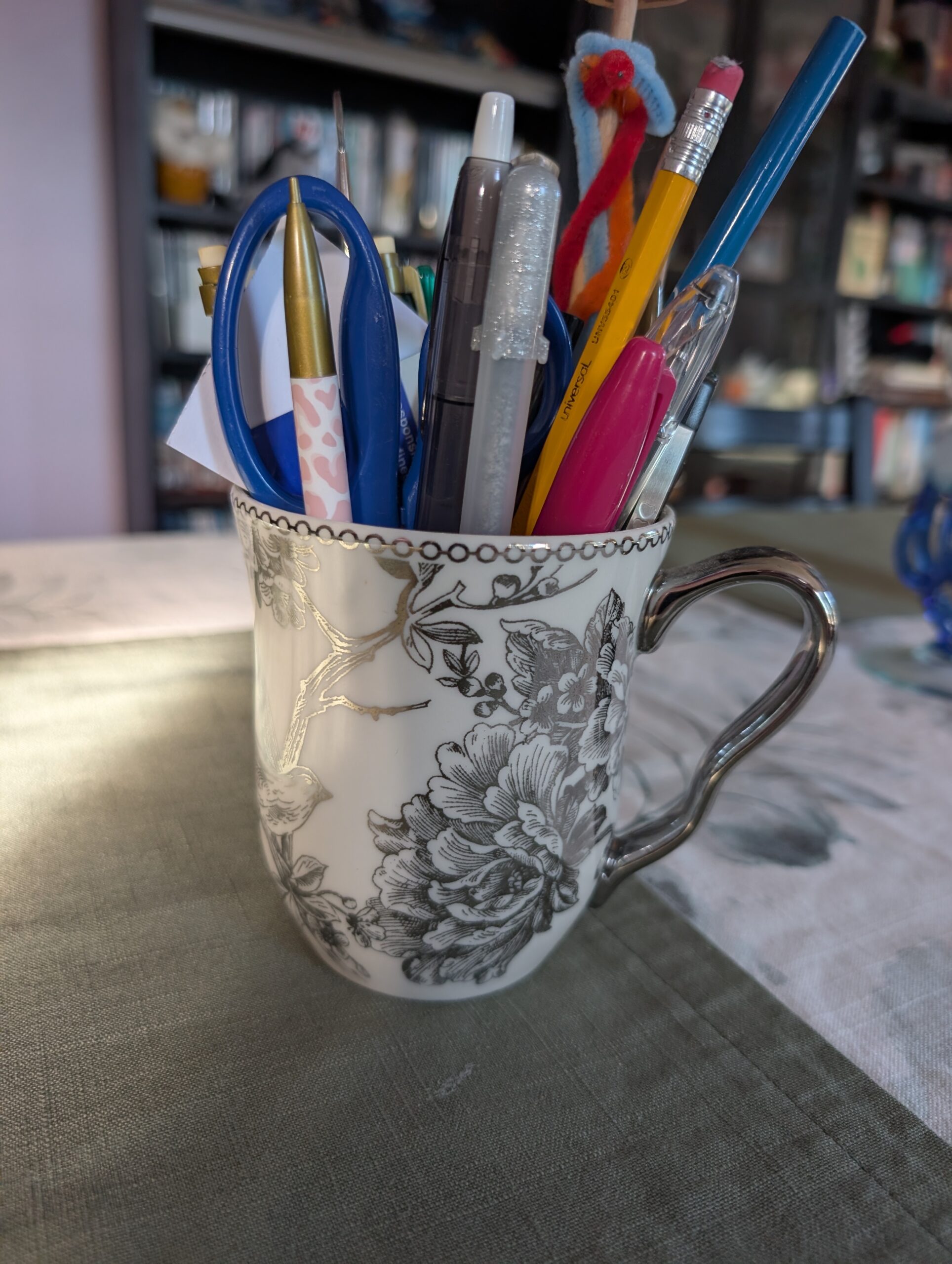
Pencil or Pen?

Writing Implements

Something written in pencil can be erased, making it easier to correct mistakes or remove a foundational sketch once it’s been inked. Something written in pen shows up more clearly on the page and cannot easily be removed. There are advantages to both. I used pencils a lot more than pens from kindergarten through high school. In college, it was 50-50. In graduate school, I favored pens – not because I liked them better, but because there were very few pencil sharpeners on campus.

These days, I’m back to the 50-50 ratio. Pens are for cards, official signatures, and crosswords; pencils are for grocery lists, brainstorming, and daily math. If I’m drawing Celtic knots, I use both. Pencils are for letters and figures that are transitory, that I might need to change and adapt; ink is for the more permanent words and images.

It’s rare that I cannot quickly and easily choose between pencils and pens for a given task. I can’t say the same in the larger, existential sense. There are times when I mistake what is transitory – what needs to be flexible and changeable – for what is permanent. There are times when I mistake the permanent – what is foundational – for what is short-term. Both are necessary and life-giving. Wisdom is knowing which one is which. Wisdom is knowing they are not interchangeable.