Category Archives: observation

Narrated

Markus Zusack’s The Book Thief is a great read for many reasons – it’s a different perspective on the horrors of war as lived out in World War II Germany, it’s centered on an orphan girl, and the street she lives on is named Heaven (Himmel). The most interesting part is the narrator who tells the tale: Death.

Death notices Liesel Meminger when she steals a copy of The Gravedigger’s Handbook (after her toddler brother died). What is a young girl going to do with a book like that? Then Death notices as Liesel steals more books throughout her childhood – one from a bonfire burning books outlawed by the Nazis, and several from the library of the mayor’s wife. Death notices Liesel because of the thefts, but then because of her life. Why steal books, and why steal books that aren’t the usual fare read by young girls?

I’m not advocating book thievery, but there’s something to grabbing onto anything that speaks of ages/places/people/professions/ideas beyond what daily life and expectations bring. In dark times, when fear robs people of their basic humanity, stealing a little of that back seems a daring and justified act. Death, largely uninterested in how humans live, noticed and found something worthwhile in it, something that revealed a life truly lived.

What marks the difference between existing for a number of years and truly living those years? Philosophy and religion have pondered and expounded on this question. God, self, neighbor. Love. Hope. Faith that things can be better – and working toward that better. Perhaps stealing a book or two…

Dad’s Life and Death Lessons

William Orpheus Smith died a couple months short of his seventy-fifth birthday. I was with him when he left this life behind, the man who gave me and my siblings life and a place and community we called home and family. He left behind a wife, four children, five grandchildren, a great-grandchild, a couple of dogs, and all his paperwork in order.

He was the son of an alcoholic who didn’t hand on that addiction. He made home a calm and safe place. He found the world an interesting place, taking advantage of his many trips abroad (U.S. Navy) to attend an opera, admire frescoes, and volunteer at the excavation of Pompeii.

He wasn’t good at making light conversation or expressing his emotions, except when matters of life and death were involved. He rarely shared his inner thoughts and held on to many of the prejudices that came with growing up in a poor New Hampshire town.

When the treatments stopped working and the hospice nurse came to discuss upcoming needs for walkers and pain management on that Friday morning, he turned from facing life to welcoming death. Eighty-seven hours later, he stopped breathing.

The life lesson I learned: hold fast to this extraordinary life.

The death lesson I learned: let life go when it’s time, and embrace the mystery beyond it.

Thanks, Dad.

April 24, 1981, Rick Springfield (Success Hasn’t Spoiled Me Yet)

Inertia

A busy couple of weeks and some dismal weather has interrupted my usual outdoor activity. I haven’t walked the half mile to the post office – or the half mile to the grocery and drug stores. I’ve caught up on some paperwork and correspondence, and read a couple of books. These are all good things, but all sedentary. Even though I value my outdoor time, I find that spending too much time parked on the couch leads to more time parked on the couch.The laws of physics apply to me: my body at rest tends to stay at rest.

Why is it that my life balance is so easily knocked over? It’s not as if I’m avoiding things I don’t like – I’m avoiding things I love because I’ve gotten used to not doing them. And it’s not just physical activity. If I skip my prayer time, my writing time, my connecting with friends and family time, it’s easy to drop them from my life pattern. It requires intention to start up again.

If I grow into my larger self, perhaps this will change. But, I haven’t achieved personal perfection yet. I’m still a work in progress, and it’s still work to return to a more balanced life. How about you?

Turbulence

Lack of sleep, an early boarding time, and ninety minutes of turbulence put a twinge in my lower back. A bumpy second flight, and the car trip home turned a twinge into real lower back pain: I Advil’ed up and avoided bending and lifting. Continued stretching, a heating pad, and an adjustment from a chiropractor had my back feeling better – not back to normal, but on its way.

It’s not the first time I’ve had lower back pain, and airplane turbulence isn’t the only reason for it. Stress, grief, exhaustion, and a lack of physical activity can lock my spine in a vise grip. Everything I usually do is affected until restorative sleep and gentle exercise loosen things up. I’m forced to put much of life on hold, and left to contemplate how my own actions and inactions had a major role in my sorry state. Then I get around to asking the big question: 

What needs to change?

I have no control over turbulence on a flight. I do have control over whatever internal turbulence is jolting my emotional life. When I forget this truth, a pain in the back shows up to remind me.

What’s On the Inside

Filler Stones

When my steps were built in the 1950’s, these rocks were used to fill the center. Over the decades, these rocks pushed on the brick stairs, weakening them until the mortar failed and they broke into pieces. The demise of the stairs began at their construction.

Looking at that huge pile of rocks makes me wonder: what’s inside of me that might be causing damage, pushing my inner life apart? Anger. Resentment. Disappointment. Jealousy. All these are inside me as surely as Joy, Gladness, Satisfaction, and Admiration are. Unlike the steps, I have a choice in what fills me, in what I retain inside myself.

Turns out, Mister Rogers was right: it’s what’s on the inside that counts – of me and of a set of stairs. Will I choose what is life-giving, or what will break me?

Tiny Mister Rogers

Connected

Laying the Granite Treads

The concrete pad was laid, an extra step constructed, then the bricks and cinderblocks put in place. All that was left was the treads. Because brick and granite priced out the same (bricks a cheaper material with a higher labor cost, granite a more expensive material with lower labor cost), we went with the granite. The eight pieces of granite used were beautiful, but heavy. Getting them to lay flat and aligned was quite a task. The seams were mortared, then it was just a matter of time for them to set. A day later, it was just a quick rinse with a hose to finish the job.

New, Safe, Welcoming

I doubt many people will pay much attention to the new steps. They aren’t remarkably different from the old ones. But noticed or not, they are an integral part of how we live and welcome the world into our home – and how we go out into that world. We are connected again, for our goings out and our comings in. And that is a gift.

In the next couple of years, we’ll take on the walkway. That will require skill beyond me or my husband, so our mason will be back. Sometimes, we need someone else to help connect us to the world outside the door – even if few visitors will ever notice the skill and effort that connection required.

What is important and necessary isn’t always obvious. Thank you, Brett Alden, for your work.

Work In Progress

Necessary Supplies

The front steps finally gave up after seventy years of loyal service. They were falling apart, listing to the right, with one step separating from another. Beyond repair, they were removed Wednesday morning.

It’s important, this set of stairs that connects home to the world. It needs to be solid, not too slippery when rain and ice fall, and it needs to look like it belongs on the front of this 1950’s Cape.

It’s a lot of work, this clearing out what is no longer working, this replacing connections. It requires time and effort, and no small amount of skill. And it won’t last forever.

That sounds a lot like life…let’s take a look…

[Part of the Work In Progress series. Click the tab above for more information.]

Point of Reference

Let’s begin with a point. Add a second point and we can connect them with a line. Add a third that doesn’t sit on the line and we’ll end up with a triangle when we connect them. Point, line, plane. Non-dimensional, one dimensional, two dimensional. These ideas are the foundation of geometry a la Euclid. There’s really no proof that a point, a line, and a plane exist, but assuming that they do makes all kinds of things possible – and makes it a lot easier to frame out a door, hang a picture, and build a skyscraper.

So what does this have to do with Lent, a time of letting go of what doesn’t matter and loving what does? What is the point, the line, and the plane – the foundation – in all this? Here are the three my faith life assumes:

Point: God is the source of all that is (seen and unseen)

Line: Jesus of Nazareth is God-With-Us

Plane: We are neither God nor Jesus, but we are related to both

Point, line, plane: God, Jesus, Us

And when I note the difference between you and me, when we become neighbors in this space, life goes from a two-dimensional idea to a three dimensional grace-filled reality.

Path, and perspective

[Note: Euclid was a mathematician in Ancient Greece, circa 300b.c. The foundations of geometry can be found in his Elements, as well as in other works.

Also Note: Euclidean geometry isn’t the only geometry. For space/time issues, Euclid and his assumptions give way to other foundations…]

Town Hall

Town Hall. It’s where residents go to pay taxes, register a dog, or talk with the town manager. But every Saturday, it becomes the backdrop for something with far-reaching intent and effect. On that empty sidewalk, hundreds gather for an hour to protest the inhumane policies enacted and carried out by federal agencies intent on frightening the citizens of this democracy into silence. Illegal searches and detentions; masked agents carrying weapons into peaceful streets and communities; smear campaigns against victims who died at the hands of undertrained and overzealous ICE agents. People make signs objecting to all of it. All ages from all neighborhoods gather and stand together.

It may not seem like a very effective way to stop the violations and the violence happening just down the street and throughout the country. But just such tactics have worked wonders in the past – in occupied India as well as in our own country a few decades back. Shedding light on actions that harm and holding the government and individual people accountable for their actions work far better in the long run than returning violence for violence. For true change that lasts, a better and more peaceful world is a goal achieved by better and more peaceful means.

So hold a sign, call a representative, attend a vigil. It may seem like it’s a waste of time, or at best a silly symbolic action. But it can be transformed into so much more…

But God chose what is foolish in the world to shame the wise; God chose what is weak in the world to shame the strong. ICor. 1:27, NRSV

High Water

Robert Kegan

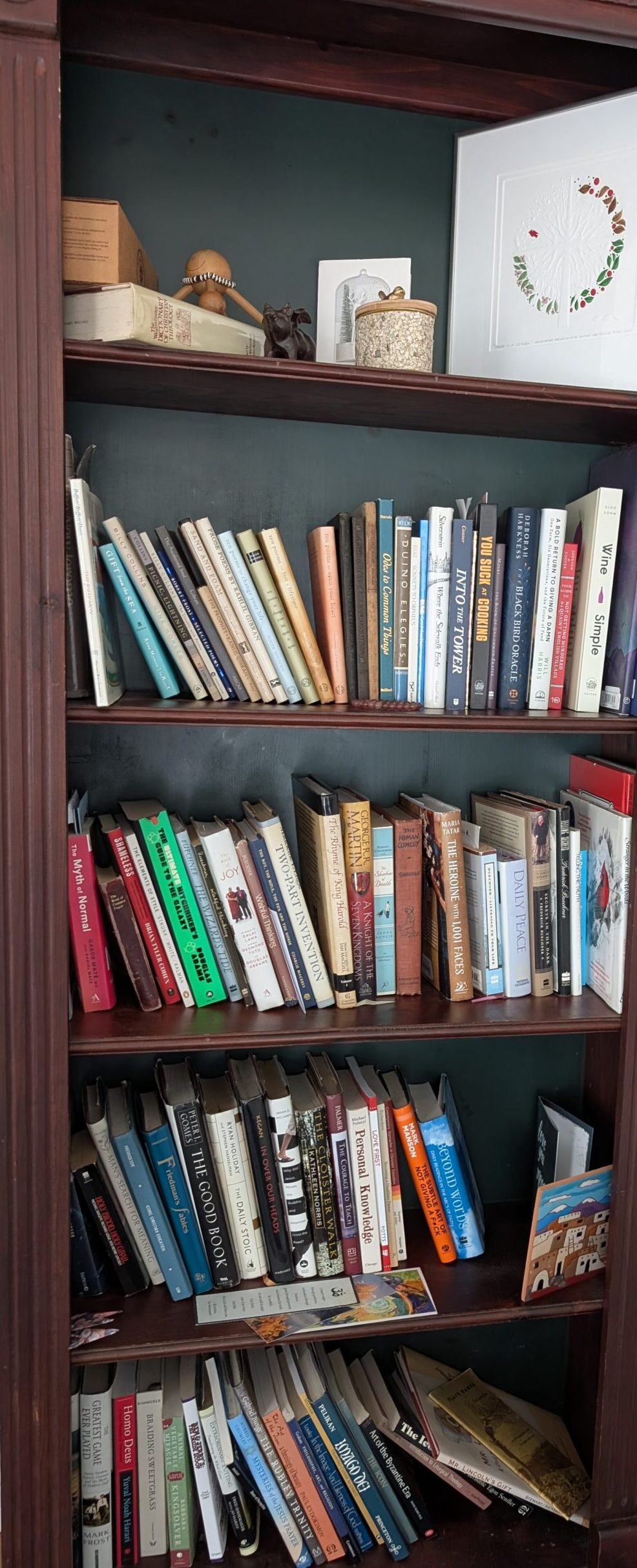
These days, there’s so much coming at us from all sides. The noise of media never stops; it comes with a chirp on our phones, with the never-ending ticker tape running across the bottom of the television screen, with flashing billboards that cram two or three ads in the time it takes to drive past them on our morning commutes. Where is the high ground, the safe space that offers rescue and rest from the deafening storm of modern life?

Modern life isn’t providing a multitude of ideas akin to brainstorming. The pace of it is too rapid to be absorbed or digested. The response is to hunker down, to weather it.

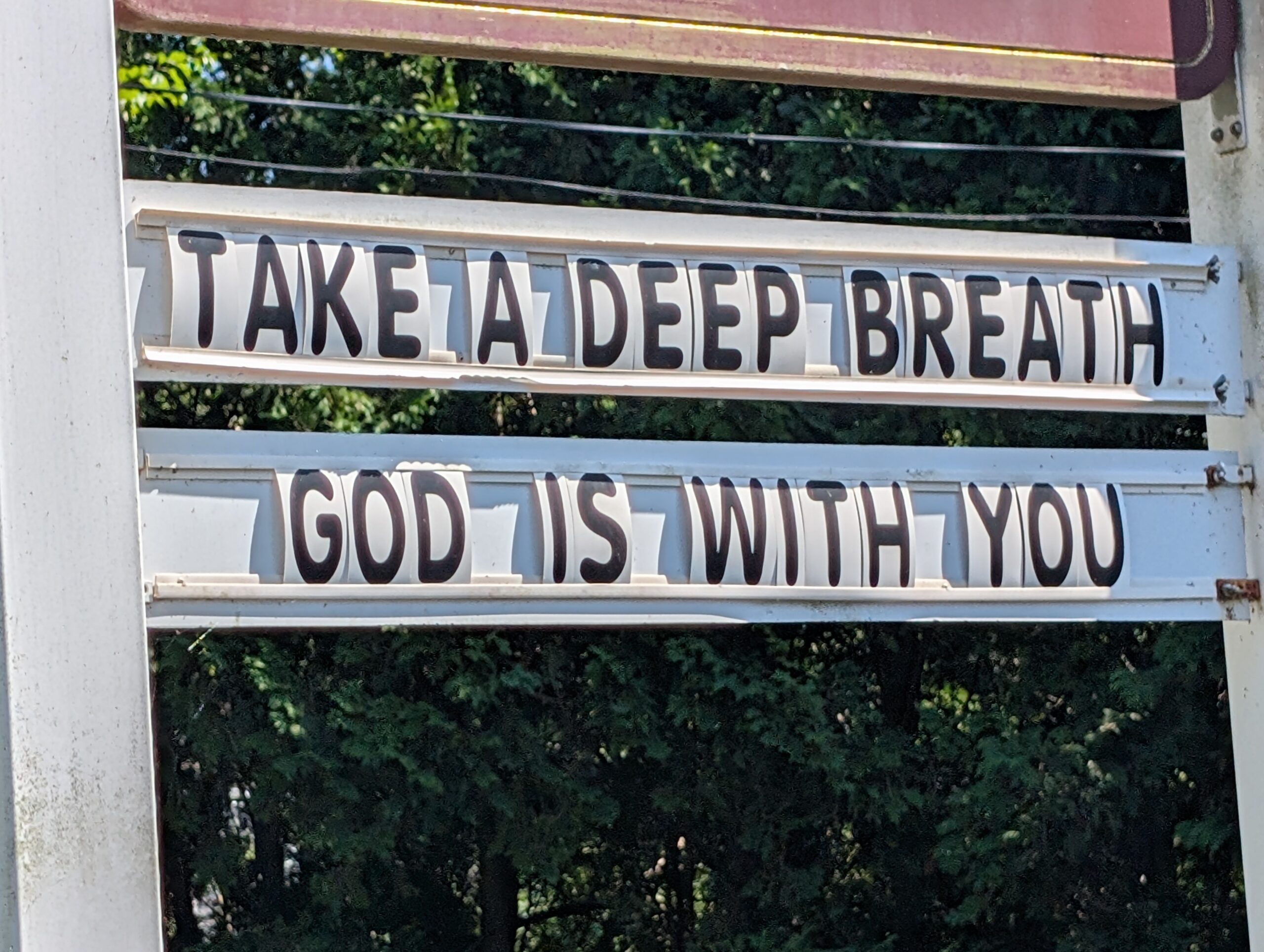
So what can we do, how do we aim for more than surviving this modern life? The answers are ancient: breathe. center. cultivate silence.

Will we miss out on some interesting things by doing these things? Absolutely.

Will it save us from drowning in the maelstrom of things tearing us apart? We’ll only know by trying…

[Robert Kegan wrote this book in the 1990’s. His main point: it isn’t enough to be a good person and a skilled, dedicated worker to live a successful life. Modern life demands critical thinking skills never required in past decades. And our society is not fostering those skills.]