Category Archives: Meditation

Things Handed Down

Were he still alive, my father would be 76 years old today. With his birthday being so close to Thanksgiving, it’s a simple thing for me to remember him with deepest thanks. Because of him, I am a part of a loving family. I didn’t choose them and they didn’t choose me, but this unplanned life has been nothing but a blessing.

My mother is 76 years old. Because of her, I am a part of a loving family. I give thanks for such a blessing every day.

The same can be said of all those who came before me, unfamiliar names on a family tree that handed down my particular genetic pattern. How can I be anything but thankful  – to those with me, to those who came before me, and to the God who made us all?

Marc Cohn, The Things We’ve Handed Down, The Very Best of Marc Cohn, 2005

Big Blue Marble

The Earth’s a big blue marble when you see it from up there

The sun and moon declare her beauty’s very rare.

Big Blue Marble theme song

It’s a little over two miles from where we parked to the end of canal. With sunny skies and a brisk breeze at our backs, we set out for the farthest point on the Cape Cod Canal path. A few cyclists, the odd fisherman, and a handful of other walkers shared this extraordinary place and time with us.

A cormorant fanned her wings, standing on a seaweed covered rock; seagulls caught updrafts, skillfully hovering in place. Almost invisible sparrows emerged from the sea grass just a few feet away from us. We left the Sagamore bridge at a bend in the path before we could see the beacon that marked the path’s end. Spiderwebs filled the spaces between the breakwater rocks, sheltered from the ocean currents, blowing sands, and gusting wind.

We spoke a few words out on the breakwater, sharing a few amazing particulars in the vast beauty of ocean, sky, and land. Most of the time, we listened to the wind and water, two small creatures keeping silent before the mystery of nature.

On the walk back, we gathered up the pieces of our everyday life we’d left along the way. Lunch ideas, guesses on when we would get back to the car, and afternoon plans were reclaimed as the bridge and traffic sounds reappeared. The couple of hours spent walking settled into place, a piece of the day among other pieces. Time moved us along its path.

But our walk wasn’t just a way to get from one point to another, and it wasn’t just a photo opportunity – nothing so common as either of these. When the blindness that prevents us from seeing the beauty of this place is healed, when we know we are a part of Life’s story, and when we bow down in gratitude for our small and fleeting part in it? It’s a walk in Eden and a glimpse of heaven.

I am grateful beyond words.

How to begin?

Mickey Cray had been out of work ever since a dead iguana fell from a palm tree and hit him on the head…

…”Me, too, Lucille.”

[Carl Hiaasen, Chomp, (New York: Alfred A. Knopf), 2012, pp. 1, 290]

Like real life, it’s full of secrets and sacrifice. Money and fame change people, but so do kindness and courage. The second rate reality star gets chomped by a long list of critters and insects and stumbles into helpfulness. A family faces medical bills and two young people become friends for life. Not too dark, not to sweet.

There’s an art to starting a story, and how we begin telling our own tales can intrigue or bore ourselves and others. If we think our lives are dull, we will use flat words written with broken pencils. If we see our lives as adventures, a dead iguana may start the whole thing moving. This goes double for our faith stories: how we feel about them will come across in how we tell them to ourselves and others. Are there a few dead iguanas, flashes of light and thunder, brave children foiling evil plots, something that we can’t quite tame that makes the heart beat? I certainly hope so!

How will you begin your story? How will you tell me all about your sacred life? I wonder. There’s no real beginning and no real end, but there are always places to start and specific chapters to end. If I were telling you my story, I’d begin like this:

Is an eighty-six year old man strong enough to get my head above water? I hope so, because Pastor Chase is taking a long time, and this is only the first of three dunks in my Merrymeeting Lake baptism…

A Worded Life

Rain fell that night, a fine, whispering rain…

…As Mo had said, writing stories is a kind of magic, too.

[Funke, Cornelia; Inkheart (New York: Scholastic Inc), 2003, pp. 1, 534]

Meggie’s begins with a stranger’s visit on a rainy night. It ends with Meggie’s decision to create new worlds with paper and ink, writing places for readers to visit. In between these lines, storytellers read villains and fairies out of their book worlds into ours through the magic of their voices. But there’s a catch: for everything that comes out of a book, something or someone leaves behind our world to enter it. Behind the words, through the pages and in the chapters, a rich life awaits – a place that some call home and others want to visit. So real is this story world that Meggie thinks that “perhaps there really was something behind the printed story, a world that changed every day just like this one.” (p.529)

I’ve spent thousands of hours in Middle Earth, the Hundred Acre Woods, Inkworld, Hogwarts, Tara, and countless versions of London, New York, and Maine. The ability to create a new reality on the page that changes real life is a powerful gift.

The words I read to myself can change who I am. The words I read to others can do the same, feeding the imaginations of adults and forming a child’s ability to reason. They can reveal marvelous possibilities for tomorrow or they can damage heart and soul. It’s vital to choose the stories I tell wisely.

The same can be said of scripture. It’s a world of love, pain, loss, ignorance, and miracles. But it’s not really just a collection of stories. It is a doorway into the biggest world possible: the one God created, nurtures, and enters to meet us. Not just words on a page, but the Word that created all possible worlds – most especially the beloved cosmos we all call home.

Also many other things…

In the beginning was the Word, and the Word was with God, and the Word was God…

But there are also many other things that Jesus did; if every one of them were written down, I suppose the world itself could not contain the books that would be written. John 1:1, 21:25

Whenever I teach, I end the last class with John’s final words about Jesus. No matter the age and stage of the learners, how short or long the class ran or subject studied, these words have the last word. It’s a beautiful way to end a gospel or close a class, this truth.

Jesus did so much that I never saw or heard about, bringing the grace of God to unknown people and forgotten places. This sentence reminds me that I will never know or appreciate all that God-With-Us did when he walked this earth.

Paired with the opening words, John takes me from God-before-creation to God-in-Jesus. That’s a cosmic trip lasting billions of years, spanning unimaginable distances. The world that holds me could not contain the books that could be written about the beginning of everything – much too much for words to convey.

These words were written after Easter, after Jesus sent the Spirit to be God-within-us, God-walking-with-us, God-everywhere-around-us. Jesus is now with me through the Spirit. Of course the world itself could not contain the books that would be written about Jesus: the story continues to unfold in me, in you, in all that is, and in all that will be. Once again, much too much for words to convey. Isn’t that extraordinary? Isn’t that wonderful?

Photo on 2015-07-13 at 10.10

The Bad Beginning of a Long Journey

If you are interested in stories with happy endings, you would be better off reading some other book…

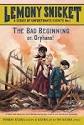
The car drove farther and farther away, until Justice Strauss was merely a speck in the darkness, and it seemed to the children that they were moving in an aberrant – the word “aberrant” here means “very, very wrong, and causing much grief” – direction. (Lemony Snicket, A Series of Unfortunate Events, The Bad Beginning (New York, NY: Harpercollins publishers, 1999)
search

It’s the story of the Baudelaire orphans trying to survive the fiendish plots of Count Olaf with life, health, and inheritance intact. As the three children get older, they grow from seeing everyone as either all good or all evil to seeing everyone (themselves included) as a mixture of light and dark, good and evil. Along the way, some good people make costly mistakes and a few villains find the courage to do what’s right. There is a lot of gray, and not all the questions are answered.

Like most of us, the Baudelaire children gradually come to realize that not everyone is willing to do the right thing. Some lack courage, others can’t figure out what the right thing is, and still others prefer worldly gain over personal sacrifice. Not everything gets resolved, and the three children don’t get a clear happy ending. What they get are moments of decision and the strength to accept the consequences of their actions. They make mistakes, they cause pain, and they grow up enough to withhold snap judgements about the actions of others.

At the end of the series, the children face an uncertain future together, willing to help others even at their own cost. They accept the world for all the hurts it has brought, and they accept their own inability to create a perfectly happy ending for everyone they love.

There isn’t anything particularly religious in this book or the twelve others in the series, but moving from a child’s simplistic view of people as all good or all bad to a more nuanced perspective is a sure sign of maturity. If such maturity evokes compassion for self and others, it is a journey of faith. If it ends in the rigid condemnation of others and personal despair, it’s a glimpse of hell.

Thank you, Lemony Snicket, for the ethics lesson, and for all the big and small words that took me on the journey.

Make Time To Pray

They are on bumper stickers and church message boards everywhere. But last night I saw them shining down from another place: Collision and Auto Repair of Carver. I pass the sign at least once a week. I am always thankful for the reminder, but until last night I hadn’t connected the business with an exhortation to pray.

I’ve seen good death and painful death working in a hospital. I’ve seen pain and suffering endured with and without grace. I’ve stopped at a few accidents to offer pastoral care. For doctors, nurses, EMT’s, chaplains it’s all part of the job. But it’s also part of the job for those who tow the cars away from the accident, and for those who repair them. Why this never occurred to me until last night, I cannot say.

To offer up a prayer, and ask that others do the same. From people who see the wreckage and work to repair it, this is no glib request. Life and death come to their doorstep every day. Lord bless them as they have blessed me with wise words and deep commitment.

Fortune Cookie Truth

images-1

I am not naturally honest. I am so sometimes by chance.

Fortune Cookie, Way Ho’s

I pulled this fortune out of its cookie a couple of years back. It’s been living in the ceramic bowl that holds my flash drives ever since. Sometimes it strikes me funny when I read it, other times it strikes a little too close to home. In either case, it’s true.

I’m not dishonest in the sense of lying or cheating; I do my best to act in good faith. But I doubt most people behind me in the grocery line have any clue who I am, and I don’t have any idea who they are. I don’t attempt to connect with everyone in a meaningful way. I’m not intentionally avoiding anyone, but an honest encounter takes courage, trust, and energy. It’s exhausting to swim beyond the socially acceptable shallow waters and head for the depths. If I saw every person for who he or she truly is, a sacred child of God, I doubt I’d get through the morning without tears of joy and compassion. If I allowed even strangers to see in my faulty life the hand of God, what might come of it? Such encounters don’t happen very often outside the small circle of family and friends.

But every once in a while, a random encounter as I open my post office box or return my grocery cart. A glance at the man with a red beard or a quick hello with the spiky haired girl stuns me with a glimpse of true holiness. By chance, I have eyes to see and ears to hear. I see my life and this world for what they are: sacred, blessed, and much more than enough.

I Had A Life, But My Job Ate It

It was on the Jeep in front of me, read at a red light on Cranberry Highway. White letters on a blue background, on the bottom of the back door. When I saw it, I was thinking about the calls and emails I had to make today – trustee matters, first steps in a new library/school project, reminders for tomorrow’s meeting.

Earlier in the drive, it was thoughts of tomorrow’s Bible study: Hannah’s story. Before that, writing the mental list of things that need to be done in the learning garden before a service day brings a dozen or more high school learners into it.

I don’t think any of these tasks eat away at my life. I am happy with the time I spend on and at work. It adds something to my life, and it’s a way to serve God and neighbor. But I don’t have a forty hour a week job, or a fifty or sixty hour a week job. Or two jobs to keep a roof overhead. I have the time and energy to work for what I value rather than what pays bills. It has the disadvantage of no money, but the great blessing of time well spent.

If I were to put this bumper sticker on my car, I’d have to change it:

I Had A Job, But My Life Ate It

Fairy Tale Life

Confused and sad, he gazed with sick eyes into the many angry, disturbed, and spiteful faces, and in each one of them, he saw a hidden charm and a spark of affection that glimmered from beneath the hate and distortion. All these people had loved him at one time, and he had not loved any of them. Now he begged their forgiveness and sought to remember something good about each one of them.
Herman Hesse, “Augustus,” The Fairy Tales of Hermann Hesse, Jack Zipes, trans; New York: Bantam Books, 1995, p. 95

It’s “hell hath no fury” from the perspective of the scorner, not the scorned. But now Augustus is aware of the damage he’s done – the turning point in a fairy tale about a mother’s anxious wish, a godfather’s patience, and the cost of becoming pure of heart in a life of excess wealth, power, and ease. If you have the time for this twenty-six page tale, I hope you read it.

This is Hesse’s answer, or at least one of his answers, to what happens when every wish is granted, nothing must be earned, and there are no consequences to cruel, hurtful actions. It begins when Augustus’ mother says, “I wish that everyone will have to love you.”
Augustus grows up to be a selfish, cruel, and desperately lonely man because of this wish. Surrounded by everything he could possible want, he enjoys and appreciates none of it. Beloved by everyone, he feels no love. He lives the opposite of Saint Francis’ prayer: is it any wonder Augustus’ life is a living hell?

Love isn’t a fairy tale wish. It’s the face of God and the birthright of every living thing. It cannot be killed and it’s available in endless supply. But it’s only found in sharing with another – a person, animal, plant, whatever. Even in solitude, it’s shared with God. If Augustus’ mother had wished for her son to seek such love and offer such love to others, could his life be anything but splendid and holy?

If I seek such love and offer such love to others, could my life be anything but splendid and holy? Could yours?