Category Archives: Education

Tending

Love is not envious or boastful or arrogant or rude

I Cor. 13:4-5

I learned how to tend bar at twenty, mixing drinks at Dockside in Alton Bay when the owners weren’t around to do it. Most people ordered the typical: martini, sombrero, something-and-soda. It wasn’t until I worked at Cranberries in Dover that the drinks got complicated. Fortunately, the bartender who continued my training was a kind man and skilled teacher.

“If you don’t know how to make a drink, ask me. If I’m not here, ask the customer who ordered it. No one knows everything. Only a bad bartender is afraid to learn from others.”

I think the same is true about life in general, bad meaning insecure or unsure rather than a moral deficiency. Not knowing something isn’t shameful, it’s an opportunity to learn. Needing to acquire a particular skill isn’t a failure, just an inevitable part of being human. A willingness to ask questions, to learn from the wisdom and mistakes of others, and to be open to the complexity of the world are honorable qualities that enhance life. Learning and teaching, giving and receiving, are acts of love.

Envy and boasting, arrogance and rude behavior are the burden of the fearful. Feeling inadequate, they romanticize the lives of others (envy); feeling small, they make a shield from inflated accomplishments (boasting); feeling worthless, they project their inadequacy on others (arrogance); feeling insubstantial, they chip away at others by word and deed (rudeness). Giving and receiving love is what’s most needed and what’s constantly rejected. If perfect love casts out fear, fear throws love away with both hands.

Tending bar or living life, offer what you have and ask for help when you need it. God knows, no one is perfect and everyone is loved. Cheers.

Love is Kind

Love is patient, love is kind; one follows the other. Love that is patient chooses a world governed by compassion and care rather than convenience or expedience. Love that is kind honors the dignity of others, not because it’s the “right” response but because it’s the only response. Everything else is a refusal to respond, or a serious misunderstanding of the nature of self, life, and the universe. The kind look at others and see God. If they happen to be wise, they see God and others in the mirror as well…

Love is Kind

I Cor. 13:4

Love is Patient

Love is Patient

I Cor. 13:4, NRSV

 “Love is patient, but you’re not.” Carl Geores said these words to me and my husband, Dave. It’s the line I’ve never forgotten from the sermon he gave at our wedding. It crosses my mind quite often, almost twenty years after the white dress and tuxedo, champagne toast and cake event. Mostly because it’s true.

Patience isn’t so much a virtue or ability as it is a way of living in the world. It’s more to do with putting things in perspective than putting up with delay. Patience is knowing and appreciating the fact that the cosmos doesn’t run on my schedule; in other words, it’s knowing and accepting that I’m not the center of the universe – Thank God!

Patience is enjoying the interaction with others in this wonderful world. Patience is rejoicing over the personal plans that didn’t come to fruition – and knowing that something better did. It’s the still, small voice nudging me onto a better path, granting me a blessed life. It’s a lot quieter than noisy ambition or blaring insecurity, but it’s steady and strong enough to overcome both.

Today, patience comes in cat form, asking me to take a break from laundry and writing. Today, patience sits in my lap and purrs – happy I chose giving and receiving love over getting my blog piece written fifteen minutes earlier…


For more on this Quieting Life Noise series, see “About.”

Love: Beginning Thoughts

If I give away all my possessions,

and if I hand over my body so that I may boast,

but do not have love, 

I gain nothing.

(I Corinthians 13:3, NRSV)

What is this love that Paul is writing about? He’ll list its characteristics in the nine verses following this one – something to go through adjective by adjective. But here are a couple of thoughts for starters:

Love is meaning good things for another and sacrificing to bring those things into reality; it’s not an emotion (like and love are not the same) but a choice to act willingly for the good of another. It’s why loving neighbor and enemy is possible, even when liking them is not.

Love recognizes that people are not means to other ends – this includes ourselves. Jesus said that the scriptures boiled down to two commandments: 1) Love God, and 2) Love Neighbor as Self. Loving our neighbor is recognizing and honoring the sanctity of his or her life. Without this love, we may reduce our neighbor to a tool that helps us or a hindrance that frustrates us. Loving ourself is recognizing and taking responsibility for the sanctity of our own life. Without this love, sacrifice for others reduces us to mere tools for the benefit of others and we gain nothing.


Why would some choose not to love neighbor? Fear of sacrifice: not having enough left for self, losing equality with another.

Why would some choose not to love self? Fear of integrity: having more than enough for self and neighbor – claiming equality with another.

Deeper than consciousness is the longing to give love and a willingness to give it sacrificially. (James Loder, The Transforming Moment, Colorado Springs: Helmers & Howard, 1989, p.177)


Erosion

If I speak in the tongues of mortals and of angels, but do not have love,

I am a noisy gong or a clanging cymbal.

And if I have prophetic powers, and understand all mysteries

and all knowledge, and if I have all faith, 

so as to remove mountains, but do not have love,

I am nothing.

I Corinthians 13:1-2, NRSV)

(Paul wrote these words to those who gathered in Corinth in the name of Jesus Christ. There were debates about whose gifts were most valuable.)

There’s a drain pipe that carries rainwater from the Daffodil Hill to the Cocheco river over twenty feet below. It’s buried on the top and ends at river level a few hundred feet away. It’s supposed to be buried here, too, but the ground around the drainpipe has been eaten away by floodwaters. A wedge of land is gone, leaving a hole and the exposed pipe, making a hiding place for the frogs.

Seeing the hole from the yard above is tricky. The water eroded soil from the bottom up, leaving an overhanging layer of dirt only a few inches thick. There are plants growing on the edge, along with moss, making it hard to see where solid ground ends and the overhanging dirt shelf begins. At first glance, it all looks the same – the solid ground that supports the abundant life above and the dangerously thin dirt that cannot hold more than the lightest of plants. Without support, without terra firma, it will crumble, revealing the empty space beneath.

Is that what Paul was writing about? No matter what the gifts are, no matter what the talents or treasures, it all comes crashing down if there is no love beneath it. Without a grounding in love, everyday life will eat away at our talents and works, making a hole we may not even see until we’ve already fallen in. Nothing planted can thrive if the ground is hollowed out beneath it – and we are no different. Our outer lives can sustain nothing if we our inner lives are eroded, eaten away beneath the surface. One day, we wake up and think, “I am nothing.” All for lack of sustaining love.

How can we tell if our outer lives are planted in firm soil, or if they’re barely surviving in a few inches of dirt? We can pause, slow down, stand in one place. We can look and listen, feel the ground underneath our feet. Paying attention and being still give us a chance to take a closer look at all the things on life’s surface. Then we can answer two questions:

Is my life sustained by love, green and growing?

Is my life lived on a thin layer, lacking strong roots, barely hanging on?

Noisy Life

My neighbor had some tree limbs removed this morning. Family Tree Service did a fantastic job – branches came down with little fuss and no damage to people, plants, or property. When all the cut branches were gathered in the driveway, the chipper pulled up. For the next forty-five minutes, I heard nothing but the grinding of limbs into mulch. I ran the vacuum and couldn’t hear it; I moved boxes and my portable dishwasher without the usual creaks and rolls. My tea kettle at a boil couldn’t be heard. My two cats headed for the room farthest from the noise – they are wise about such things. When all the branches were gone, blessed quiet returned. Bird song, the rustling of leaves in the breeze, the gurgle of water filtering in the fish tank all returned. Not silence, but a sufficient and interesting quiet.

It’s not just wood chippers that bring unconquerable noise; schedules crowded beyond reason, cut-throat competitive practices at work or home, inordinate preoccupation with material or career success – all these things can unite to push life to decibels capable of drowning out the sufficient and interesting quiet required to hear God and neighbor. Granted, it’s usually noise I’ve created out of societal expectations, personal doubt, and selfishness. The big question: how do I turn down the volume of life noise?

August will be about just that – turning down the volume that drowns out peace and quiet. Scripture, prayer, faith practices, and trust can help turn the knob. I’ll start with I Corinthians 13…

Elm Street

Across from Park Street is Elm Street, the last one I’ll describe on this blog. The train tracks cross here. The Old Company Store is on the left, just past Fearing Tavern Museum. The old Tremont Nail Company buildings sit on the right, town property yet to be repurposed. Just past that is the bridge, closed down for repairs at the moment. The water on the left side of the bridge is several feet higher than on the right. There’s a ladder for fish to climb, bypassing the gates that dam the water. The remains of a water wheel are still attached to the nail factory, a symbol of power and the passage of time.

Elm street needs work. Its pavement is bumpy from years of frost heaves and patching; the sidewalk is narrow, cracked, and sandy. It looks and feels like a neglected space, well past its prime and not yet reclaimed for future purposes. Except for The Old Company Store.

Over fifteen years ago, two sisters bought what once was the company store for the nail factory. They kept the wood floors inside and the shingles outside. A ton of cleaning, dreaming, and great attention to detail later, this store is one of the most successful businesses in town. Food, music, books, housewares, gifts of all sorts, special events – you can find it all here. The owners and staff are friendly and knowledgeable, the prices are more than reasonable, and shoppers find things here that malls just don’t offer. They support local charities and happenings. In recent years, they repaired and bricked the sidewalk from the edge of the bridge to a bit past their parking area. There are tubs of flowers and decorations for holidays. The love they have for this town and their business is evident in everything they do and everything I see here. Without a doubt, Wareham is a better place because The Old Company Store lives here.

Elm Street is a walk into possibility and neglect. The life of a town can go either way, and usually does. The difference is often connected to dreams and hard work, and an ongoing trust that nothing is beyond redemption. That’s a lesson I need to learn over and over again.


Question: What lessons are found on the streets of your town?

Main Street

At the bottom of Cedar Street, I can see the beginning of Main Street to the right – a few hundred yards back at Warr Avenue. But I go the other way, walking past Tobey Hospital into town.The Agawam river meets salt water here at Besse Park, hosting swans and herons, fish and fishers. Train tracks run between Main Street and the river, disappearing behind downtown businesses just a few yards past the hospital.

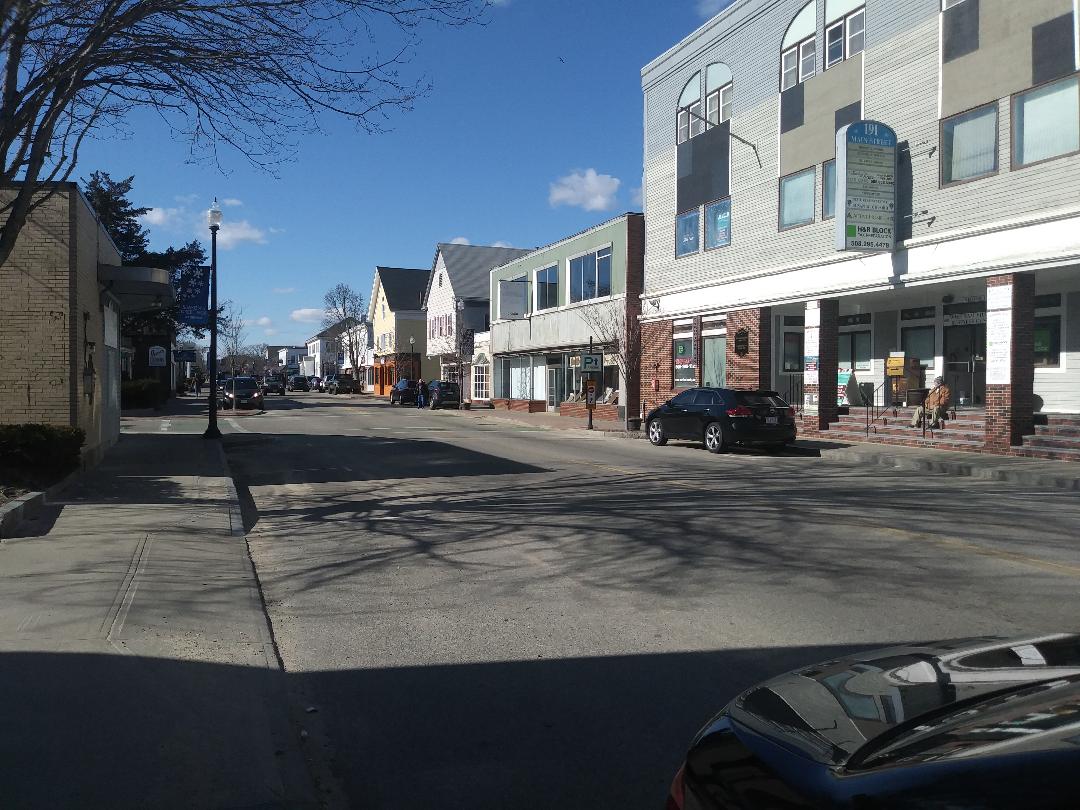
Wareham village, the town center, looks good. New sidewalks and lights, gardens and trees make it a welcoming place – a federally funded facelift that encourages tourists and residents alike to spend time here. Riverside Cafe serves a tasty breakfast at a low price, Twigs & Tides offers the wares of local artists, Minerva’s has great pizza, and the post office staff is friendly and efficient. Bait and tackle, dog grooming, legal advice, haircuts, chiropractic adjustment, and gas for the car are all here in this half mile space.

The odd thing about Main Street: the businesses on the right side of the street, closest to the river, face away from the water. Changing tides and graceful wildlife are blocked from view by walls, storage rooms, and dumpsters. Riverside Cafe’s customers can see the insurance office across the street, but not the river. The only exception: Cafe Soleil. When it was Merchant’s Way Cafe years back, the owners built the dining room facing the river.

I love this downtown, but I see in it a cautionary tale. For convenience and the loveliness of human communal space, the wild world that feeds human bodies and souls is often ignored. The Agawam has its own life, far removed from human needs and preferences. It supplies fish and oysters, and destroys homes and streets when it floods. This tidal area serves a much larger purpose than feeding and entertaining me and the rest of the human family. It is fearfully and wonderfully made by and for the glory of God – not for the glory and convenience of humanity. When I walk on Main Street, I wonder if these buildings turn away from the river to avoid facing this.

Question: What can you see in the heart of your town?

For more information on this series of writings, see Walking Wareham on the “About” page.

High Street: Gibbs/Marion Road to Cedar Street

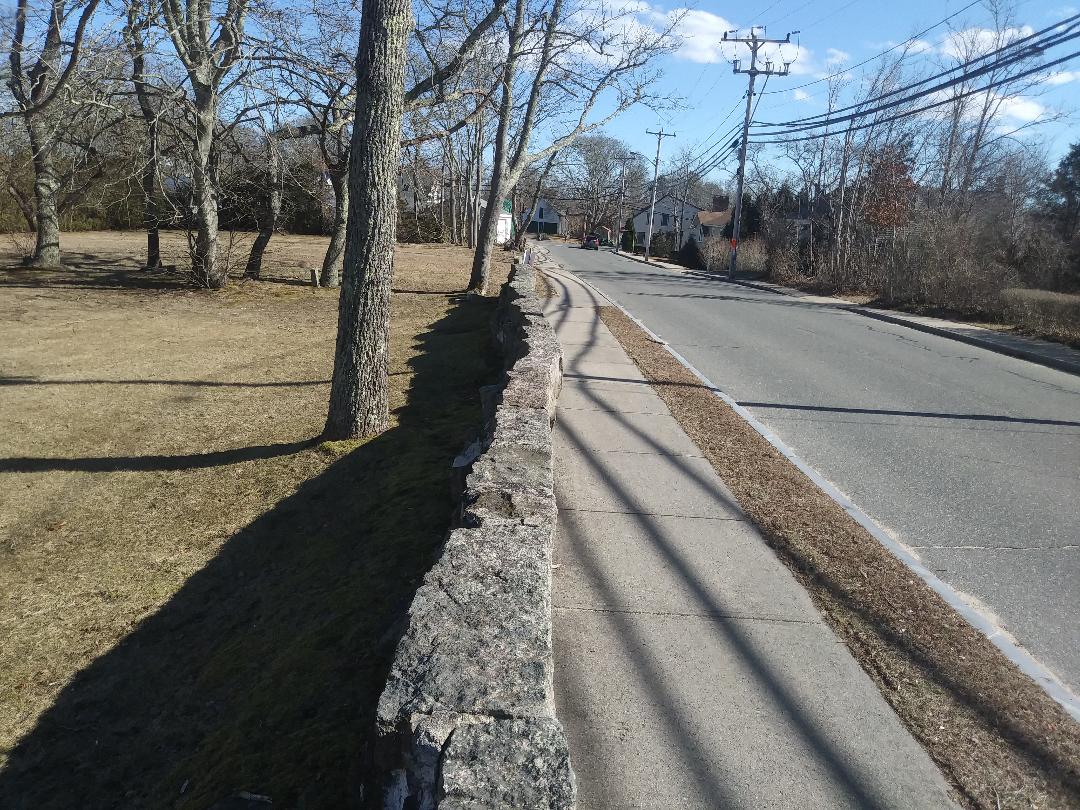
Walking up from the light is a literal statement – the street slopes upward, coming to its apex just beyond Tobey Hospital. Past the light on the left is Ladner Street, with a garden so lovely it refreshes the soul. Sawyer Street cuts in on the left halfway up, with Kennedy Street one house up from it on the right side. Half the distance again, and Center Street is on the left. Saint Patrick’s Church and Church of the Good Shepherd (the bullet hole in its spire cross is a story for another time) are on the right side. Tobey hospital comes next, on the left. High street dead ends a few hundred feet later, with a right or left turn onto Cedar Street. With houses lining its sides, two churches and a hospital, it offers the full range of human experience – a living novel. But those stories are for another day. Today, it’s the walls.

The first is a three layer wooden retaining wall, just eight or so inches high. It hugs the yard of a white colonial on the corner of Chapel and High. Next, fieldstone walls on either side, forty inches high with taller columns marking the driveways.

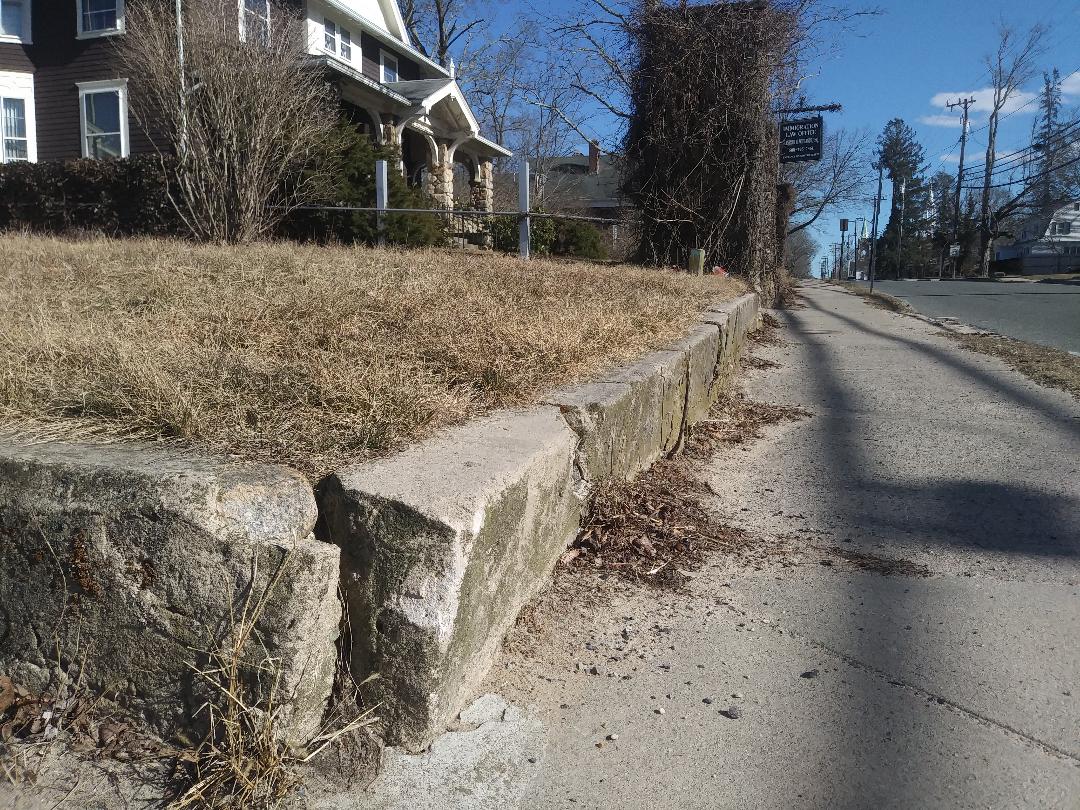
At Sawyer Street, a nine inch cement retaining wall in front of Wiegandt Immigration Law. Almost across from it, a two foot fieldstone wall with electric lanterns lighting the front walkway. Close to the end, a waist high stacked stone wall separates the street from Tobey hospital’s parking lot.

I’ve loved walls my whole life, walking countless ones for untold hours and holding the hands of many little ones as they learned to do the same. I’ve fallen off a few – gravity at work. Balancing on the narrow ones, skipping along the wide ones, walls offer a new perspective. Young children grow taller than their parents, getting a foretaste of their grown-up height. Adults can see farther in all directions than is possible on the ground. Thin ones are an exercise in balance and trust, wide ones are steady as solid ground.

I don’t walk on them so much as walk beside them these days, except the one at Sawyer Street; the owners are friends who won’t mind my trespassing. I still love them, though. They remind me that 1) Adventure and fresh perspective can be found by anyone, but not without personal effort and some risk; 2) Learning to walk on walls is easier with a helping hand; and 3) At some point, it’s time to be the helping hand.

High Street: Gibbs Ave to Chapel/Marion Road

It’s over a mile long, parallel to Main Street, and I find myself on it almost every day. It begins on Gibbs Avenue, with the blue and white hospital sign pointing the way. Mulberry Bed & Breakfast and Bladez Hair Salon are on its left side, workplaces and living spaces to their owners. A quarter mile down, Highland Avenue comes in on the right. Morse Avenue  comes next, its sign obscured by the grand Catalpa on its corner. Another few hundred yards along comes the light at Chapel Street/Marion Road. It’s as far as I’ll walk today.

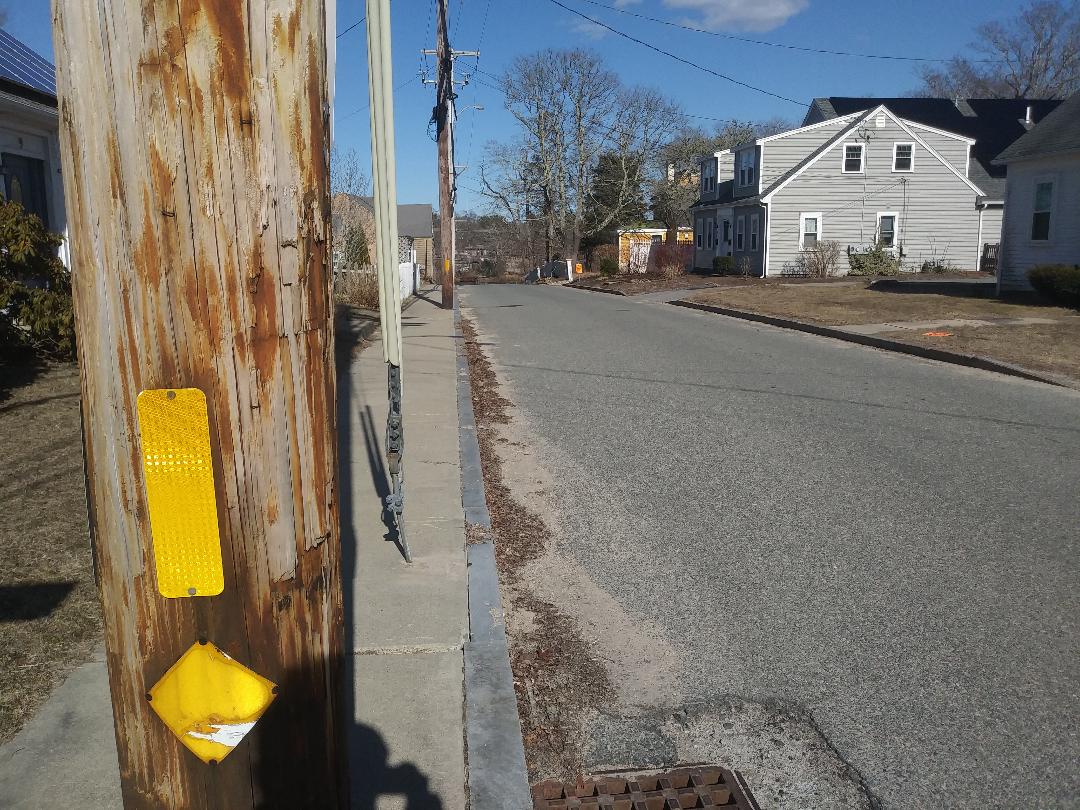
One of my favorite things about High Street is its geometry. I can stand at any telephone pole, look either way, and see all the other poles on the street perfectly aligned with it. If I stand behind one pole, all the others disappear completely. It’s an amazing gift of engineering and craftsmanship. It’s the same with the old trees that line the sidewalk. I take time to enjoy this visual effect at least once a week, an investment of a few seconds to behold geometric perfection realized with wooden poles and living wood.

I know very little about civil engineering, but I know it’s made High Street a good place: a one-point perspective  in three dimensions, bringing with it a life-enhancing sense of proportion and order. It wasn’t created to be admired from afar. It was built for hands and feet, wheels and foliage, asphalt and wires. A public work that works for the public.

High street is a lesson. Skill and vision, with work and good materials, make an artful way to get people from one place to another – a beautiful means to an end beyond itself, outlasting its creators. It’s the same with scripture, poetry, and prayer – words thoughtfully aligned, beautiful in their own right, holy because we walk through them to God.

Question: What do you see on your town’s High Street?

For more information about the Walking Wareham writings, see  the “About” page.