Category Archives: Biblical Reflection

A Ruler’s True Measure

Readings: Psalm 72:1-7, 18-19; Isaiah 30:19-26; Acts 13:16-25

Give the king your justice, O God, and your righteousness to a king’s son.

May he judge your people with righteousness, and your poor with justice.

May the mountains yield prosperity for the people, and the hills, in righteousness.

May he defend the cause of the poor of the people, give deliverance to the needy, and crush the oppressor.

May he live while the sun endures, and as long as the moon, throughout all generations.

May he be like rain that falls on the mown grass, like showers that water the earth.

In his days may righteousness flourish and peace abound, until the moon is no more…

Blessed be the Lord, the God of Israel, who alone does wondrous things.

Blessed be his glorious name forever; may his glory fill the whole earth. Amen and Amen.

This psalm of Solomon is an admission that ruling with wisdom and compassion is not sustainable without God’s presence and guidance. Solomon knows that he does not have the strength to rule God’s beloved children out of his own resources; he must draw on God’s well of compassion and wisdom if he is to exercise his power without losing his soul. The king’s rule is measured by how communal life for the most vulnerable is blessed, not by how much wealth he attains.

None of us will be ruling an ancient civilization any time soon. Most of us don’t hold the power of life and death in our hands, and we do not make or enforce the laws of our society. But each of us has power – the power to nourish the life of this world we call our own. When we call on God’s strength and compassion, we can use our power wisely – and be nourished in mind and spirit through it all.

A Game of Chance

Readings: Psalm 72:1-7, 18-19; Isaiah 4:2-6; Acts 1:12-17, 21-26

Then they returned to Jerusalem from the mount called Olivet, which is near Jerusalem, a sabbath day’s journey away. When they had entered the city, they went to the room upstairs where they were staying, Peter, and John, and James, and Andrew, Philip and Thomas, Bartholomew and Matthew, James son of Alphaeus, and Simon the Zealot, and Judas son of James. All these were constantly devoting themselves to prayer, together with certain women, including Mary the mother of Jesus, as well as his brothers.

In those days Peter stood among the believers (together with the crowd numbered about one hundred and twenty persons) and said, “Friends, the scripture had to be fulfilled, which the Holy Spirit through David foretold concerning Judas, who became a guide for those who arrested Jesus – For he was numbered among us and was allotted his share in this ministry.”

So one of the men who have accompanied us during all the time that the Lord Jesus went in and out among us, beginning from the baptism of John until the day when he was taken up from us – one of these must become a witness with us to his resurrection.” So they proposed two, Joseph called Barsabbas, who was also known as Justus, and Matthias. Then they prayed and said, “Lord, you know everyone’s heart. Show us which one of these two you have chosen to take the place in this ministry and apostleship from which Judas turned aside to go to his own place. And they cast lots for them, and the lot fell on Matthias; and he was added to the eleven apostles. Acts 1:12-17, 22-26, NRSV

There came a time when Judas Iscariot, having given up his life on the Field of Blood, needed to be replaced among the ranks of the apostles. There were only eleven of them. They wanted an even dozen. Peter, always the emboldened one, put forth the names of two men:Joseph (Barsabbas) and Matthias. After having prayed about the matter, the group agreed on the selection process. They would cast lots, which is akin to drawing straws.

WAIT…WHAT? This is the apostleship we’re talking about! Are they just going to gamble on it? Shouldn’t they conduct interviews? Stage a debate? Maybe hold an apostle’s decathlon? At the very least, shouldn’t they vote? Nope. The next apostle was going to be chosen by a game of pure chance. Well, you may remember the outcome. Matthias won and was granted entry into that esteemed circle.

Now, pardon my impertinence, but it seems to me that Jesus might have granted both gentlemen entry into the club – along with their wives (We know Jesus’ feeling about exclusion. It was an equal protection issue for him.).

So why this obsession with the number 12? Yes, I know Jesus himself chose 12 disciples. But he also appointed a different, much larger group of persons (70 or so) to spread the news. I can’t help but wonder why they were so intent at keeping their number at a dozen. Was it because that’s the way it had always been? Or did it have something to do with the 12 sons of Jacob? Or 12 as a covenantal number? Did these people really think that deeply about numerology?

And what of poor Joseph? Did he need to seek counseling to reconcile his hurt over this slight in favor of Matthias? Or maybe, just maybe, Joseph was secretly relieved not to have been chosen?

Such questions are, of course, unanswerable. It’s probably better not to have all the answers. Socrates didn’t like answers very much, at least not the surface variety. He spent most of his life asking questions and little else.

Mary Oliver wrote a poem about that entitled The Man Who Has Many Answers:

The man who has many answers

is often found

in the theaters of information

Where he offers, graciously

His deep findings.

While the man who has only questions,

to comfort himself, makes music.

Offered by Bryan Fredrickson, child of God.

How Are We To Believe?

Readings: Psalm 124; Isaiah 54:1-10; Matthew 24:23-35

Sing, o barren one who did not bear; burst into song and shout, you who have not been in labor!

For the children of the desolate woman will be more than the children of her that is married, says the Lord.

Enlarge the site of your tent, and let the curtains of your habitations be stretched out; do not hold back; lengthen the cords and strengthen your stakes.

For you will spread out to the right and to the left, and your descendants will possess the nations and will settle the desolate towns.

Do not fear, for you will not be ashamed; do not be discouraged, for you will not suffer disgrace; for you will forget the shame of your youth, and the disgrace of your widowhood you will remember no more.

For your Maker is your husband, the Lord of hosts is his name; the Holy One of Israel is your Redeemer, the God of the whole earth he is called.

For the Lord has called you like a wife forsaken and grieved in spirit, like the wife of a man’s youth when she is cast off, says your God.

For a brief moment I abandoned you, but with greater compassion I will gather you.

In overflowing wrath for a moment I hid my face from you, but with everlasting love I will have compassion on you, says the Lord, your Redeemer.

This is like the days of Noah to me; Just as I swore that the waters of Noah would never again go over the earth, so I have sworn that I will not be angry with you and will not rebuke you.

For the mountains may depart and the hills be removed, but my steadfast love shall not depart from you, and my covenant of peace shall not be removed, says the Lord, who has compassion on you. Isaiah 54:1-10, NRSV

Shout for joy. 

Do not fear. 

Do not be discouraged. 

These are not easy things to do.

With great compassion I will gather you. 

With everlasting love I will have compassion on you. 

My steadfast love shall not depart from you. 

These are not easy things to believe.

A world shaped by love and compassion seems far from our daily experience. Politics is divisive and becoming ever more so. Racism and homophobic prejudice, in both subtle and blatant forms, is rampant. Violence confronts us at every turn. More and more people are feeling less and less secure, both physically and financially. It seems impossible to be joyful, impossible not to fear or be discouraged. We struggle to believe that love and compassion can be real, except perhaps in a small and intimate way.

And yet, these are the words we hear in Advent. These are the proclamations of the prophet. These are the promises of God.

How are we to believe and act this way in a world that confronts us with a starkly different reality? The simple answer is we can do it if we have faith. But if it stops there it’s little more than a platitude, sounding appropriately pious, but still all but impossible to believe. We need something more than nice words. However, if words point us to something real, something that we have experienced, they begin to take on a power that makes belief and action possible.

The truth is that the words of Isaiah 54 mean very little unless they are grounded in the words of Isaiah 53.

Who has believed what we have heard? And to whom has the arm of the Lord been revealed?

For he grew up before him like a young plant, and like a root out of dry ground; he had no form or majesty that we should look at him, nothing in his appearance that we should desire him.

He was despised and rejected by others; a man of suffering and acquainted with infirmity; and as one from whom others hide their faces he was despised, and we held him of no account.

Surely he has borne our infirmities and carried our diseases, yet we accounted him stricken, struck down by God, and afflicted.

But he was wounded for our transgressions, crushed for our iniquities; upon him was the punishment that made us whole, and by his bruises we are healed.

All we like sheep have gone astray; we have all turned to our own way, and the Lord has laid on him the iniquity of us all. Isaiah 53:1-6, NRSV

We can believe the words of Isaiah 54 because Isaiah 53 reminds us that we have experienced the truth of these words. We know that there is a divine compassion and love that saves us from ourselves and anything the world can throw at us. Yes, the world is in a sorry state. That’s why we need a savior. And in great compassion and love God offers that savior to us. We know that because we have experienced it. So, it is possible to believe these words of hope. It is possible to act in joy, not be afraid, not be discouraged.

It is possible! That is the wonder of Advent and the miracle of the Incarnation.

Offered by Jeff Jones, child of God.
Psalm 124

Readings: Psalm 124; Genesis 9:1-17; Hebrews 11:32-40

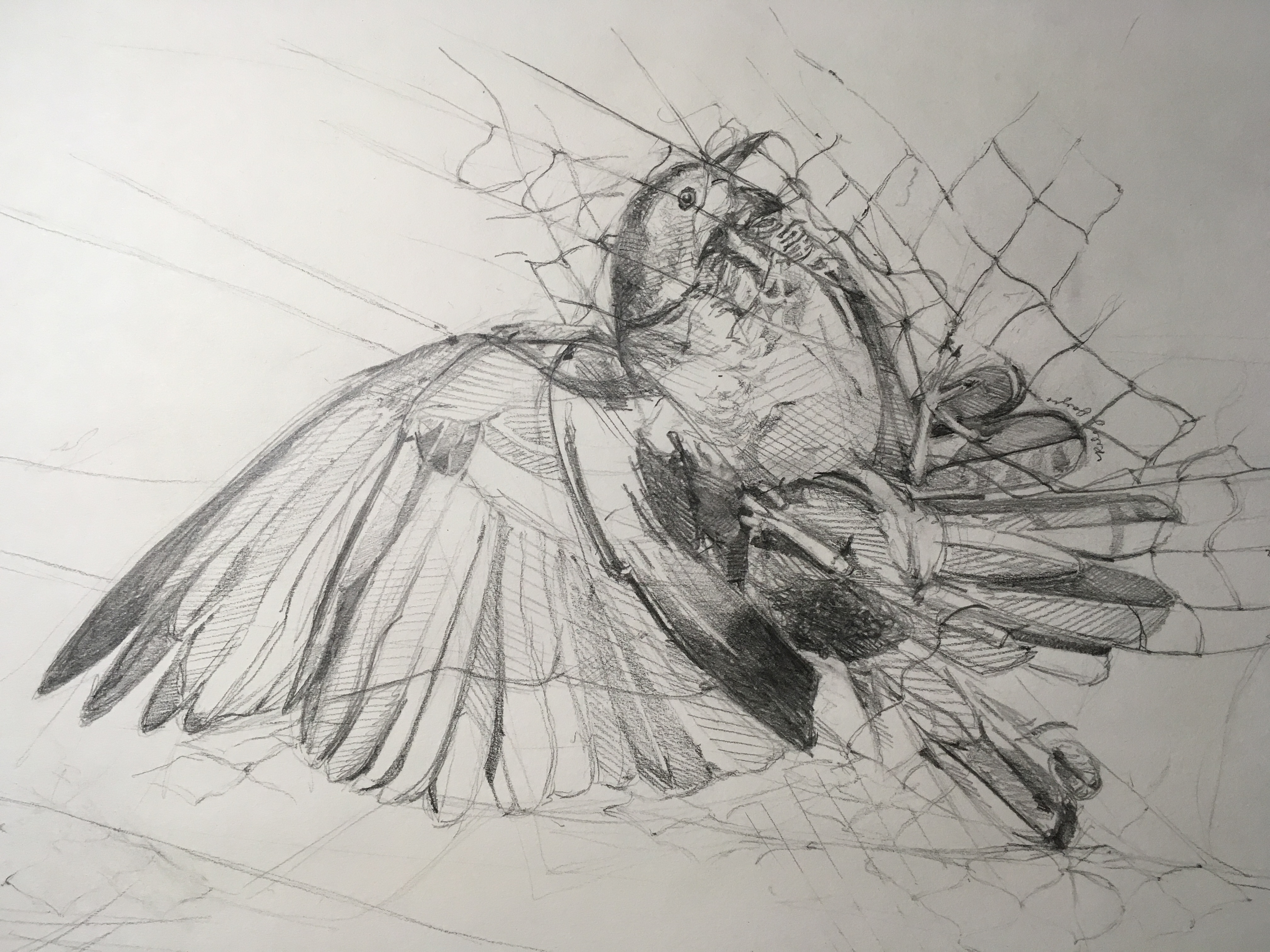
Psalm 124 by Riley Anderson

If it had not been the Lord who was on our side – let Israel now say –

if it had not been the Lord who was on our side, when our enemies attacked us,

then they would have swallowed us up alive, when their anger was kindled against us;

then the flood would have swept us away, the torrent would have gone over us;

then over us would have gone the raging waters.

Blessed be the Lord who has not given us as prey to their teeth.

We have escaped like a bird from the snare of the fowlers; the snare is broken and we have escaped.

Our help is in the name of the Lord, who made heaven and earth.

Psalm 124, NRSV

Offered by Riley Anderson, child of God.

Change

Readings: Psalm 124; Genesis 8:1-19; Romans 6:1-11

But God remembered Noah and all the wild animals and all the domestic animals that were with him (Noah) in the ark. And God made a wind blow over the earth, and the waters subsided; the fountains of the deep and the windows of the heavens were closed, the rain from the heavens was restrained, and the waters gradually receded from the earth. Genesis 8:1-3, NRSV

One of my favorite songs is Everything Must Change by George Benson on an old Quincy Jones album I have. It starts out:

Everything must change, nothing stays the same.

Everyone must change, nothing stays the same.

The Young become the Old, mysteries do unfold.

Cause that’s the way of time, nothing and no one remains unchanged.

Then Later:

Winter turns to Spring, wounded heart will heal.

Never much too soon, everything must change.

I would imagine that Noah, his family, and all the animals were grateful for the lack of permanence. Change can be scary and yet we know change is inevitable and sometimes vital. What might you and I want to change as we begin this Advent season? Perhaps we should pray for guidance:

O God, by whom the meek are guided in judgement, and light rises up in darkness for the godly: Grant us, in all our doubts and uncertainties, the grace to ask what you would have us do, that the Spirit of wisdom may save us from all false choices, and that in your light we may see light, and in your straight path may not stumble. Through Jesus Christ our Lord, Amen. BCP

https://youtu.be/oqtHo0pU-1M

Offered by Bill Albritton, child of God.

Awake

Readings: Psalm 122; Isaiah 2:1-5; Romans 13:11-14; Matthew 24:36-44

In the days to come the mountain of the Lord’s house shall be established as the highest of the mountains…the word of the Lord shall arbitrate for many peoples; they shall beat their swords into plowshares, and their spears into pruning hooks; nation shall not lift up sword against nation, neither shall they learn war any more. Isaiah 2:2, 4 NRSV

But about that day and hour no one knows, neither the angels of heaven, or the Son, but only the Father…Keep awake therefore, for you do not know on what day your Lord is coming. But understand this: if the owner of the house had known in what part of the night the thief was coming, he would have stayed awake and would not have let his house be broken into. Therefore you must also be ready, for the Son of Man is coming at an unexpected hour. Matthew 24:36, 42-44, NRSV

Besides this, you know what time it is, how it is now the moment for you to wake from sleep. For salvation is nearer to us now than when we became believers; the night is far gone and the day is near. Let us then lay aside works of darkness and put on the armor of light; let us live honorably as in the day, not in reveling and drunkenness, not in debauchery and licentiousness, not in quarreling and jealousy. Romans 13:11-13, NRSV

Isaiah shares a vision of the future, when God’s children will let go of violence and ignorance, throwing out the directions on how to win at the expense of others. In the days to come, resources and time devoted to destruction will be invested in restoring the environment and making sure everyone has all the basics to live a meaningful life. It won’t come without a lot of work, though – swords don’t beat themselves into plowshares, after all. But Isaiah didn’t give the when along with the vision.

Jesus doesn’t provide the when, either, because he doesn’t know. God only knows, he tells us. The reign of God will come like someone breaking into your house, so be ready. Again, it doesn’t seem to be something that just happens – like a good meal, it doesn’t cook itself.

When it does come to pass, how we treat each other and understand our own worth is yanked out from under us; it feels like the end of the world, maybe, but it’s really just the end of what kills us. The thief takes away our darkness and leaves behind revelatory light. Whenever it comes to pass…

Perhaps the reason God only knows when this will be is because it’s connected to our actions. Until we put in the work, until we start living transparently – acting the same whether anyone is around to see us or not – it will stay in the realm of whenever.

But don’t forget that we already know what time it is. It’s Advent – time to wake up and live into the reign of God. How amazing is that!

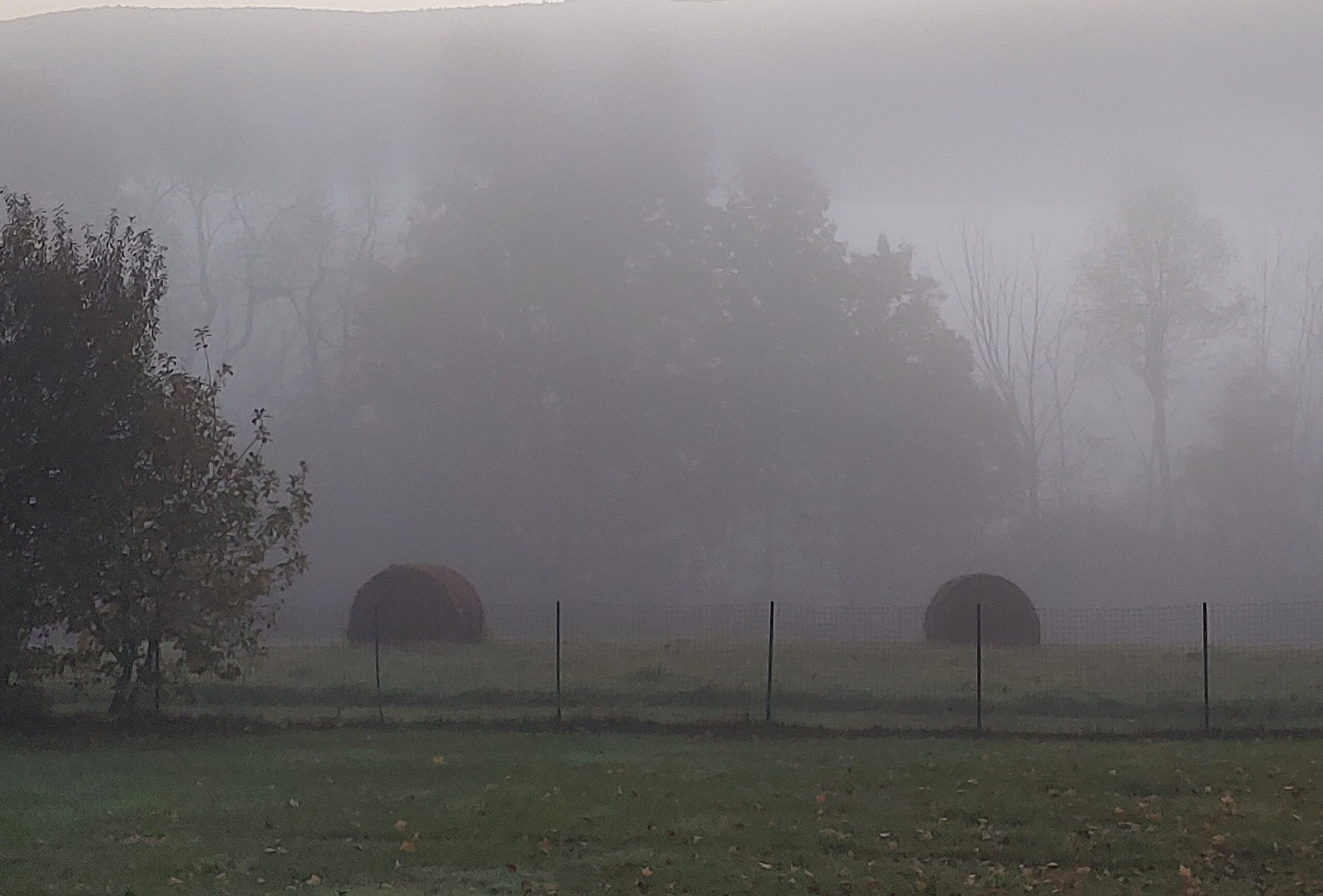
In a Fog

Sunday, October 16

I lift my eyes to the hills – from where will my help come? Psalm 121:1, NRSV

In the Bible of my childhood, the old King James, Psalm 121:1 wasn’t a question, but a statement: I lift up mine eyes unto the hills, from whence cometh my help. It wasn’t until I was well into my 20’s that I learned it was a grammatical error. Correcting the punctuation moved it from an affirmation of faith and trust to an uncertain questioning. I look to the hills not because I know the source of my help, but because I can’t see it. It’s hidden in a fog that I cannot penetrate, and I am looking for an answer that has yet to appear. In that time and place of mystery and uncertainty, I can only wait and hope that such an answer will appear. And it does:

My help comes from the Lord, who made heaven and earth.

He will not let your foot be moved; he who keeps you will not slumber. He who keeps Israel will neither slumber nor sleep.

The Lord is your keeper; the Lord is your shade at your right hand. The sun shall not strike you by day, nor the moon by night.

The Lord will keep you from all evil; he will keep your life.

The Lord will keep your going out and your coming in from this time on and forevermore.

Psalm 121:2-8, NRSV

The older I get, the happier I am to live with the questioning version. There have been so many times that I’ve needed to ask this very question, and the psalm gave me the words of faith to do just that.

Noonday Sight and Blindness

Almighty Savior, who at noonday called your servant Saint Paul to be an apostle to the Gentiles: We pray you to illumine the world with the radiance of your glory, that all nations may come and worship you; for you live and reign for ever and ever. Amen.

Was it at noon that the burst of light and the voice of God met Saul on the road? At noon that his companions had to lead a blind Saul into the city? At noon that a blind Saul was healed, transformed into a sighted Paul?

How is it that we can remain blind to what it takes to live a holy life – loving God, self, and neighbor – even on the brightest of days? Saul couldn’t see it, or didn’t see how to apply it; it took three days of blindness, the courage and grace of a stranger, and a new name for writer of so much of our New Testament.

What will it take for me to see?

[Book of Common Prayer, p. 107]

Daily Sustenance

Give us this day our daily bread.

What’s the difference between a want and a need? What is necessary for a life well lived and loved? This question is all wrapped up in a request for daily bread – not daily five course dinner in a mansion, but what is necessary to sustain life and a roof over my head.

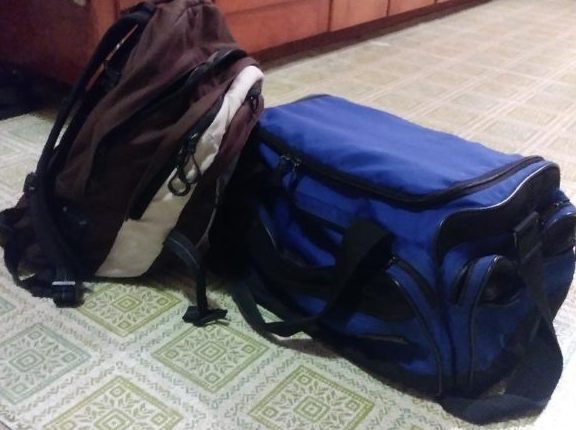
This is playing out in a larger sense at the moment, as I decide what to bring to a new (and temporary) home and what to leave behind. I want to bring what will make a fruitful, faithful life possible; I want to leave behind what distracts and hampers that life. I don’t want to waste this opportunity to let go of what is unnecessary and what doesn’t really matter.

Lord, help me discern what daily bread is, and what it is not. And help me pack accordingly. Amen

[For more on this, click Noonday Prayer Service above.]

Our

Officiant and People: Our Father, who art in heaven

If you look through the New Testament, the word saints is only in its plural form – no singular saints, just a collective. This is different from the honorific Saint that is bestowed on a select few whose very human essence scattered the love of God like a prism flings light. Christianity, like its mother Judaism, is a communal affair rather than a singular pursuit.

The collective shows up again in the prayer Jesus left with us. Our father, not my father or your father. God isn’t the personal property of a single person, even one praying this prayer in solitude. God gives life to everyone, and everyone is claimed as a child of God’s love.

Our means I can’t exclude those I’d prefer to exclude, and they cannot exclude me. We are in this life together. We come before God together, even when we don’t, can’t, or won’t admit it.

What a powerful reminder, in the middle of whatever activities the day brings, that I am not alone – unique, beloved, but never alone.

That goes for you, too.

[For more on the Noonday Prayer service, click above.]