Many Hands

Bless this meal and the hands that prepared it.

In the past two decades, my husband Dave and I have made seventeen thanksgiving meals in four different homes. Friends, family, and the occasional stranger have joined us, bringing appetizers, sides, and desserts. For the first time in many years, it will only be my husband and children at table with me for Thanksgiving. If Dave gives the blessing, today’s table grace words will be in it. The food and the hands that prepared it are both blessed because a meal doesn’t prepare itself…

The turkey comes from an East Coast family farm worked by people I’ll never meet.

The potatoes were grown and picked by Maine workers. The roasted vegetables and candied yams come from a CSA in Plymouth and many other places.

The stuffing brings together California growers, New England bakers, Vermont dairy farmers, and the herbs I grew in my own garden.

Cranberry sauce berries were grown and picked in my home town by hundreds of local employees. Pumpkin pie comes from Midwest farms, topped with whipped cream from Massachusetts dairies.

The wine and sparkling cider come from California, France, and New England. The recipes for all these delights come from many families, a few magazines, and the dog-eared pages of favorite cookbooks.

My husband, children, and I all help make Thanksgiving dinner, but we aren’t the only ones. I can’t imagine how many hands made my family feast possible, but I am grateful beyond words.
Aftergrace

We thank you, Christ our God, for you have satisfied us with earthly gifts. Do not deprive us of your heavenly kingdom, but as you, O Savior, came among your disciples and gave them peace, come among us also and save us.
(Thanksgiving after lunch, Daily Prayers for Orthodox Christians: Brookline, Massachusetts, Holy Cross Orthodox Press, 2010, p. 14)

I don’t say grace after a meal. I thank whoever made, bought, brought, or served my meal, and I am grateful for all the work that went into it. For whatever reason, I haven’t thought to give a prayer of thanks to the one who gives life and light. Is it because I’m no longer hungry or thirsty? Reading this grace makes me think I’ve been settling for physical contentment rather than seeing a meal for what it is: peace of body and spirit that may be offered by human hands, but is always an earthly gift from God.

MacIntosh Blessing

Ohhhh, the Lord’s been good to me, and so I thank the Lord, for giving me the things I need, the sun and the rain and the appleseed, the Lord’s been good to me. Amen.

The Johnny Appleseed Blessing

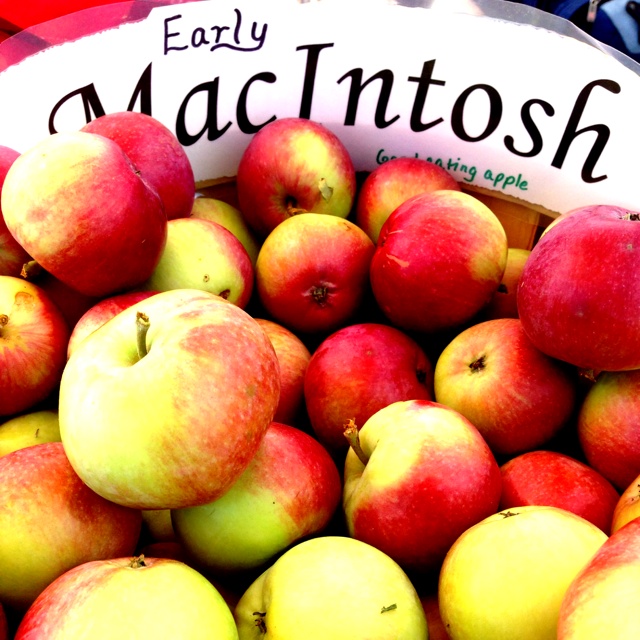
In New England,MacIntosh Apples are everywhere. They are small, sweet and tart, good for eating raw as well as cooked into applesauce or baked goods. Stored properly, they last all winter; stored poorly, they bruise and become soft – still okay for cooking, but not so good raw. Up until about thirty years ago, Macs were one of the few fresh fruits available in a New England winter. I often found one in my school lunch – my mother making sure I had a daily dose of vitamin C and fiber with my PBJ.

These days, I pack lunches for my sons, sending them to school with figs, cranberries, kiwis, and occasionally pomegranate seeds. They eat apples, but prefer to have them at home. Macs aren’t their only choice these days; Honey Crisps, Galas, and Fujis can be found at the local market. There are so many options for nutritional essentials these days. While I enjoy the variety, I sometimes wonder if a basic truth has gone into hiding among so many choices: having even the basic essentials of sustaining food, clean clothing, and protective shelter is a blessing and gift. If I were born elsewhere or elsewhen, I might not have such necessities.

When I pack lunch tomorrow, I’m going to sing the Johnny Appleseed song. Perhaps I will see in the bread and fruit the blessing of the Lord. I hope so.mac

Great, Good, Food

God is great, God is good,

Let us thank God for this food.

Amen.

It’s the first prayer I memorized, and maybe the first one you did, too. It’s prayed in a singsong way more times than not. It’s nothing fancy, but it opens the door to a life of gratitude for all ages. I hope I never forget it. More than once, I’ve heard it said that a person can be great or a person can be good, but not both. Being great in the usual sense means fame, fortune, or some kind of accomplishment that sets a person apart. Being good often means opening doors, telling the truth, and saying prayers at night. The two don’t seem to go together very comfortably. How many times has bad behavior been tolerated by those considered great? How often is goodness mistaken for not upsetting anyone or swearing?

I think this prayer is about something else entirely: scale.

God is great, the creator of this whole universe. Such vastness is beyond my understanding.

God is good, bringing hope and communion out of even the biggest messes. Second chances are real, and each of us is a delight to God.

Thanking God for this food – God is in everything that nourishes, right down to the chemicals and calories that our bodies need. And God is in us when you and I share the essentials.

There is no scale or reality without God, and I live this truth every time I pass you the potatoes and you pour me a glass of water.

(Communion) Table Grace

Risen Lord, be known to us in the breaking of the Bread.
(Eucharistic Prayer C, Book of Common Prayer)

I know Bread is communion bread, with all the meaning it holds, but this grace works for any bread on any table: rye, pumpernickel, sandwich white, and honey whole wheat are all Bread. The bread’s not really the point; anything that sustains body and soul will do.

These twelve words are an extraordinary request when I pray them. I’m asking God for the miracle of recognizing eternal love in the simple act of sharing my meal and my life. All I have to do is ask – and be willing to live with the holiness of your life, my life, and everybody else’s life.

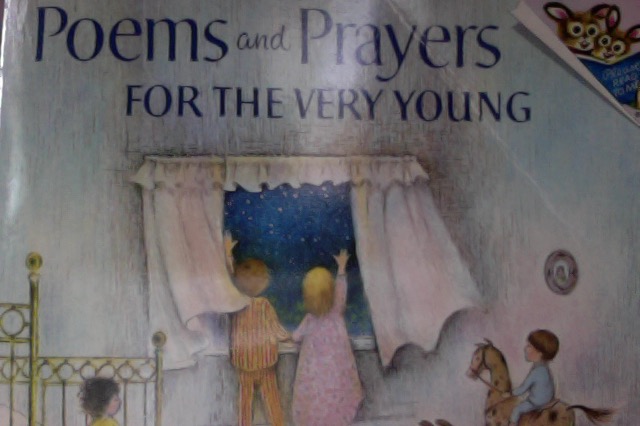
Poems and Prayers for the Very Young

Photo on 11-6-15 at 11.09 AM

God, we thank you for this food,

For rest and home and all things good;

For wind and rain and sun above,

But most of all for those we love.

Maryleona Frost

From Poems and Prayers for the Very Young (Martha Alexander, illustrator, Random House, New York, 1973)

My friend Cheri tucked this little paperback into a box of baby presents when my younger son was born. She had one for her two girls and thought I’d like one, too. These four lines are just one of the treasures in it.

This little table blessing doesn’t put conditions on thanks. There is no escape clause if peas are served rather than corn on the cob. Home can be an apartment or a mansion, and rest had in a tent or on a sofa. Wind and sun and rain reign above for rich and poor, friend and stranger. Thanks are included for those we love with no distinction.

When we leave childhood behind, we make distinctions. We separate the foods we like and the ones we don’t, saving our approval and our thanks for what we want. Our homes become places moving toward an imagined ideal, not a place where we can live interesting lives. The elements are welcome when they don’t interfere with the daily commute or vacation plans. Even love can be doled out according to merit and convenience.

I’m old enough now to leave that kind of adulthood behind for a second kind of childhood – not simplistic, but simple. I am thankful for whatever is on my plate. I am grateful for the means to eat when many will not. When I welcome friends and family with kindness, care, and attention, my home is good enough. I trust they come to visit me and my family, not my furniture. And for those I love? Imperfect just like I am, and God’s sure grace in my life.

For all these, God, may I always be thankful.

Thankful?

Thank you for the world so sweet, thank you for the food we eat,

Thank you for the birds that sing, thank you, God, for everything. 

Amen

Dear Lord,

Sometimes I eat without taking a moment to be thankful for what is on my table. I forget the farmers who grew the crops and the animals that were raised to be food on my plate. I overlook the work of grocers and clerks, cooks and truck drivers. I forget the millions who won’t eat, or won’t eat enough, today. I eat so quickly that I don’t really enjoy the spices and flavors.  I don’t look at the others sitting around the table, and I half listen to their tales of the day. I am blind to the candlelight that dances among the serving dishes. Forgive me for my ignorance and arrogance.

But tonight, I see my sons and hear what happened in Latin class and Model UN. I pick up my napkin and give thanks for Craig and Patti, its givers. I see the roasted vegetables grown by Karen and the Autumn leaf candle holder glowing at the table’s center. My husband pours the wine and we talk about nothing in particular. Outside the darkness grows and the owls cry. From this warm and abundant place, set in this marvelous corner of creation, I am thinkful and thankful.

Photo on 11-3-15 at 8.34 AM

Vampires, Mummies, and the Holy Ghost

Vampires, Mummies, and the Holy Ghost

These are the things that terrify me the most…

These two lines are part of the chorus to a Jimmy Buffett song. It’s an oddly upbeat song about phobias – not really a Halloween tune, but the lyrics do fit the season. I always liked the song, and these word have stuck with me. Why put the Holy Ghost in with scary movie monsters? It makes me wonder two things:

Is there a difference between feeling scared to death and scared to life?

What is the church doing wrong if its children mistake the Holy Spirit for a monster?

Witches, Goblins, Pirates, Ghosts

In a few days, all manner of scary critters will come to my door, threatening mischief if I don’t provide snacks. My house is popular on Halloween – on a downtown side street along with a dozen others whose porch lights will welcome the scary horde. This yearly visitation is one of the reasons I love my home.

The usual assortment will come: babies in strollers, toddlers holding orange jack-o-lanterns in one hand and their parents’ hands in another, batches of elementary schoolers, and the random teen with a pillowcase and a latex zombie mask. No one looks like they usually do, and many have spent hours covering themselves in masks and make-up. Some will even have bloody fingernails and warts. One and all will leave with Twix bars or Nerds. The next day, everyone will be in their usual clothes with their usual faces – scary no longer.

This season makes me wonder what kind of masks we wear every day, hiding our everyday selves, trying to look fierce, asking for what we want with a threat to encourage its granting.

From Ghouls and Ghosties,

And long-legged Beasties,

And things that go bump in the night,

Good Lord, deliver us.

Scottish prayer


Rules

Many years ago, I took my young sons Trick-or-Treating. I would take them to the houses with the outside lights on and skip those that weren’t, following the traditional Halloween rules and teaching them to my children. Everything went as it usually does on Halloween – candy and costumes, laughs and glow-in-the-dark bracelets – until we got to the white house with the wrought iron fence. Lights were on, inside and out, so we went up to the door and rang the bell. No one came. After a minute, my son rang the bell again. “I can hear it ringing,” he said, but no one came. “Try knocking,” I said. No one came. After another minute, we walked away. “That’s not fair. They have their lights on,” my other son said. For several Halloweens after, my sons would talk about the rule breakers in the white house; oddly enough, they never said a word about the lights off houses. It was the rule breaking that bothered them, not missing out on treats.

The lights off/lights on Halloween house rule is a great way to know who wants costumed children at the door and who doesn’t. Most people abide by this rule because it’s practical and convenient, not because it has moral weight or importance. Breaking with custom or habit may make things awkward, but unless real harm is intended or inflicted, there is no need to harbor resentment. I suspect the same can be said for many of the social rules I hold dear.

When my sons came home from school today (high school and middle school), I brought up that Halloween incident. It took them a few moments to remember it, and they moved on to another topic within a minute. No negative comments, no judgment, and no interest in past sins. They had moved on. When a social rule I value is disregarded, especially when no harm has come, I hope I can do the same.

Moving into God’s presence through words