It boils down to this: are other creatures merely means to whatever ends we seek, or are living creatures here for reasons beyond our own? If I hold with the latter, I’ll pay the extra couple of bucks for the humanely raised meat and eggs on my plate. I’ll use my money to buy make-up that didn’t harm animals, and I’ll be willing to pay higher taxes to have oversight of animal treatment in medical research.
Those are my ethical reasons. But it’s the wonder of all the cats and dogs I’ve known that is the real reason…
Most come from Afghanistan, but a few are from Haiti, Mexico, and Guatemala. I see them walking in Bennington and Manchester, and hear their mysterious, beautiful languages. They are here because they cannot stay at home. The reasons are many and full of sorrow – oppressive regimes, religious fervor, no way to make enough money to survive.
As a Navy brat, I grew up moving every year and a half – new schools, new accents, and new homes. But I always knew the local language and my family could always go back to our home community to visit family and friends. It wasn’t always easy, but it was quite an adventurous way to grow up.
With the climate bringing destruction and violence common in many places, the number of people forced to make their home among strangers is only going to increase. I pray that I can find ways to make my new neighbors feel welcome, not as permanent guests but as family.
From Jane Goodall’s A Prayer For World Peace; Hong Kong: Minedition, 2015. For more on this and the rest of the series, click threeP’s above.
We pray for the victims of violence and war; for those wounded in body and for those wounded in mind.
John called his wife and the pastor of his church a couple of minutes beforehand because he didn’t want one of his twin sons to find his body in the garage – he didn’t leave enough time for Linda and David to prevent it.
John couldn’t find a way to talk about the war that left his heart, mind, and soul in a dark room with no way out but a bullet.
John left behind a family and circle of friends that loved him, and a bunch of us in the congregational church choir who loved his wife and eight year old sons.
At twenty-one years old, I couldn’t imagine how anyone could be so isolated and so grief-stricken that death seemed the best gift he could give himself and those he loved.
War and violence claimed him, caged him, and spilled into the lives of those he wouldn’t for the world want to hurt.
But hurt us he did.
I hope we learned enough from John’s death to find other ways out of dark places.
Every child deserves to be welcomed into the world with joy. Each baby should have the basics – safety, food, clothing, shelter, engagement – provided without fuss or resentment. No child should have to offer his or her body for the use and gain of others, and no one should have to choose between death and committing murder.
Violence or violation? No child should have to choose. No adult should, either.
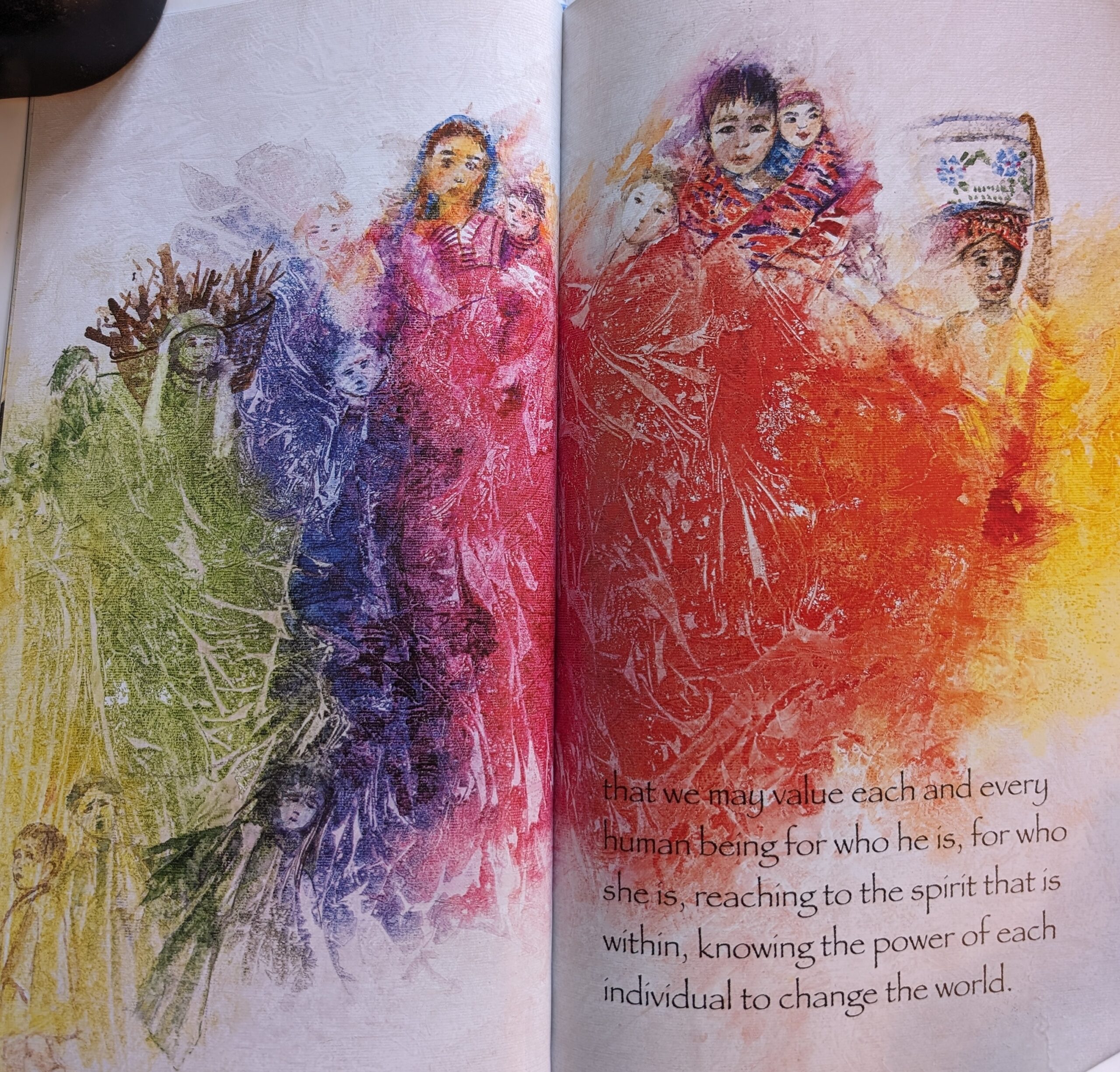
We pray to the Great Spiritual Power in which we live and move and have our being. We pray that we may at all times keep our minds open to new ideas and shun dogma; that we may become ever more filled with generosity of spirit and true compassion and love for all life; that we may strive to heal the hurts that we have inflicted on nature and control our greed for material things, knowing that our actions are harming our natural world and the future of our children; that we may value each and every human being for who he is, for who she is, reaching to the spirit that is within, knowing the power of each individual to change the world.
I’ve been lucky enough to have mentors who provided guidance without insisting that I take up a particular profession or remain in their particular discipline. I had a grandfather who let me learn boy’s skills, and a father who didn’t value me less because I was a daughter. Math, languages, science, home economics – it was all encouraged if I wanted to pursue it.
Many of my friends weren’t so lucky; if they questioned the direction chosen for them, there were serious consequences. Perhaps they weren’t wished a lesser life, but they were encouraged to be who they were not rather than who they were.
In the here and now, here’s hoping we mean what we pray…
From Jane Goodall’s A Prayer For World Peace, Hong Kong: Minedition, 2015
Jumping worms have invaded Vermont. They aren’t the helpful kind of worms that improve soil. Instead, they drive out native species and damage forests. They are causing enough damage that the state of Vermont has put out warning flyers. Because I’m installing a couple of raised beds, they may become my problem soon enough.
I’ll do my best to prevent an infestation – checking plants and soil for worms and eggs and keeping a watch on everything after planting. But if I find these jumping worms, I’ll have to make a choice: kill them or let them decimate the local environment. Loss of life will occur, by my direct action or my inaction. I hope I never get to the point that it becomes an easy choice.
[This is part of an ongoing series. Click ThreeP’s above for more in this series.]
Dogma: A principle or set of principles laid down by an authority as incontrovertibly true.
What can we say about our faith, our God, our world that is incontrovertibly true? Depending on when and where we were born, the dogmatic laundry list would be different. Even if the lists were identical, our own age and stage of life color our take on what we consider incontrovertibly true. Gender, age, experience, geography, current events, health – all these and more influence our lists and our understanding of what those lists mean.
So how do we make sense of it all when so much of what we think of as incontrovertibly true, given by an authority we honor, isn’t truly written in stone? What is the foundation that remains solid and reliable, a bedrock that can bear the weight of our lives and all the changes that come with them? Our perspectives are so limited, our life spans so short – how do we live holy lives?
From my own limited and biased point of view, with all its shortcomings and blind spots, I’m going with the perennial favorite that winds through every faith in every time: when in doubt, go with what honors God and offers love to self and neighbor. Dogma is just a list; God, self, and neighbor are life.
[From Jane Goodall’s A Prayer For World Peace (Feeroozeh Golmohammadi, illustrator); Hong Kong: Minedition, 2015
God is great, God is good, God is the creator – our prayers and theological tomes are full of these adjectives describing the one to whom we address our prayers. The technical term for addressing the nature of God: Cataphatic Theology.
God is not fully knowable, God is not contained in this creation, God is not limited to our understanding – our catechetical books and seminary libraries are full of adjectives stating what God is not. The technical term for addressing what God is not: Apophatic Theology.
Spending time seeking knowledge of God in either way can be very helpful: it can clear away some of our misconceptions and make us aware of our own limited perspectives. If pursued with honesty and as an expression of faith, these two different paths can keep us humble and increase our capacity for kindness and compassion.
If we remember the most basic truth of life, we can avoid mistaking or preferring our ideas of God with our relationship to God. We can remember that we are always held by God. Said poetically:
We pray to the Great Spiritual Power in which we live and move and have our being.
[A Prayer For World Peace; Jane Goodall and Feeroozeh Golmohammadi(illustrator); Hong Kong: Minedition]
I think the vows are a pair of tickets to a music festival: the main attractions you know going in, but the rest of the acts are a mystery. Some of it will be amazing, some surprising, some disappointing. But, at the end of the day, it’s the person you came with that makes all the difference.