Category Archives: Biblical Reflection

Whence?

I life my eyes to the hills – from where will my help come?

My help comes from the Lord, who made heaven and earth.

He will not let your foot be moved; he who keeps you will not slumber.

He who keeps Israel will neither slumber nor sleep.

The Lord is your keeper; the Lord is your shade at your right hand.

The sun shall not strike you by day, nor the moon by night.

The Lord will keep you from all evil; he will keep your life.

The Lord will keep your going out and your coming in from this time on and forevermore.

Psalm 121, NRSV

[Note: In the King James translation, the first verse was changed from a question to a statement – a beautiful statement of faith, but not what was written in Psalm 121. This is part of an ongoing series. For more information, click A Song of Ascents above.]

Where do I look for help when I’m in trouble? Whence cometh my help, to put more of a King James spin on it. Whom do I trust with my very life, in all circumstances? It’s a critical question, and the answer is always a statement of faith, even when God’s presence has sustained me through past difficulties. I will trust in God when I need help, just as I trust in God when things are going well.

Once I give my answer in this psalm, I find myself in good company. All of a sudden, there’s another voice, assuring me of God’s faithfulness. Someone else is with me in all of this, someone else is telling me that God will keep my life: I won’t be alone through any of it. I’m not the only one who cries for help, and mine isn’t the only life held by God. My neighbor in faith is with me, and we are both beloved children of the one who created and sustains this universe.

God, self, and neighbor in this mysterious and holy creation. Bound together in all circumstances. Not a one of us alone.

Marvelous.

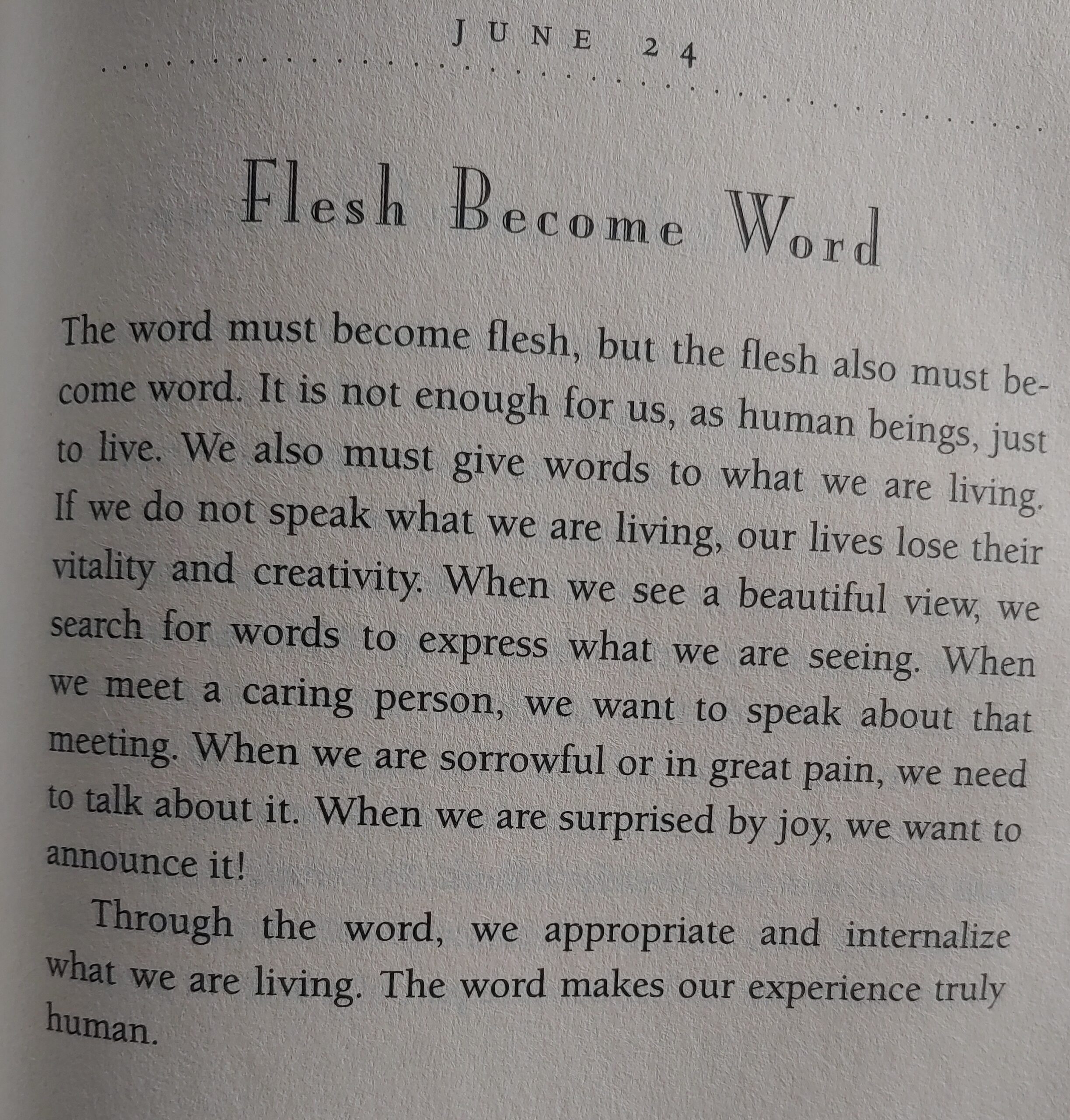
Putting it in Words

[Henri Nouwen, Bread for the Journey, June 24]

When we speak deep truths, something irrevocable occurs. We can’t unsay them, even if we speak them aloud to no one but ourselves. An I love you spoken and heard can transform the world well beyond the sayer and hearer. An I love you left unsaid may be deeply felt, but there’s a certain something it only gains in the saying. It may not be necessary, but it is vitally important.

The same is true for words of grief. To pick up the phone and tell someone that a beloved parent/friend/husband/wife has died is to make it real in a way it wasn’t beforehand. The words don’t change the loss, but they change it from an external reality to the heart’s own truth.

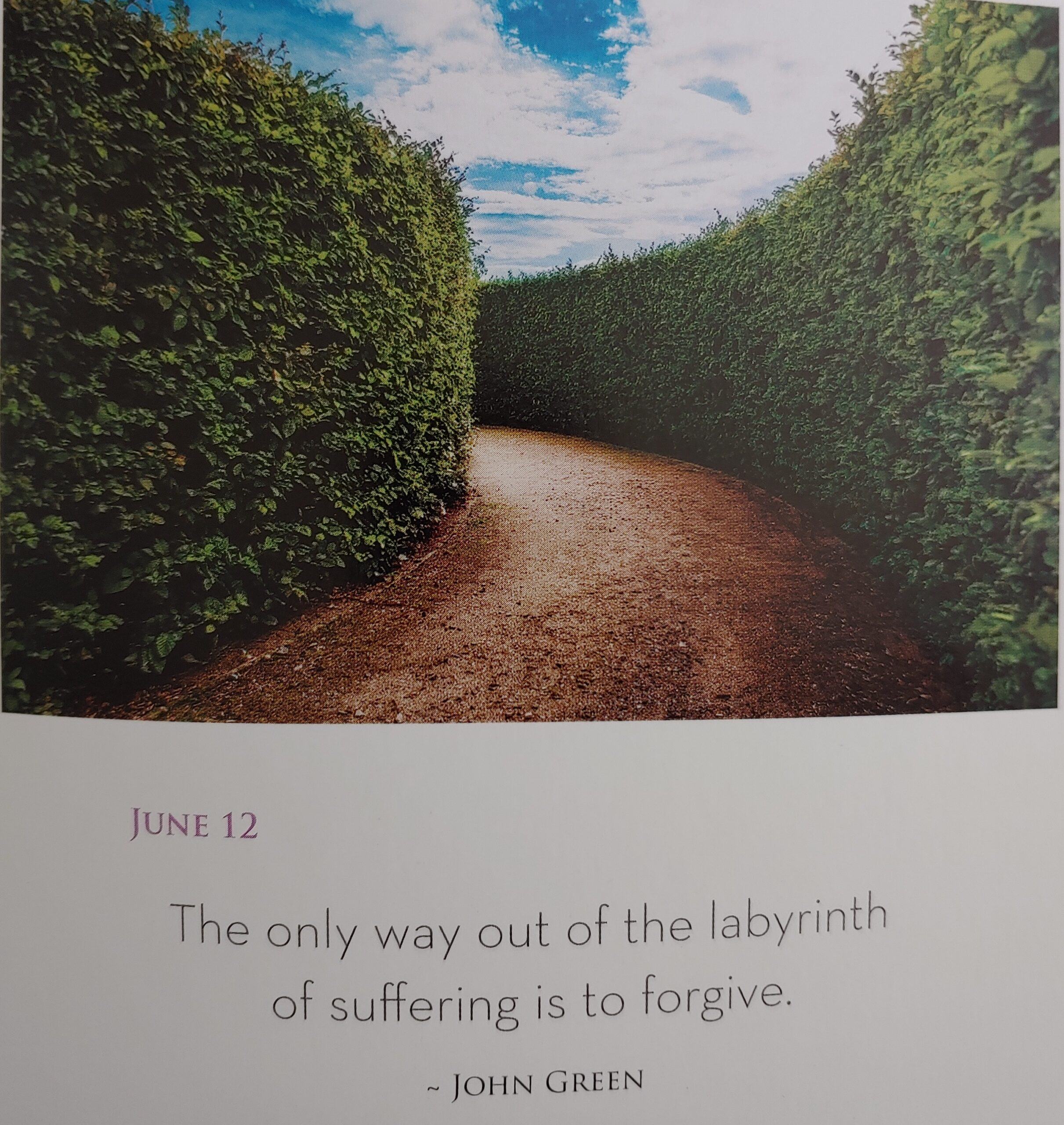
For Whose Benefit?

Then Peter came and said to him, “Lord, if another member of the church sins against me, how often should I forgive? As many as seven times?” Jesus said to him, “Not seven times, but, I tell you, seventy-seven times.” Matthew 18:21-22

For most of my life, I assumed that the reason Jesus told Peter to forgive another was for the benefit of the other person. It seemed like a lot to require of anyone, and it still does.

The older I get, the more inclined I am to see how forgiveness benefits the forgiver as much or more than the one forgiven. To be released from that acid gnawing away at body and spirit that corrodes the very heart of my being until I forgive is a grace bordering on the miraculous.

Is releasing another from a burden of guilt, of restoring another’s inner peace, too high a price for the reprieve from my own suffering?

[Daily Peace: Washington, D.C.: National Geographic Society, 2015; photos by Marek Minch and Elena Alyukova-Sergeeva. For more on this series, click Daily Meds above.]

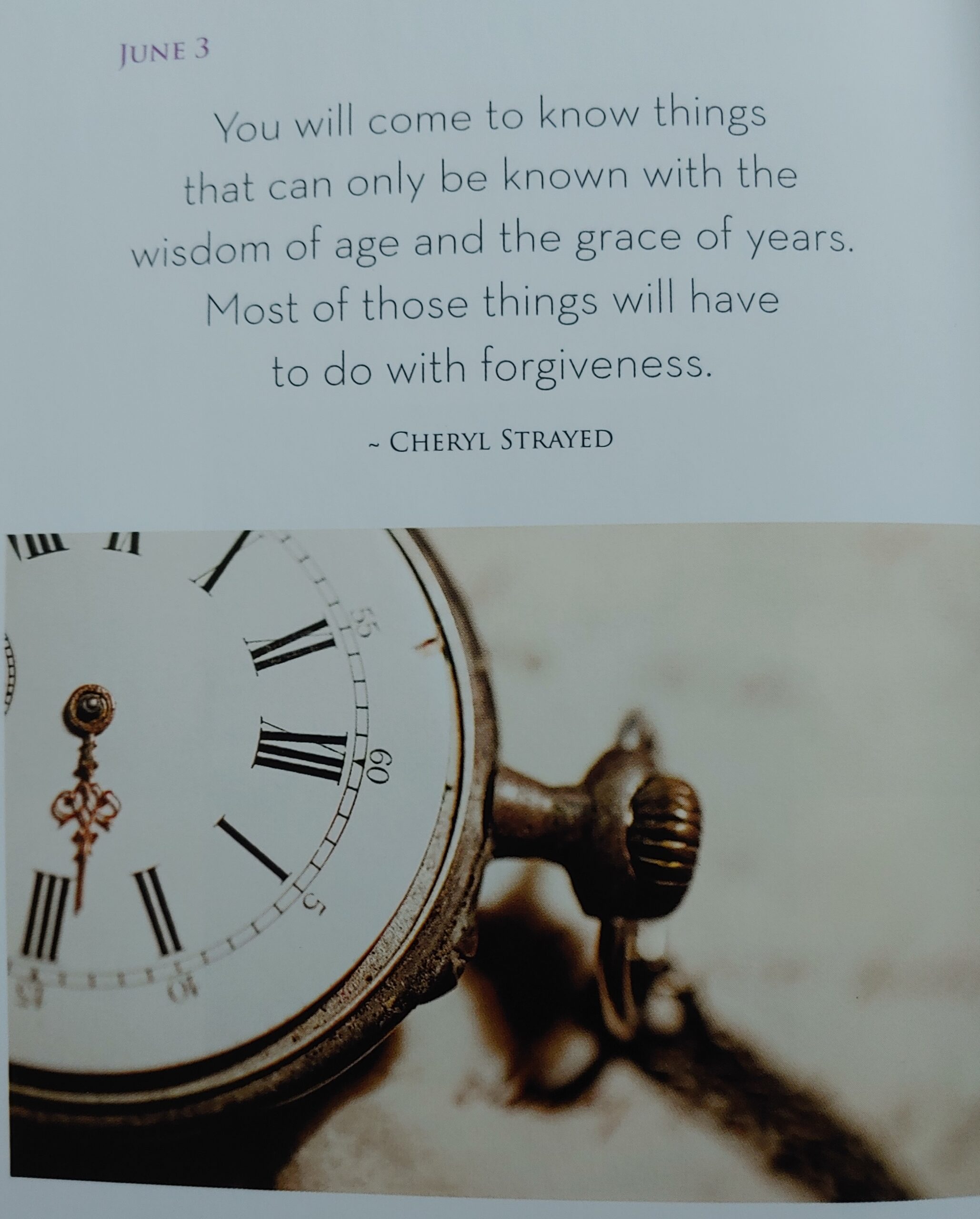
With age…

[Author of Wild: From Lost to Found on the Pacific Crest Trail; excerpt from Daily Peace; Washington, D.C.: National Geographic Society, 2015]

What is unforgivable? It’s an important question that arises whenever harm comes into our lives. And an even more critical question: who cannot be forgiven?

The older I get, the more I am convinced of this: when I assign someone to the land of the unforgivable and unforgiven, I end up living there, too. Only by the grace of God can either one of us find release.

What is Required?

“What is your vocation? To be a good person.” Marcus Aurelius, Meditations, 11.5

The Stoics believed, above all else, that our job on this earth is to be a good human being. It is a basic duty, yet we are experts at coming up with excuses for avoiding it.

Ryan Holiday and Stephen Hanselman, The Daily Stoic: 366 Meditations on Wisdom, Perseverance, and the Art of Living, New York: Portfolio/Penguin, 2016, p. 165

One of my family’s core beliefs: you weren’t put on this earth to be miserable. Most often, it came out when one of us had been dealing with a difficult situation or person over a long enough period of time to warrant some kind of change – this affirmation that none of us was meant to live a miserable life.

On occasion, it was used in the other sense – none of us was meant to be the cause of suffering and misery for others. This wasn’t because the lives of others were of lesser value, but because there were other ways of saying the same thing that were more frequently said: treat others as you want to be treated; if you can’t say anything nice, don’t say anything at all; how would you like it if…; you were put here to be a gift to the world.

You would think it goes without saying that all of us have a responsibility to be good to others and to be good to ourselves, that such a thing is too obvious to miss, but it isn’t true. What’s left unsaid is easily forgotten or ignored – and the world is the lesser for that omission.

Say it in whatever person’s words work for you – Marcus Aurelius, Gandhi, Malala Yousafzai, or Mother Teresa. Or go with the classic:

He has told you, O mortal, what is good; what does the Lord require of you but to do justice and to love kindness, and to walk humbly with your God? Micah 6:8, NRSV

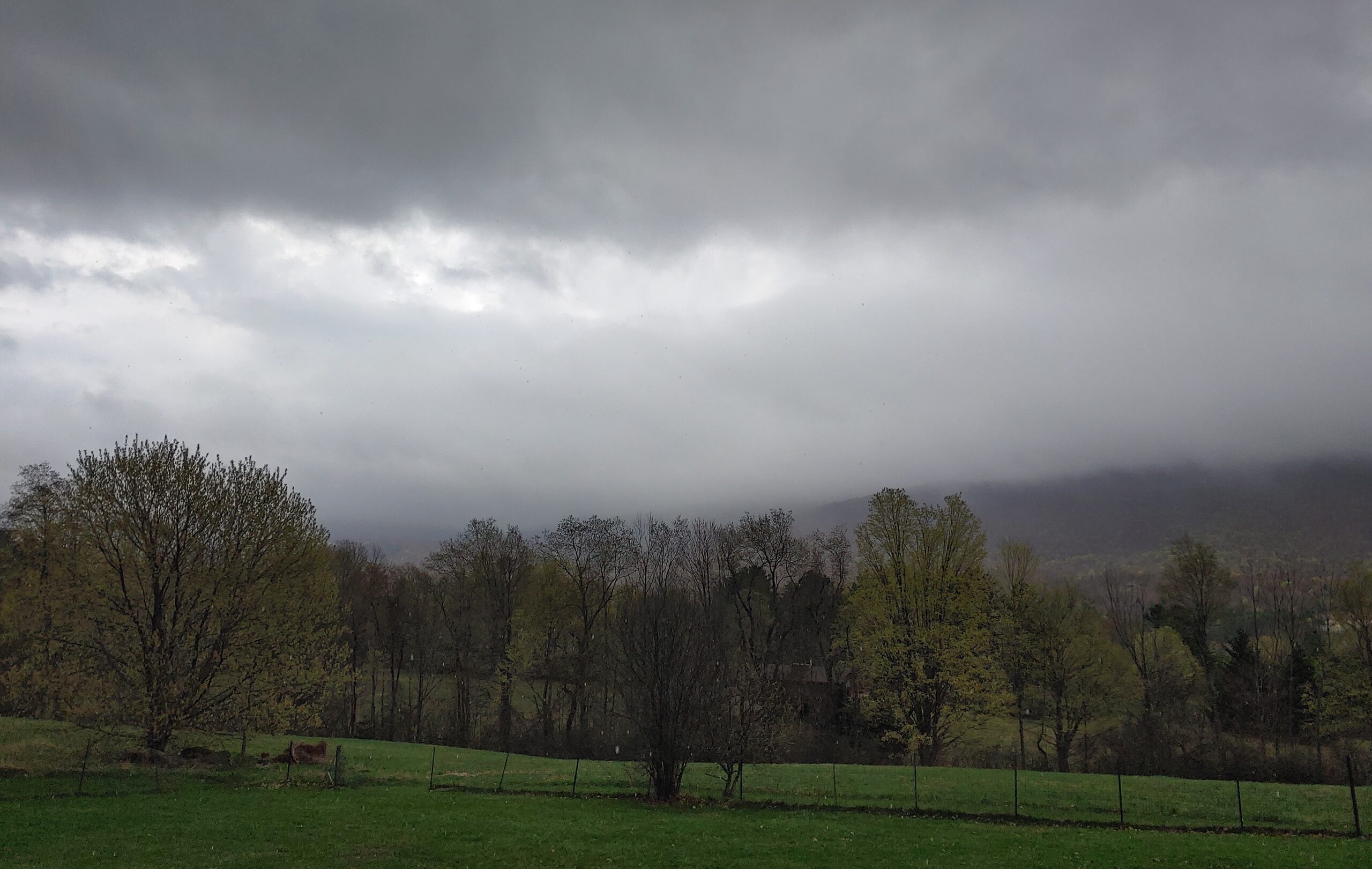
Incoming

The wisps of cloud dipping down mark its edge. There’s a soft rustling and a faint brush of moist air. It’s rare in this part of the world – a visible wall of rain moving down the mountain toward me.

These few words and this image are the best way I can offer an experience of it, but it isn’t something easy to recognize from a photo or description. They might help you recognize what they indicate sometime in the future, or bring to mind an experience you’ve already had of rain coming in. They may draw you in to the experience, past or yet to be.

Sometimes, I think that’s what scripture is – humanity’s best attempt to share an experience of God in word and image. If you’ve already had the experience, they will draw you back into it. If your experience is yet to come, they’ll guarantee you know it when it arrives…

Obscured

For now we see in a mirror, dimly…Now I know only in part; then I will know fully, even as I have been fully known… ICorinthians 13: 12

Canterbury Road

Perhaps because I cannot see everything, I appreciate what I can see – and recognize that even on the clearest of days I cannot see it all.

Vermont Fog
Night on the Green Mountains

What limits my vision may help me love what I can see, even when I know I am not seeing everything. What limits my vision may also help me love what I cannot see. After all, if what I see is any indication, imperfect as it is and imperfect as I am, what I cannot see is bound to hold something mysterious, imperfect, and lovable.

Letting go of what doesn’t matter: The assumption that I need to see all that life offers in its entirety before I can love it.

Loving what does: Everything.

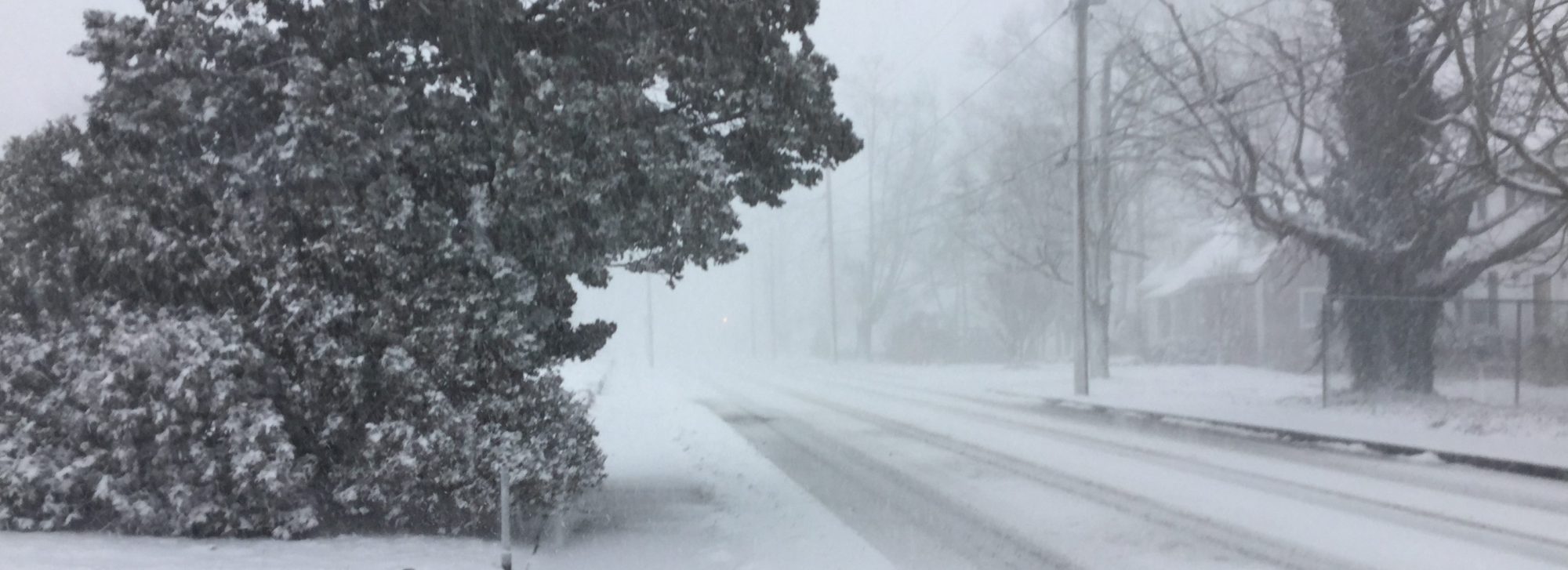
High Street in Snow

Crumbs

Jesus left that place and went away to the district of Tyre and Sidon. Just then a Canaanite woman from that region came out and started shouting, “Have mercy on me, Lord, Son of David; my daughter is tormented by a demon.” But he did not answer her at all. And his disciples came and urged him, saying, “Send her away, for she keeps shouting after us.”

He answered, “I was sent only to the lost sheep of the house if Israel.” But she came and knelt before him, saying, “Lord, help me.” He answered, “It is not fair to take the children’s food and throw it to the dogs.”

She said, “Yes, Lord, yet even the dogs eat the crumbs that fall from their masters’ table.”

Then Jesus answered her, “Woman, great is your faith! Let it be done for you as you wish.” And her daughter was healed instantly. Matthew 15:21-28, NRSV

For Jesus, it was plain that he was sent to Abraham’s children – all those who served the God of Jacob, Leah, Abraham, and Hannah. God knows he had his hands full with that destiny, and may not have given anyone who fell outside that focus much thought. Until an outside voice cries for help, desperate enough to break through any barrier to save her daughter.

We are not worthy so much as to gather up the crumbs under thy table.

She doesn’t argue the point with Jesus, or pretend that she is one of the flock. She doesn’t even contradict him when he relegates her to dog status, worth so much less than a child. She doesn’t ask for a place at the table, she just claims her right to the smallest grace – the crumbs that are so small that they end up on the floor, out of sight and mind of those enjoying the banquet. She turns Jesus’ image on its head by claiming her place within it; she gains a demon-free life for her daughter, and Jesus, perhaps, sees the scope of his life’s work widen to include outsiders as well as insiders.

But thou art the same Lord whose property is always to have mercy.

Worthy or not, everyone has a right to claim the crumbs.

We do not presume to come to this thy table, O merciful Lord, trusting in our own righteousness, but in thy manifold and great mercies. We are not worthy so much as to gather up the crumbs under thy table. But thou are the same Lord whose property is always to have mercy. Grant us therefore, gracious Lord, so to eat the flesh of thy dear Son Jesus Christ, and to drink his blood, that we may evermore dwell in him, and he in us. Amen. Prayer of Humble Access

Humble Access

Some love it, some have a problem with the language. You might hear it at an eight o’clock service, but rarely at a ten or eleven o’clock Rite Two. After many years of hearing thoughts divided between appreciation and discomfort, I thought I’d take a closer look. I hope you join in!

Prayer of Humble Access

We do not presume to come this thy Table, O merciful Lord, trusting in our own righteousness, but in thy manifold and great mercies. We are not worthy so much as to gather up the crumbs under thy Table. But thou art the same Lord whose property is always to have mercy.Grant us therefore, gracious Lord, so to eat the flesh of thy dear Son Jesus Christ, and to drink his blood, that we may evermore dwell in him, and he in us. Amen.

[Rite One Eucharistic Service, Book of Common Prayer]