Property Values

But thou art the same Lord whose property is always to have mercy.

[For full prayer, click Humble Access above.]

Years ago, at the end of a delightful meal in the company and home of people I had just met, the conversation turned to the story of the neighbor across the street. At the end of a nasty divorce, the man of the house left and the woman and her two children remained. To keep up with expenses, the now single mom had brought her sister in to live with her. A few minutes were spent discussing how hard it was for single parents to make ends meet, and how important it was for children to remain in their homes when possible.

An abrupt end to the whole conversation arrived when my hostess said, “It’s too bad they’ll have to move, but it’s against the home owner’s association policy to have two heads of household in the same home. The rules protect our property values.” For her the matter was settled. There could be no exceptions to the rules, no matter how those rules might cause additional damage to an already stressful situation. Property values were at stake.

It’s easy to judge my hostess for her lack of compassion and questionable values. Still, I wonder how my own past thoughts and decisions would have been different if the property I most valued was mercy?

Philadelphia Row Houses by Colin Fredrickson

Crumbs

Jesus left that place and went away to the district of Tyre and Sidon. Just then a Canaanite woman from that region came out and started shouting, “Have mercy on me, Lord, Son of David; my daughter is tormented by a demon.” But he did not answer her at all. And his disciples came and urged him, saying, “Send her away, for she keeps shouting after us.”

He answered, “I was sent only to the lost sheep of the house if Israel.” But she came and knelt before him, saying, “Lord, help me.” He answered, “It is not fair to take the children’s food and throw it to the dogs.”

She said, “Yes, Lord, yet even the dogs eat the crumbs that fall from their masters’ table.”

Then Jesus answered her, “Woman, great is your faith! Let it be done for you as you wish.” And her daughter was healed instantly. Matthew 15:21-28, NRSV

For Jesus, it was plain that he was sent to Abraham’s children – all those who served the God of Jacob, Leah, Abraham, and Hannah. God knows he had his hands full with that destiny, and may not have given anyone who fell outside that focus much thought. Until an outside voice cries for help, desperate enough to break through any barrier to save her daughter.

We are not worthy so much as to gather up the crumbs under thy table.

She doesn’t argue the point with Jesus, or pretend that she is one of the flock. She doesn’t even contradict him when he relegates her to dog status, worth so much less than a child. She doesn’t ask for a place at the table, she just claims her right to the smallest grace – the crumbs that are so small that they end up on the floor, out of sight and mind of those enjoying the banquet. She turns Jesus’ image on its head by claiming her place within it; she gains a demon-free life for her daughter, and Jesus, perhaps, sees the scope of his life’s work widen to include outsiders as well as insiders.

But thou art the same Lord whose property is always to have mercy.

Worthy or not, everyone has a right to claim the crumbs.

We do not presume to come to this thy table, O merciful Lord, trusting in our own righteousness, but in thy manifold and great mercies. We are not worthy so much as to gather up the crumbs under thy table. But thou are the same Lord whose property is always to have mercy. Grant us therefore, gracious Lord, so to eat the flesh of thy dear Son Jesus Christ, and to drink his blood, that we may evermore dwell in him, and he in us. Amen. Prayer of Humble Access

Merciful

We do not presume to come to this thy table, O merciful Lord, trusting in our own righteousness, but in thy manifold and great mercies.

When we come to God in all our humanity, flawed thinking and acting on full display, will we be welcomed or rejected?

Since God came to us in Jesus, proactively seeking us out and offering love, I’m going to go with welcomed.

When we come to God in all our humanity, acutely aware of our flaws and mistakes, will we accept God’s love or reject it because we only want what we have earned?

An answer of yes isn’t as sure a thing, because it’s entirely up to us rather than God.

Say yes, for God’s sake as much as ours.

Presume

We do not presume to come to this thy table, O merciful Lord, trusting in our own righteousness, but in thy manifold and great mercies. We are not worthy so much as to gather up the crumbs under thy table. But thou are the same Lord whose property is always to have mercy. Grant us therefore, gracious Lord, so to eat the flesh of thy dear Son Jesus Christ, and to drink his blood, that we may evermore dwell in him, and he in us. Amen.

[Prayer of Humble Access, various sources. To read more on this: https://en.wikipedia.org/wiki/Prayer_of_Humble_Access]

Presume: To undertake without leave or clear justification; to expect or assume especially with confidence; to suppose to be true without proof; to take for granted. [merriam-webster.com]

The table which feeds us spiritually isn’t our personal property, and we have no claim on its bounty. Just as it would be wrong to assume a place at our neighbor’s table for dinner, it’s presumptuous of us to assume a space at God’s: neither God nor neighbor owe us automatic hospitality. It’s important to admit that we need an invitation.

At the same time, it’s critical to remember that we do have an invitation, that Jesus asked us to take our place at his table. There is a place at the table for each one of us – not because of our own claim on it, but because God claims us as welcome guests. If we remember that we are guests at the table and not hosts, we won’t take the bounty of the table for granted.

Humble Access

Some love it, some have a problem with the language. You might hear it at an eight o’clock service, but rarely at a ten or eleven o’clock Rite Two. After many years of hearing thoughts divided between appreciation and discomfort, I thought I’d take a closer look. I hope you join in!

Prayer of Humble Access

We do not presume to come this thy Table, O merciful Lord, trusting in our own righteousness, but in thy manifold and great mercies. We are not worthy so much as to gather up the crumbs under thy Table. But thou art the same Lord whose property is always to have mercy.Grant us therefore, gracious Lord, so to eat the flesh of thy dear Son Jesus Christ, and to drink his blood, that we may evermore dwell in him, and he in us. Amen.

[Rite One Eucharistic Service, Book of Common Prayer]

Suddenly

Readings: Isaiah 9:2-7; Psalm 96; Titus 2:11-14; Luke 2:1-14

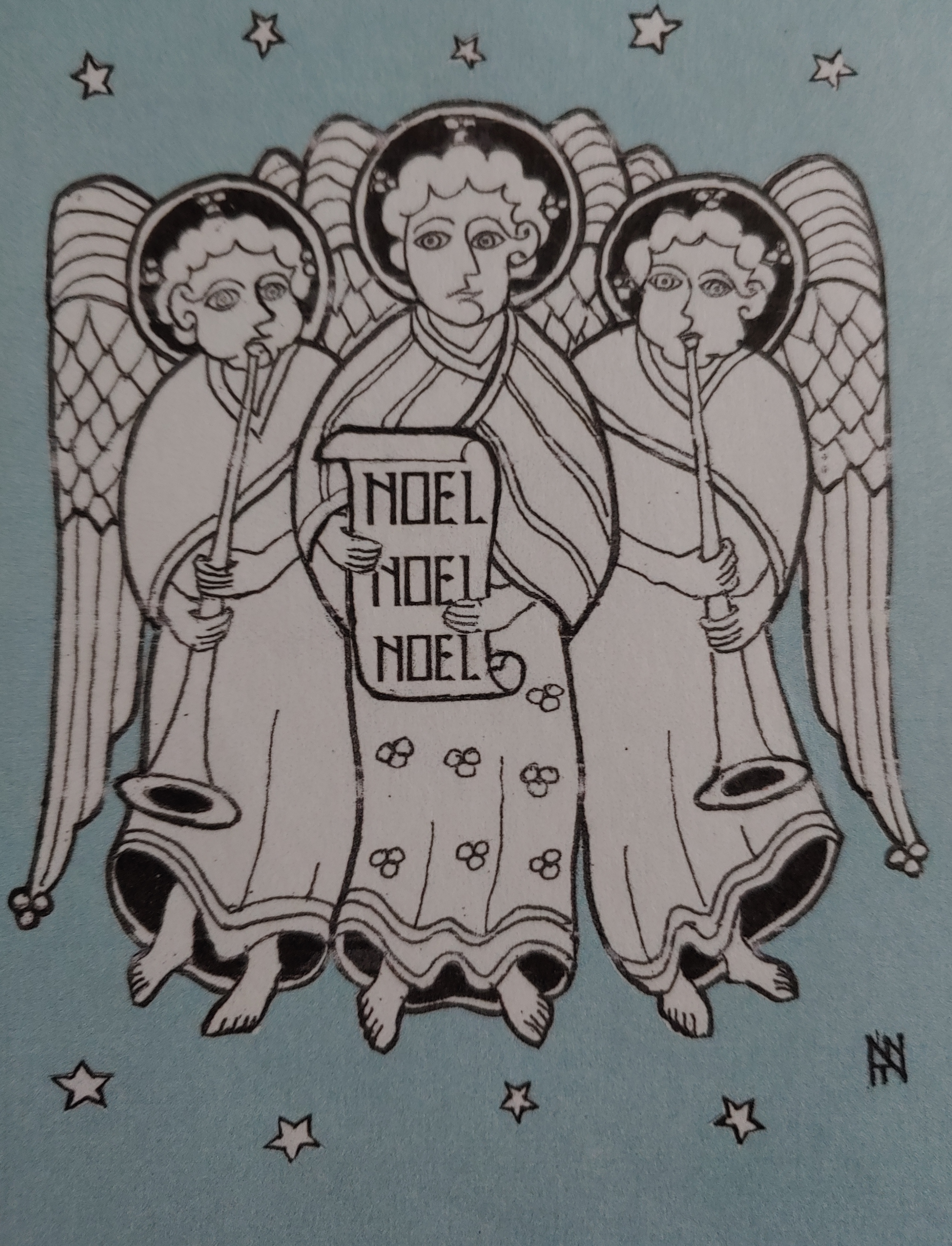
Heavenly Host by Thomas Nordquist

In those days a decree went out from Emperor Augustus that all the world should be registered. This was the first registration and was taken while Quirinius was governor of Syria. All went to their own towns to be registered. Joseph also went from the town of Nazareth in Galilee to Judea, to the city of David called Bethlehem, because he was descended from the house and family of David. He went to be registered with with Mary, to whom he was engaged and who was expecting a child.

While they were there, the time came for her to deliver her child. And she gave birth to her firstborn son and wrapped him in bands of cloth, and laid him in a manger, because there was no place for them in the inn.

In that region there were shepherds living in the fields, keeping watch over their flocks by night. Then an angel of the Lord stood before them, and the glory of the Lord shone around them, and they were terrified. But the angel said to them, “Do not be afraid; for see – I am bringing you good news of great joy for all the people: to you is born this day in the city of David a Savior, who is the Messiah, the Lord. This will be a sign for you: you will find the child wrapped in bands of cloth and lying in a manger.”

And suddenly there was with the angel a multitude of the heavenly host, praising God and saying, “Glory to God in the highest heaven, and on earth peace among those whom he favors.”

Luke 2:1-14, NRSV

Gracious God, give us the wisdom to seek angels, and to see them in our midst. Give us eyes to see, ears to hear, and hearts to love. On this holy night, make us holy. Amen.

Art offered by Thom Nordquist, child of God who is with Jesus.

Magnificat

Readings: Luke 1:46b-55; 2 Samuel 7:18, 23-29; Galatians 3:6-14

And Mary said,

My soul magnifies the Lord, and my spirit rejoices in God my Savior, for he has looked with favor on the lowliness of his servant.

Surely, from now on all generations will call me blessed; for the Mighty One has done great things for me, and holy is his name.

His mercy is for those who fear him from generation to generation.

He has shown strength with his arm; he has scattered the proud in the thoughts of their hearts.

He has brought down the powerful from their thrones, and lifted up the lowly; he has filled the hungry with good things, and sent the rich away empty.

He has helped his servant Israel, in remembrance of his mercy, according to the promise he made to our ancestors, to Abraham and to his descendants forever.” Luke1:46b-55

Bringing life into the world to save all that is, was, and ever will be is a matter for pure joy. Before the planning, the uncertainty, the aches and road trip, before shepherds and angels, Mary sings her elation – offering Hannah’s words of thanksgiving and a few all her own.

For the life we were given through Mary’s profound yes.

For the life we are given this day.

For the holiness of it all – good, bad, and everything in between – we give thanks.

Magnify the Lord, O my soul.

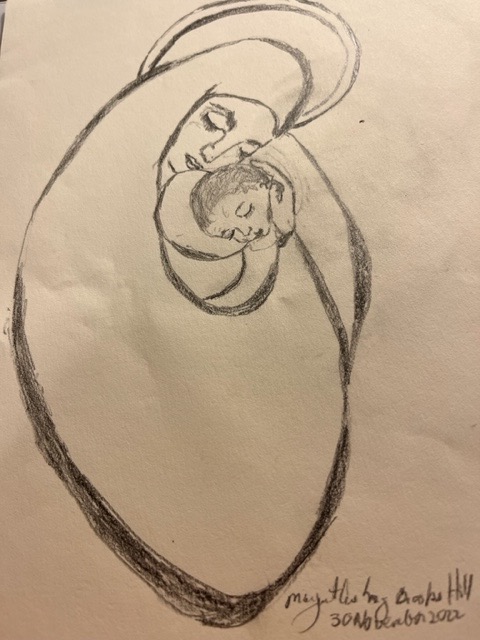
Mary and Jesus by Margaret Hill

Words by Johnna Fredrickson and Image by Margaret Hill, children of God.

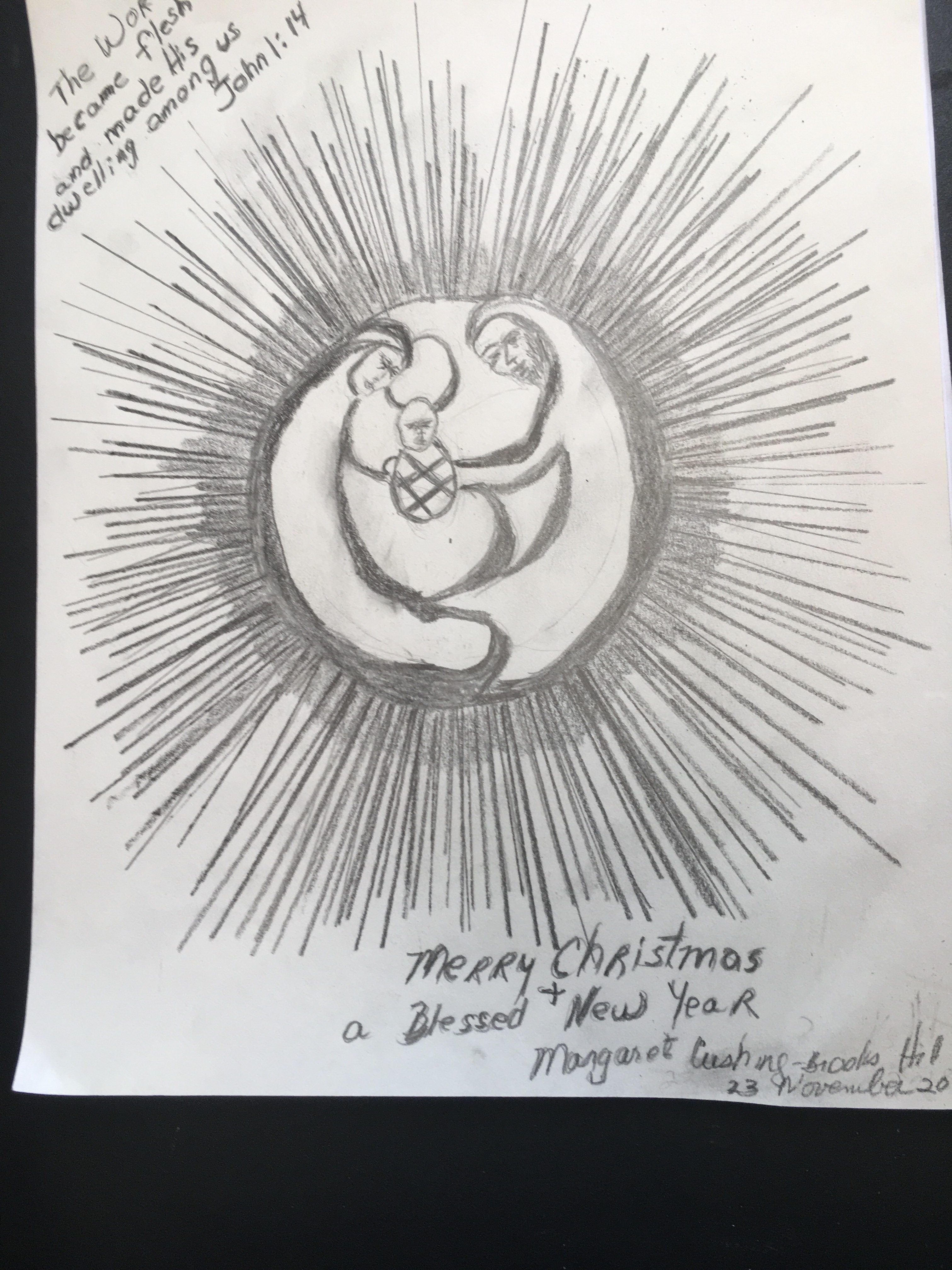
Mary’s Song

Readings: Luke 1:46b-55; Isaiah 33:17-22; Revelation 22:6-7, 18-20

Modern Magnificat by Joy Cowley

My soul sings in gratitude.

I’m dancing the mystery of God.

The light of the Holy One is within me

and I am blessed, so truly blessed.

This goes deeper than human thinking.

I am filled with awe

at Love whose only condition

is to be received.

The gift is not for the proud,

for they have no room for it.

The strong and self-sufficient ones

don’t have this awareness.

But those who know their emptiness

can rejoice in Love’s fullness.

It’s the Love that we are made for,

the reason for our being.

It fills our inmost heart space

and brings to birth in us the Holy One.

[From John Shelby Spong’s website, A New Christianity For A New World, 19 December, 2007; progressivechristianity.org]

A young and innocent Mary  approached by an Angel with a message that would change her life forever.  I am in awe of her.  She is so brave and it makes me ponder as to whether I could have been so accepting of this Angel’s message.  Mary was humble yet strong, fearful yet faithful.  She could have been miserable, but instead magnifies the Lord.  Instead of a feeling of helplessness, she responds with how blessed she is.  

Christ came to challenge the structures of sin, death and oppression.  He came to do what he has always done: to lift up the lowly, free the enslaved and feed the hungry.  Mary was able to  surrender to God’s will  knowing that this was not about her but  something much bigger and transforming.  

I think we all struggle with wanting to control situations in our lives.  I believe that if we surrender to God’s will as Mary did and believe the Good News, our lives will be blessed with all God has to offer us.

Offered by Donna Ciulla, child of God.

Thomas

Readings: Isaiah 62:6-12; Psalm 97; Titus 3:4-7; John 20:24-29

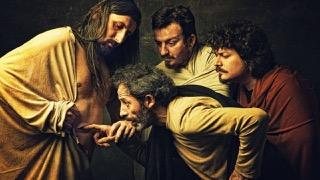
But Thomas (who was called the Twin), one of the twelve, was not with them when Jesus came. So the other disciples told him, “We have seen the Lord.” But he said to them, “Unless I see the mark of the nails in his hands, and put my finger in the mark of the nails and, my hand in his side, I will not believe.”

A week later his disciples were again in the house, and Thomas was with them. Although the doors were shut, Jesus came and stood among them and said, “Peace be with you.” Then he said to Thomas, “Put your finger here and see my hands. Reach out your hand and put it in my side. Do not doubt, but believe.” Thomas answered, “My Lord and my God!”

Jesus said to him, “Have you believed because you have seen me? Blessed are those who have not seen, and yet have come to believe.” John 20:24-29, NRSV

Today we commemorate the Apostle Thomas – aka Doubting Thomas. He not only doubted the Lord’s bodily resurrection, he doubted his friends who said they had seen the resurrected Jesus.

Well, I get Thomas. What a wild story. He knew Jesus had died on a cross, and now he’s up walking around? Come on.

And soon a virgin is about to give birth. Let’s face it, the Bible is full of hard-to-believe stories. Theologians over the years have attempted to explain them. The Historical Jesus movement has tried to minimize the miracles to make our faith more pragmatic. Well, good luck with that.

Our faith is full of miracles. They are happening every moment of every day. Jim Wallis, founder of Sojourners magazine and author of numerous books on theology, defines hope as believing in spite of the evidence and watching the evidence change. Jesus exhorts Thomas to stop doubting and believe. That’s good enough for me.

Lord, I believe. Help thou my unbelief (Mark 9:24)

May your Advent be full of miracles.

Offered by Bill Albritton, child of God.

Moving into God’s presence through words