Category Archives: Prayer

Strength, obedience, service

I arise today (I bind unto myself this day)

Through the strength of the love of cherubim,

In the obedience of angels,

In the service of archangels,

In the hope of resurrection to meet with reward,

In the prayers of the patriarchs,

In the predictions of prophets,

In the preaching of apostles,

In the faith of confessors,

In the innocence of holy virgins,

In the deeds of righteous men.

Saint Patrick’s Breastplate, Third stanza (For complete prayer, click Lent 2016: Saint Patrick’s Breastplate)


I don’t bind unto myself or arise through strength or in obedience and service in general: I do so through the strength of the love of cherubim, in the obedience of angels, and in the service of archangels. Strength, obedience, and service to all that is holy and compassionate can transform the world, bringing creation closer to the heart of God. Strength, obedience, and service to anything less can break the spirit and bring devastation to the universe. I must be careful what I bind unto myself and what gives me the strength to arise.

Cherubim, angels, and archangels live before God and for God. They see and serve the Mystery of the Creator and Sustainer. If I ever encounter one, I’ll be frightened by my own helplessness in the presence of such power (I’ll definitely need a “fear not”). But they come from the God who loves me and will not harm me. Instead of annihilation from such strength, obedience, and service, I arise because of it.

But I don’t live before and for God with my whole self. I am capable, willing even, to seek partial power for myself rather than rest in the holiness of God. I seek my own good at the expense of others. I cannot wish good things for my enemies, or even my friends, unless the love of God surrounds me.

But I dare to arise because others have arisen. Not completely, not without mistakes, but arisen nonetheless: patriarchs, prophets, apostles, confessors, holy virgins, and righteous men who dared to live in and for God’s love.

Now, it’s my turn.

 

cropped-nighttracks.jpg

Ash Wednesday: Saint Patrick’s Breastplate

I arise today 


Through a mighty strength, the invocation of the Trinity,


Through belief in the Threeness,


Through confession of the Oneness


of the Creator of creation.

The wonder-full arising – a daily blessing, miracle even, when I arise with God’s mighty strength. When I praise God for this day with my first breath upon awakening, the Creator of creation is known to me;

the one who became like you and me, who walked through History with dusty feet and showed us the Way, cementing salvation in our souls, is known to me; the one who is in me, nearer than hands and feet, closer than that first awakening breath, whose presence is real when I am truly awake, is known to me.

I have called these realities the Father, Son, and Holy Spirit but they are the One. Whatever I say about God the Father – omnipresent, eternal, loving – can be said of Jesus and the Spirit. What a great God we serve who has pulled out all the stops to be known in this moment of awakening.

May I be truly engaged this first day of Lent, this Ash Wednesday, in this Presence – and throughout these 40 days be tuned in to the Frequency that is my life.

Offered by Bill Albritton, teacher, leader, follower of Christ.


Brilliant Light, Gathering Darkness

Six days later, Jesus took with him Peter and James and his brother John and led them up a high mountain, by themselves. And he was transfigured before them, and his face shone like the sun, and his clothes became dazzling white. Matthew 17:1-2, NRSV

The season of Epiphany ends here on this mountaintop. The disciples see Jesus shining like the sun, and they are nearly blinded by the light. But this isn’t a story about Jesus having a supernatural transformation: he didn’t change on that mountain, the disciples did. Their blindness fell away and they saw Jesus as he always was: divine and human.

This is one of my favorite passages in the New Testament. It says something about who Jesus is (God’s son, real person), and something about who I am – capable of seeing the glory of God in this life and equally capable of closing my eyes to it in willful blindness. Even when I see the glory of God, I am as likely to misunderstand its meaning in my life as Peter did just a few short verses later. The glory of God is more than a brilliant light burning on a mountaintop. This light is the living, breathing, love of God who will leave the heights to bring light and hope to the darkest of places.

The shadows are darkening, and the road to Jerusalem beckons. The brilliance of this mountaintop transfiguration will shine into resurrection. But the days in between are dark, and I am afraid. I would not dare to walk this road alone. But I walk with all the faithful who have ever lived. Like Saint Patrick did when in danger, I will arise to walk the road, and I will bind unto myself the strength of God. I will dare to follow Jesus on this Lenten road…

[Note: A different part of Saint Patrick’s Breastplate will be the focus for each week of Lent. To read the full prayer, click Lent 2016:Saint Patrick’s Breastplate at the top of the page. Background information on the prayer and resources for further study can be found by clicking About Saint Patrick’s Breastplate.]

Christ is Born!


Readings: Isaiah 62:6-12; Psalm 97; Titus 3:4-7; Luke 2:8-20

When they saw this, they made known what had been told them about this child; and all who heard it were amazed at what the shepherds told them. But Mary treasured all these words and pondered them in her heart.” Luke 2:17-19

IMG_3246

Today the  Word is made flesh. This Word that was in the beginning, that created all things, is now here in our midst as one of us. I love Eugene Peterson’s translation of John’s prologue in The Message: “The Word became flesh and blood and moved into the neighborhood…” and now the neighborhood, the world, the cosmos is changed forever. Merry Christmas indeed! I love equally the joy experienced by the shepherds who are the first team of missionaries making known to all their conversion experience. And I love Mary—she who treasured and pondered all that had happened and is happening. This Grand Miracle, as C.S. Lewis calls it, may be best expressed in a “Hymn on the Nativity” by Ephrem of Syria (c.306-373).

Your mother is a cause for wonder: the Lord entered her
and became a servant; he who is the Word entered
and became silent within her; thunder entered her
and made no sound; there entered the Shepherd of all,
and in her he became the Lamb, bleating as he came forth.

Your mother’s womb has reversed the roles:
The Establisher of all entered in his richness,
but came forth poor; the Exalted One entered her,
but came forth meek; the Splendrous One entered her,
but came forth having put on a lowly hue.

The Mighty One entered, and put on insecurity
from her womb; the Provisioner of all entered
and experienced hunger; he who gives drink to all entered
and experienced thirst: naked and stripped
there came forth from her he who clothes all.

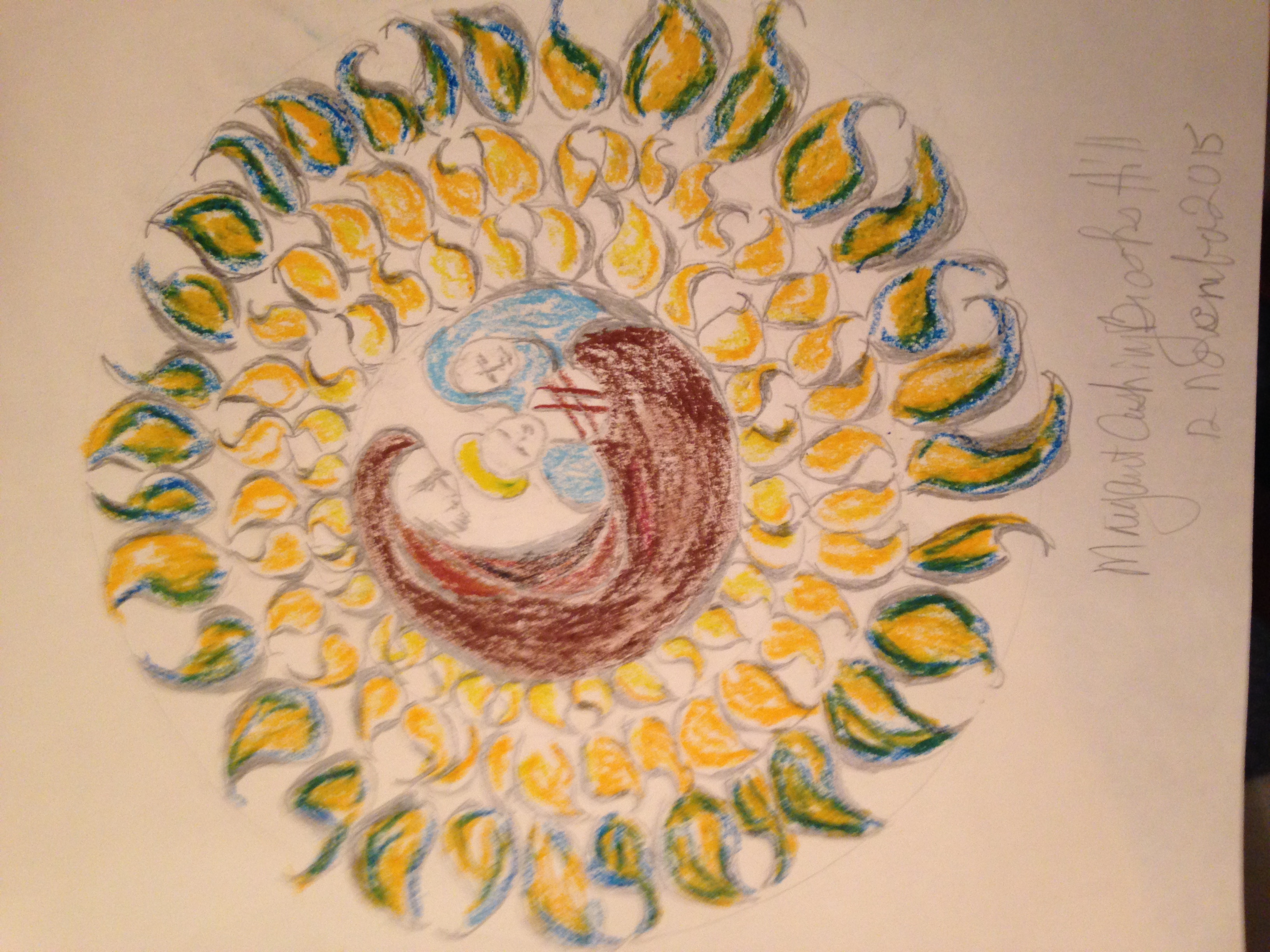
Holy Family artwork offered by Margaret Hill and words offered by Bill Albritton, companions seeking the Christ Child.

Insignificant

Readings: Micah 5:2-5a; Luke 1:46b-55; Hebrews 10:5-10a

But you, O Bethlehem of Ephrathah, who are one of the little clans of Judah, from you shall come forth for me one who is to rule in Israel… Micah 5:2a

For he has looked with favor on the lowliness of his servant... Luke 1:48 a

Ever feel insignificant? By whose definition? Well, we know it’s not God’s if we even casually read the scriptures. Bethlehem is called one of the little clans of Judah, insignificant by most standards. In The Message, Eugene Peterson calls it “the runt of the litter.”

And what about Mary – a lowly servant who sings of how the proud are scattered and the powerful are dethroned and the lowly lifted up? The Bible is replete with so-called insignificant places and people being exalted by God. It seems God’s standards of significance are quite different.

When God emerges from the womb of an “insignificant” young woman to walk among us, heal us, feed us, save us, whom does this Jesus choose as his closest companions? Pretty much a bunch of insignificant people. As we celebrate the coming of our Lord this week, let us be reminded of True Significance, of what really matters (one definition of significant is the extent to which something matters).

Born of a lowly servant in a one-horse town, in a stable with that horse and other insignificant animals, and worshipped by a group of lowly shepherds, we find the One who matters the most in our lives as Christians. The One who changed the world.

Maybe we should reconsider our definition of insignificance as we welcome him into our hearts. And may we know our true significance in the heart of God this Christmas.

Come, Lord Jesus, Come.

Offered by Bill Albritton, prayer team leader, faith educator, child of God.


Leading the Blind

Readings: Psalm 80:1-7, Isaiah 42: 10-18, Hebrews 10: 32-39

I will lead the blind by a road they do not know, by paths they have not known I will guide them. I will turn the darkness before them into light, the rough places into level ground. These things I will do, and I will not forsake them. Isaiah 42:16

There’s a difference between being lost and exploring a new place without a clear idea of my current position. I’ve been both in Boston. If I stray off the ever popular Freedom Trail, with its line of bricks to guide me, I end up who knows where. With a bit of faith and luck, I’ve ended up eating a delicious meal in the North End, finding the Museum of Fine Arts by way of the Fens, and standing in Cambridge and Boston at the same time in the Museum of Science. I’ve also ended up on dead end streets lined with dumpsters, the Charles River Esplanade in plain sight and no way to get to it. Lost or exploring new territory? For me, the difference is mainly emotional. Lost feels anxious and not quite safe; exploring feels exciting and confident.

But what if I walk in blindness? How would I know where I stood? How could I tell someone else how to find me? If my eyes cannot see, an unknown pathway means I am lost. Would I have the courage to walk such a path in the dark? Staying put or walking, I am afraid if I am alone.

The same could be said for this journey that is my life. In times of blindness, I am afraid to walk and afraid to say put if I am alone. But I am not alone. I have a guide who loves me and brings me home. Not only that, this guide turns my blindness into light. No longer blind, held fast, brought home.

Guide me, Lord, in life and in life beyond death. Amen.

Come, Lord Jesus, Come.

Rules and Hearts

Readings: Psalm 80:1-7; Jeremiah 31:31-34; Hebrews 10:10-18

The days are surely coming, says the Lord, when I will make a new covenant with the house of Israel and the house of Judah. It will not be like the covenant that I made with their ancestors when I took them by the hand to bring them out of the land of Egypt—a covenant that they broke, though I was their husband, says the Lord. But this is the covenant that I will make with the house of Israel after those days, says the Lord: I will put my law within them, and I will write it on their hearts; and I will be their God, and they shall be my people. No longer shall they teach one another, or say to each other, ‘Know the Lord’, for they shall all know me, from the least of them to the greatest, says the Lord; for I will forgive their iniquity, and remember their sin no more. Jeremiah 31:31-34

The temptation is to think that Christians have it made on this one. That somehow we’ve moved beyond the law to a relational faith based in Jesus. Because it is relational, we reason, it’s not about rules and regulations, but truly is a covenant written in our hearts.

Not so fast!

People are by their very nature, it seems, rule makers. So we good Christians who have been offered the gift of relationship with Jesus Christ have just as many rules, regulations and laws about faith as anyone else. Depending upon your theological orientation these “laws” are about prayers that need to be said, practices that need to be engaged, good deeds that need to be done, or beliefs that need to be held. These are what provide entre into the relationship or prove that the relationship is genuine. It’s all rational, cerebral and in almost all cases can be quantified. Even churches do it, keeping detailed accounts of the number of programs offered, pastoral visits made, baptisms perform, attendees in worship, and the size and growth of the budget. This, we assume, is a sign of faithfulness and provides assurance of God’s blessing. But it’s not about the heart.

Faith based in the heart is relational in the truest sense. It is fostered in love and shows itself in love. It dismisses rules and quantifiable criteria and lets go of the need to prove anything to anyone. This is the relational love we celebrate in the Incarnation. And the truth is it is so foreign to the way the world operates, we need to take significant time to prepare ourselves to receive it. That’s what Advent is about. It is a time to let go of the law that governs our existing and embrace the love that give full, abundant and eternal living possible. This is the covenant that is within, the gift that is offered to us at Christmas.

Come, Lord Jesus, Come.

Offered by Jeff Jones, writer, teacher, pastor, child of God.

Seeing Jesus and John

Readings: Isaiah 11:1-9, Micah 4:8-13, Luke 7:31-35

“To what will I compare the people of this generation, and what are they like? They are like children sitting in the marketplace and calling to one another, We played the flute for you, and you did not dance; we wailed, and you did not weep.’

For John the Baptist has come eating no bread and drinking no wine, and you say, ‘He has a demon’; the Son of Man has come eating and drinking, and you say, ‘Look, a glutton and a drunkard, a friend of tax collectors and sinners!’ Nevertheless, wisdom is vindicated by all her children.”

Do I see only what I want to see? Without wisdom, certainly.

When I seek the face of God, there’s nothing that can’t reveal it.

When I seek my own reflection and call it God, everything and everyone disappoint.

If I try hard enough to avoid the holiness around me, I’ll turn even John and Jesus into a hippie and a low life.

Gracious God, Open my eyes.

Come, Lord Jesus, Come.

Let There Be Peace On Earth

Readings: Isaiah 11:1-9; Numbers 16:1-19; Hebrews 13:7-17
“They will neither harm nor destroy on all my holy mountain
for the earth will be full of the knowledge of the Lord
as the waters cover the sea.” Isaiah 11:9

The time is 740 to 689 BCE and the Middle East is in turmoil. At various times there are wars between Assyria, Babylon, Syria, Israel, Southern Mesopotamia and so on. Sound familiar? The situation is so dire that the prophet Isaiah is called by God in words so intense that he is compelled to speak God’s words to the people.
The prophecy begins with the promise of a messiah to bring back the “good times” of the Davidic dynasty. The ruler to come will be full of wisdom and understanding and of “the fear of the Lord.” But the leaders of Isaiah’s time are not following God’s plan for His people. They ignore the poor and needy and have forgotten justice and righteousness.
As we watch the terrible news and events that encompass our world today, we long for the same kingdom that God revealed to Isaiah so many centuries ago. We see the terrible pain and suffering of the innocent as leaders seek power and drive people from their homes. We watch children and their parents dying of starvation and disease and others with no hope for a future. We want to help. We want to live in a world where there is no more hatred or poverty and where we live in harmony with each other and all God’s creation: where “the wolf will live with the lamb, the leopard will lie down with the calf and the lion and the youngling together, and a little child will lead them.”
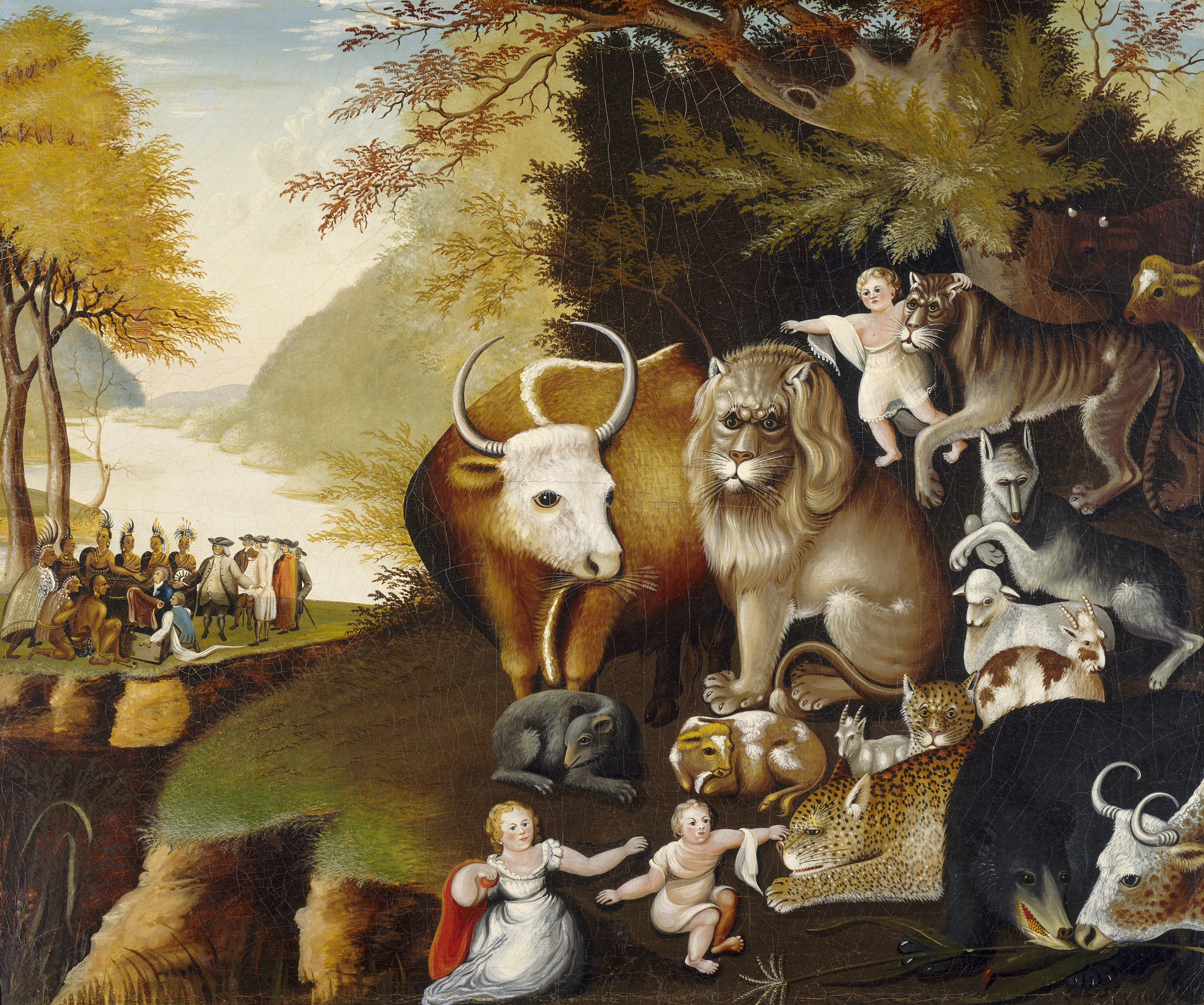
How are we to bring about the promise of the Kingdom that was part of Isaiah’s prophecy? Edward Hicks, an eighteenth century American artist, painted a much loved picture, “The Peaceable Kingdom.” And in that picture is the answer:

Edward_Hicks_-_Peaceable_Kingdom

Let There Be Peace On Earth

Offered by Marge O’Brien, worker and pray-er for peace, child of God.

Come, Lord Jesus, Come.

The Coming(s)

Readings: Isaiah 12: 2-6, Amos 9:8-15, Luke 1:57-66

Shout aloud and sing for joy, O royal Zion, for great in your midst is the Holy One of Israel. (Isaiah 12:6)

We are well into our Advent journey by now and perhaps getting a little tired of the darkness that surrounds this season. Not only are the days getting progressively shorter, at least for those of us in the Northern Hemisphere, but the period between Thanksgiving and Christmas is all too often fraught with sadness and loss. Clergy know to prepare themselves for the onslaught of funerals that often accompany this time of year.

Every one of us knows someone who is struggling to find joy and peace at this time of the year, someone who is trapped in the darkness of the Advent season figuratively looking east with great anticipation for the dawning of the light. Perhaps this is why so many of us can’t wait to put the Christmas lights up and decorate our Christmas trees the weekend following Thanksgiving, so we can be captivated by the festive lights and perhaps even skip through Advent altogether.

I for one am grateful for the reading from Isaiah today that finishes so powerfully. “Shout aloud and sing for joy, O royal Zion, for great in your midst is the Holy One of Israel.” This scripture text can be understood in so many different ways, but to me it is best captured in a sermon written by St. Bernard of Clairvaux (1090-1153). In his sermon Bernard wrote, “We know that there are three comings of the Lord…. In the first coming our Lord came in our flesh and in our weakness; in this middle coming he comes in Spirit and in power; in the final coming he will be seen in glory and majesty…. In the first, Christ was our redemption; in the last, he will appear as our life; in the middle coming, he is our rest and consolation.” (The Liturgy of the Hours, vol. 1, Advent and Christmas, Catholic Book Publishing Corp., New York, NY: 1975, pp. 169)

I find this to be a life-giving revelation that is often overlooked or misunderstood. The truth is, Christ does come to each one of us not just in the incarnation (Christmas) or the parousia (the end of time), but in every moment of our lives. You and I live in the midst of this sacred truth with every breath that we take. The present moment is infused with hope and meaning, with light in which no darkness can stand, but we need to seek it, even when the darkness seems impenetrable to us. In our midst is the Holy One of Israel and the truth is, there isn’t a thing that we can say, do, or even experience that can change this.

Lord Jesus Christ, you are in our midst, right now, as light banishing the darkness. Help us to first seek and recognize you and then help us to welcome you into every moment. Amen. 

Offered by Dave Fredrickson, spiritual director, priest, seeker of the face of God, child of God.