Category Archives: Prayer

Ashes to Ashes

In two days, crosses of ash will be drawn on foreheads. With the swipe of a finger and a few words, Lent will begin. Some people will give up desserts or alcohol while others will add daily devotional readings and service projects. Whether adding something positive or subtracting a negative habit, a change in behavior is how most people observe Lent. It’s what I’ve done for most years of my adult life. Sometimes these actions have brought about a deeper understanding of my faith and sometimes they haven’t. But each of them created the chance for me to live with greater intention, even if only in a single aspect of my life.

For the past four years, I’ve chosen a particular topic for Lent – specific prayers or poetry, parables, deadly sins or life-giving virtues have filled this blog with words and images. Others have been kind enough to add their art or words to the mix, giving everyone (most especially me) the gift of a different voice and different perspective.

This year, I’ll be looking at some of the word gifts I’ve received over the past couple of months: The Daily StoicDaily Peace, and The Book of Joy. The first two were surprises, the third one I requested. All three provide opportunities to get my inner house in order, see the world around me in all its glory, and thank God for the precious life I’ve been given.

I hope you come along with me through this path of words, and perhaps add a few of your own…

Resources:

Holiday and Hanselman, The Daily Stoic: 366 meditations on wisdom, perseverance, and the art of living (New York: Portfolio/Penguin Press, 2016)

Daily Peace: 365 Days of Renewal (Washington, D.C.: National Geographic Society, 2015)

Dalai Lama and Desmond Tutu, The Book of Joy: Lasting Happiness in a Changing World (Avery, 2016)

Uncovering the Pattern

I got a mandala scratch kit a couple of weeks back, complete with instructions, a wooden stylus, and 25 scratch squares stamped with mandala patterns –  a birthday gift of relaxation from my sister. For the past couple of weeks, I’ve been tracing lines and uncovering mandala patterns as my 20 minute morning meditation activity, matching my breathing to my hand’s movements. Faithful to the tradition of mandala creation, I don’t keep the finished mandalas for very long – all things are temporary, and letting go of my own handiwork is a spiritual discipline in its own right.

It takes me three or four days to complete each scratch mandala. I take my time, choosing which shapes to uncover first, which lines to trace, what areas to uncover and what ones to leave alone. I pause every few minutes to see how my latest marks have changed the look of the whole. When the twenty minutes are over, I take some time to look at the mandala and reflect on how it served as a spiritual focus. It’s at this time that I see how my own work falls into a pattern. There’s a pattern to how I’ve uncovered the mandala pattern. If it’s a six section pattern, I reveal the same part of each section: six circles or diamond patterns standing equidistant from the center and the outer edge of the mandala. Six flower petals around the circles, six rays connecting the petals to the center, and so on. For whatever reason, this way of revealing the overall mandala pattern is satisfying to me, providing a balanced if partial pattern as I work to reveal the whole.

I shared this meditation activity with the class of high school learners I see every Sunday. At the end of the 20 minute exercise, everyone held up their mandala. Some had started in the center, working their way out of the pattern. Others had started by revealing the outer edges and working inward. One or two worked in wedges, completing one whole symmetrical section before moving onto another one. Within these overall work patterns, each person chose the order of individual elements to uncover. Each person’s approach was unique – not a single replication. Each way had its own peculiar beauty and sense.

For me, it was an illuminating experience in the literal as well as the figurative sense. Revealing the pattern by drawing out the brilliant color underneath the black surface produced an illuminated mandala; seeing each person’s unique approach to this spiritual practice revealed his or her particular embodiment of God’s grace and holiness. Being a part of such an extraordinary moment in time and space, how can I be anything but awestruck by this sacred place and these sacred people?

Snow(y) Day

Tuesday, January 30, 2018

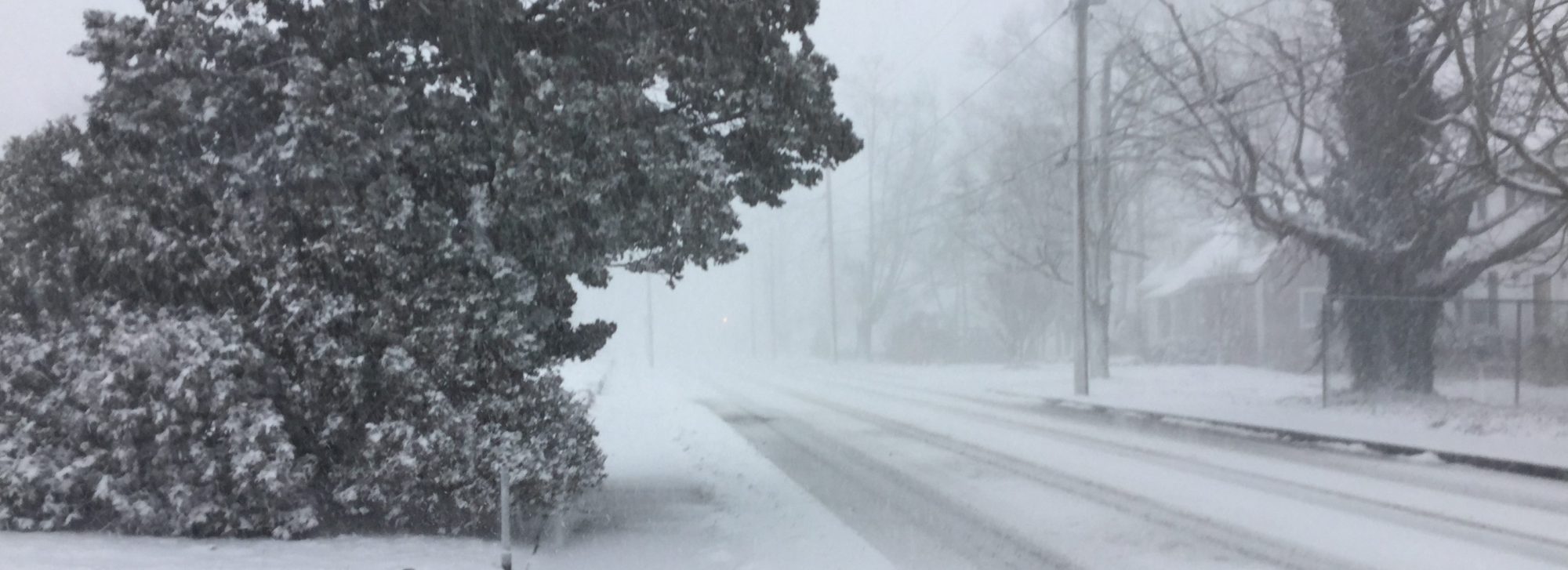
It’s a snowy day, and a school-is-cancelled snow day. After an indoor morning of prayer, writing, and cleaning, I am happy to see that the winds and driving snow have given way to a light breeze and an occasional snowflake. I put on my winter clothes and walk into nature’s crystal white. My street has been plowed, but no one is outside. It’s just me until I turn onto High street. A mother and daughter are shoveling their driveway a few houses down, and the two little girls who live in the big white house are making angels while their mother and uncle look on. Once every minute or so, a car or truck passes. In between, there’s only the scrape of shovels and the crunch of boots to break the peaceful quiet of this place.

No one’s walked on the sidewalks in the past few hours, and only a couple of homeowners have cleared the sections in front of their houses. I think I see the faint print of a boot every so often – someone who walked early in the morning, perhaps. Just like Peter in Keats’ The Snowy Day, I make different patterns in the snow by pointing my feet in or out, or by dragging them to make two long lines. It’s one of my favorite children’s books, one I loved as a young child and I loved as the mother of young children. As I make my marks in the snow, I wonder how many other people have done the same because of Keats’ words and pictures – millions, I’d guess.

The wind has made snowdrifts across parts of the sidewalk and swept other parts almost clean. Mother nature seems happy to give my feet a varied path and my eyes a feast of snowy geometry and graceful evergreen. I’m so glad I came outside. I wouldn’t have missed the sharp fresh air, the joy of this walk, or the beauty of my blanketed neighborhood for anything.

Doors

I’m on my fourth day of deep cleaning, working my way around the kitchen and into the side entry hall. All my baking supplies have been taken out and sorted, the cupboard cleaned inside and out, and goods replaced. After I shut the cupboard doors, only the faint scent of peppermint soap and vinegar gives any indication of the changes within. It’s only when I open the doors that the impact of my work can be seen.

It only takes a quick glance to appreciate the cleaning efforts in my side entry hall. Scuff marks are gone from baseboards, fingerprints and dirt removed from light switches. The magnets holding keys, bags, sunglasses, and mail are bright and shiny, as is the metal board that holds them to the wall. These are the things that anyone coming into the house might see. But it’s what most of us don’t notice that captured my attention today: doors.

There are three in my entry hall: separating the outdoors from the inside, leading to the cellar, and a usually hidden recessed door marking the entry to the kitchen. The two I can see mark and maintain the transitions from one space to another, keeping cold winds and rain from coming in and people from taking a tumble down the basement stairs. The one that’s usually hidden in the wall can keep my two cats away from people allergic or afraid of them, and provides an extra barrier to the cold if a snowstorm knocks out the power. The ability to connect and separate, to protect and invite, standing silently within arm’s reach – this belongs to these rectangular creations of wood and glass.

Hiding and revealing, connecting and separating, opening and closing. Keeping watch over the space that goes from one place to another. Marking transition from one reality to another: it’s often said that silence, prayer practices, and worship are doors to the great mystery of God. Through them the Spirit draws me into a love far deeper than I can see or imagine. Perhaps I should pay attention to these doors as well. Who knows where I might find myself when one opens and I walk on through.

My Mouth Will Proclaim

Readings: Psalm 89:1-4, 19-26; 2 Samuel 6:1-11; Hebrews 1:1-4

I will sing of your steadfast love, O Lord, forever;

with my mouth I will proclaim your faithfulness to all generations.

I declare your steadfast love is established forever;

your faithfulness is as firm as the heavens.

You said, “I have made a covenant with my chosen one,

I have sworn to my servant David:

I will establish your descendants forever,

and build your throne for all generations.”

Psalm 89:1-4

Offered by Colin Fredrickson, artist, college student, child of God.

Standing Strong

Readings: Psalm 125; I Kings 18:1-18; Ephesians 6:10-17

Those who trust in the Lord are like Mount Zion,

which cannot be moved, but abides forever.

Psalm 125:1

Finally, be strong in the Lord and in the strength of his power.

Put on the whole armor of God, so that you may be able

to stand against the wiles of the devil…therefore take up the whole

armor of God, so that you may be able to withstand on that evil day,

and having done everything, stand firm.

Ephesians 6:10, 13

Stand your ground.

Sometimes, those words are taken as an offensive posture: when fearful, fire first. But that’s not what it means in the Psalms or Ephesians. It isn’t a paraphrase of the best defense is a good offense. This is about finding the courage and the faith to endure the attacks of others without striking back or falling apart. The armor of God is worn to strengthen the self to survive with heart and soul intact, whatever may come. When surrounded by evil, when darkness threatens to overwhelm, the armor of God gives its wearer enough strength and wisdom to stand rather than cower, to hope rather than fall into despair.

Strength and aggression are not the same. True strength enables us to remain who we are – compassionate people of faith who follow a manger born savior – in the face of danger and uncertainty. It allows us to act as we believe, to return compassion for hatred and exercise restraint when threatened. Strength allows us to choose love even on a day when others choose evil.

Standing firm, remaining unmoved, withstanding. When the time of trial arrives, I’ll need the whole armor of God to do these things. Otherwise, in my weakness and fear, I just might be an agent of evil rather than a disciple of the Lord.

Hold my hand, dear Lord. Help me stand.

An Age of Grief


Third Sunday of Advent

Readings: Isaiah 61:1-4, 8-11; Psalm 126 or Luke 1:46b-55; I Thessalonians 5:16-24; John 1:6-8, 19-28

“The Spirit of the Lord God . . . comfort[s] all who mourn . . . faithfully give[s] them their recompense . . . The Lord has done great things for them.”  Isaiah  61:1-3, Psalm 126:3

Five years ago as my beloved grandmother approached her dying transition she told me that she felt as if she was being punished.  This observation had a lot to do with her unhappiness about living her last years in a nursing home, about grieving the loss of more and more physical abilities, and about her isolation from loved ones.  She further said that she couldn’t understand why she was being punished because “all I have done is gotten old. And that is not a crime.”

As I’ve watched how our culture treats elders, I am wont to wonder if, in our culture, it is a crime.  We segregate elders into institutionalized settings with rigid rules and authority figures who tell them how to spend their time.  Sounds like prisons, no, nursing homes.  We make all major and many minor decisions for them, just like prisoners.  We lose patience with their increasing inability to keep pace, understand, and navigate our frenetic world. So, we marginalize their involvement in our lives.  We withdraw our social favor by ignoring them because they and their frailties make us feel uncomfortable and burdened.

I read an outstanding book recently that addresses all these issues and puts elder treatment into poignant perspective:  Being Mortal_by Dr. Atul Gawande.  The author teaches the history of assisted living and end-of-life medical decision making in the context of what his own family experienced during his father’s decline and death.  My main takeaway from the book was that what we, the children of aging parents, want for our parents — that would be safety — is in direct conflict with what they want for themselves:  independence.  This tug-of-war for control reminded me a lot of what occurs between toddlers and their parents.  It is no wonder inter-generational meltdowns abound.

Pondering this strife-filled conundrum, I am reminded of how elders were treated in the novel The Giver by Lois Lowry.  They were given the suggested “choice” of voluntary euthanasia.  It was unclear how many made this choice under societal duress and how many welcomed it as a solution to the misery their long and debilitated lives had devolved into.

Into this situation comes the above quoted verse from Isaiah.  Do the aged feel comforted and recompensed?  My personal experience as an elder caregiver is that there is less grace and more “rage against the dying of the light (D. Thomas, “Do Not Go Gentle Into That Good Night”).  Sometimes it seems as if “the greatest thing” the Lord does for them is to end their suffering when they die.  It is miles above my understanding to see clearly into the life of this exchange, but I want to hope that it is true.

As we live longer, we face more challenges.  I would recommend Dr. Gawande’s book to anyone who is ministering to aging family members or, not even that specifically, to anyone who needs compassion when dealing with the decisions and choices of others.  It is a beautiful love story to his father but it also offers the hope of the Isaiah passage (aptly labeled the Exaltation of the Afflicted).  In the end, at the end, we all need each other.

Come, Lord Jesus, Come.

Offered by Jill Fredrickson, compassionate nurturer, business woman, child of God.

Expectations

Readings: Isaiah 40:1-11; Psalm 85:1-2, 8-13; 2 Peter 3:8-15a; Mark 1:1-8

A voice cries out: “In the wilderness prepare the way of the Lord,

Make straight in the desert a highway for our God. Isaiah 40:3

The beginning of the good news of Jesus Christ, the Son of God. As it is written in the prophet Isaiah,

See, I am sending a messenger ahead of you, who will prepare your way;

The voice of one crying out in the wilderness: Prepare the way of the Lord, Make his paths straight.

John the baptizer appeared in the wilderness, proclaiming a baptism of repentance for the forgiveness of sins… Mark 1:1-4

Why do I expect the miraculous to be blatantly, glaringly obvious? Super size and high volume don’t guarantee anything other than a long shadow and temporary hearing loss. So why do I expect God’s messenger to be a rock star, crowd pleaser, larger-than-life superman?

John wasn’t powerful among the religious leaders. He didn’t wear expensive clothes or dine at the finest restaurants, he had no army and no money. He just gave witness to God’s presence in this world and saw in Jesus God-With-Us. That’s more than enough: that’s a miracle.

Would I recognize John if I passed him on the street? Would I hear his voice? Would I listen?

Come, Lord Jesus, Come.

Steadfast Love

Readings: Psalm 85:1-2, 8-13; Hosea 6:1-6; I Thessalonians 1:2-10

For I desire steadfast love and not sacrifice,

The knowledge of God rather than burnt offerings. Hosea 6:6

Steadfast love and faithfulness will meet;

Righteousness and peace will kiss each other.

Faithfulness will spring up from the ground,

And righteousness will look down from the sky.

The Lord will give what is good, and our land will yield its increase.

Righteousness will go before him, and will make a path for his steps.

Psalm 85:10-13

God, Self, Neighbor. Everything in faith is about the relationship of these three. What I do is never done in a vacuum. If I give money to worthy causes only for the recognition it brings me, I’ve missed the point: knowing God’s heart, the holiness of my neighbor and the meaning of my own life. I don’t want to miss the point. I don’t want to mistake self-righteousness for righteousness.

It’s not easy, living a life of deep God-Self-Neighbor awareness. But an easy life isn’t really what I want. A righteous and faithful one is. When I seek God, I must do so without harming others – even and most especially the ones I don’t like and don’t agree with. When I encounter my neighbor, I cannot forget that he or she is God related and God created- just like me. Steadfast love, faithfulness, and peace – gifts God offers that can only be opened with the help of my neighbor.

Guide my feet, O Lord, on this road to Bethlehem.

Photograph by Jared Fredrickson, high school learner, keen observer of life, child of God.

Psalm 85 Remembering Pearl Harbor

Isaiah 40:1-11; Psalm 85:1-2, 8-13; 2 Peter 3:8-15a, Mark 1:1-8

Lord, you were favorable to your land;

you restored the fortunes of Jacob.

You forgave the iniquities of your people; 

you pardoned all their sin.

Let me hear what God the Lord will speak,

for he will speak peace to his people,

to his faithful, to those who turn to him in their hearts.

Surely his salvation is at hand for those who fear him,

that his glory may dwell in our land.

Steadfast love and faithfulness will meet;

righteousness and peace will kiss each other.

Faithfulness will spring up from the ground,

and righteousness will look down from the sky.

The Lord will give what is good,

and our land will yield its increase.

Righteousness will go before him,

and will make a path for his steps.

Dear Lord,

Help us always to be grateful for the blessings you have bestowed on us in this country. May we always pray for guidance for our leaders, and those of other countries, and for peace among all nations. Amen.

Offered on December 7, 2014, by Mary Roberson, financial advisor, prayer hotline volunteer, child of God, who was a young child when Pearl Harbor was bombed.