
Category Archives: Meditation

Don’t let the screen door hit you…

Readings: Psalm 42; Zechariah 8:1-17; Matthew 8:14-17, 28-34

When Jesus entered Peter’s house, he saw his mother-in-law lying in bed with a fever; he touched her hand, and the fever left her, and she got up and began to serve him. That evening they brought to him many who were possessed with demons; and he cast out the spirits with a word, and cured all who were sick. This was to fulfill what had been spoken through the prophet Isaiah, “He took our infirmities and bore our diseases.”… When he came to the other side, to the country of the Gadarenes, two demoniacs coming out of the tombs met him. They were so fierce that no one could pass that way. Suddenly they shouted, “What have you to do with us, Son of God? Have you come here to torture us before the time?” Now a large herd of swine was feeding at some distance from them. The demons begged him, “If you cast us out, send us into the herd of swine.” And he said to them, “Go!” So they came out and entered the swine; and suddenly, the whole herd rushed down the steep bank into the sea and perished in the water. The swineherds ran off, and on going into the town, they told the whole story about what had happened to the demoniacs. Then the whole town came out to meet Jesus; and when they saw him, they begged him to leave their neighborhood. [Matthew 8:14-17, 28-34, NRSV]

A place for everything, and everything in its place. Great advice for keeping track of off season clothes, Christmas decorations, and that apple slicer/peeler/corer used once a year for making applesauce. When things have a designated place, it’s much easier to find and use them. It makes life easier. Even if the organizing isn’t perfect, we resist changing it (even if the change is for the better), because changing the world we inhabit is uncomfortable. It isn’t such a big deal when we are dealing with material things: it’s a monumental deal when we are talking about people.

The Gadarenes were used to the two demoniacs blocking passage in a certain part of town; it might have been inconvenient, but everyone adjusted accordingly. Then Jesus throws everything out of whack by healing them – not something the townspeople expected or requested. The way is no longer blocked, but it cost everyone their comfortable routine. Everyone must face these questions: what happens now that the demoniacs aren’t taking up their usual place? What changes have to be made to help them find their new place in the community? This caused so much anxiety among the townspeople that they asked Jesus to leave rather than risk more changes to their predictable communal lives. In the end, they’d rather a few of their own live with demonic possession than disturb the comfortable routine of their communal life – a place for everyone, and everyone in their place, even if it’s killing them.

Jesus dwelling among us means things will change. We won’t be able to treat people like objects, consigning them to a particular place forever because it’s easier than accommodating the blessing of their release from the demons that tortured them. And we won’t be able to lie to ourselves, convincing ourselves that nothing can bring healing to our lives. When Jesus comes into our neighborhood, all kinds of things will change.

The big question: will we ask him to stay or show him the door?

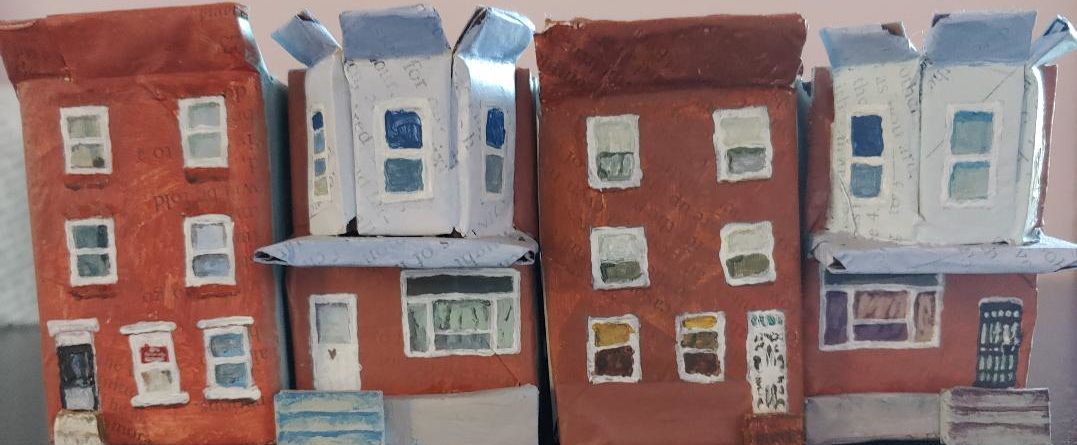
[Three Rowhouses, 2018-2019, by Colin Fredrickson]
Worldly

Readings: Psalm 42; Ezekiel 47:1-12; Jude 17-25

It is these worldly people, devoid of the Spirit, who are causing divisions. But you, beloved, build yourselves up on your most holy faith; pray in the Holy Spirit; keep yourselves in the love of God; look forward to the mercy of our Lord Jesus Christ that leads to eternal life. [Jude 19-21, NRSV]

My friend Karen’s parents did their best to cause trouble between her and her brother, Chris. When Karen got a role in a school play, they asked Chris why he didn’t. When Chris got a summer job, they accused Karen of being lazy because she didn’t. The success of one was always the failure of the other. Karen and Chris were never allowed to be friends, to support each other and be happy in each other’s company. Even after their parents died, they didn’t become close: too much damage had been done.

I think that’s what Jude meant by worldly people: people who do their best to divide and diminish. He saw it as an indication that they were missing a connection with the Spirit; where there should be an abundance of love, there was a void. Perhaps sowing division is all that’s possible with a barren inner landscape. How else to explain parents pitting one child against another?

Until I read this passage, I hadn’t thought about Karen and Chris in years. Jude has given them back to me. In gratitude for this unexpected Advent gift, I’ll give them back to God in prayer.

Lord, bless them and keep them, bring them home to Bethlehem. Amen.

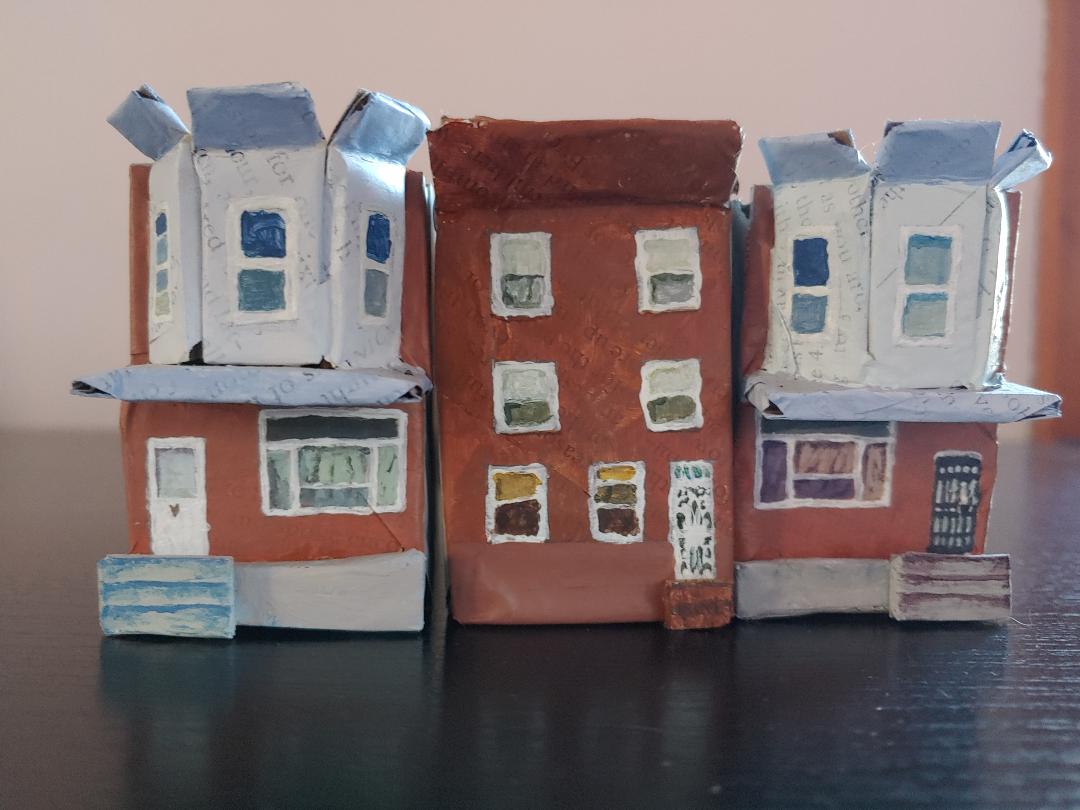
[Three Rowhouses, 2019-2019, by Colin Fredrickson]


A Contemplation of Isaiah 29:18-20

Readings: Psalm 42; Isaiah 29:17-24; Acts 5:12-16

On that day the deaf shall hear the words of a scroll, and out of their gloom and darkness the eyes of the blind shall see.

The meek shall obtain fresh joy in the Lord, and the neediest people shall exult in the Holy One of Israel.

For the tyrant shall be no more, and the scoffer shall cease to be…

Isaiah 29: 18-20, NRSV

Our longing each Advent for Emmanuel to come and free us from captivity will be fulfilled. Isaiah tells us so over and over. But is it true? Gloom and darkness still persist. People still remain in desperate need of physical and spiritual sustenance. Tyrants still reign. Scoffers and benders of truth still push their lies.

The poet Robert Frost knew despair and the beckoning of a snowy woods, lovely and deep, where he could escape from what had become for him a never-ending darkest evening of the year. Frost’s solution wasn’t easy. It was the resolution to continue on with life because he had promises to keep. There is no fulfillment of Isaiah’s prophecies, of the promises the Holy One has given all generations, unless we keep the promises we make to each other, those promises we deeply need: love us, listen to us, lift us when we fall, forgive us when we fail.

Yes, the ancient promises are genuine. They are gifts. But no gift can unwrap itself. It takes resolution—and faith. We have miles to go before we sleep; but if we follow the Advent lights and journey together, we become the promise. And that’s cause for exultation.

Offered by Peter Trenouth, tai chi instructor, author, walking home to Bethlehem.

[Robert Frost, Stopping By Woods on a Snowy EveningRobert Frost’s Poems, New York: Washington Square Press, 1971, p. 194 (among other anthologies…]

[Three Rowhouses, 2018-2019, by Colin Fredrickson]
Patience

Readings: Isaiah 35:1-10; Ps. 146:5-10; James 5:7-10; Matthew 11:2-11

Be patient, therefore, beloved, until the coming of the Lord. The farmer waits for the precious crop from the earth, being patient with it until it receives the early and the late rains. You also must be patient. Strengthen your hearts, for the coming of Lord is near. [James 5:7-8, NRSV]

Back in my Corporate days, I would sometimes interview 8-10 people in a day for various jobs we had available. A really ineffective question to avoid asking (I thought) during an interview was what is/are your weakness(es)? One interesting response before I stopped asking this question was “Kryptonite.” I mean, really. If a candidate were truly honest in response to that question you might want to question their judgement.

Whenever I was asked this question in an interview, my response was usually “patience.” I figured it showed that I was a real go-getter. Who wants a bunch of patient people in the rough-and-tumble world of competitive business? Our motto was: don’t wait for your ship to come in – swim out and get it!

The Jewish faithful were anxious for the Deliverer to deliver  the messiah/king who would restore the glory of Israel and its people to the days of King David. In today’s gospel,  even John the Baptizer sends an inquiry from his prison cell: are you that one, Jesus, or should we look for someone else? 

People were tired of being patient, and who could blame them? But it seems our Lord has a different timetable, and all our anxiety and impatience seem to have little effect on anything other than our own peace of mind.

Advent features opportunities to practice patience. It was amply rewarded back then, and it still is for us now.  May we use this time wisely to patiently prepare our hearts for his coming. Who knows what precious crop it may produce?

Come, Lord Jesus, come.

Offered by Bill Albritton, student of the Word, walking home to Bethlehem.

[Rowhouses, 2018-2019, Colin Fredrickson, Artist]

It’s the End of the World (but not as we know it)

Readings: Psalm 146:5-10; 2 Peter 3:11-18; Luke 3:1-18

Happy are those whose help is the God of Jacob…who made heaven and earth, the sea, an all that is in them; who keeps faith forever; who executes justice for the oppressed; who gives food to the hungry. [Psalm 146:5a, 6-7, NRSV]

But, in accordance with his promise, we wait for new heavens and a new earth, where righteousness is at home. Therefore, beloved, while you are waiting for these things, strive to be found by him at peace, without spot or blemish. [2 Peter: 3:13-14, NRSV]

I’ve lived through three “end of the world” days; I’ve had doomsday pamphlets handed to me in front of the post office, and an agenda for the apocalypse (day one) left on my windshield. The few interviews I’ve seen with the leaders who predicted these end times weren’t filled with visions of peace and renewal: they were full of dire judgement – a now you’ll get what’s coming to you, complete with a good finger wagging. Nowhere to be found was the patient love of God, the lifting up of the poor and oppressed, or the revolutionary idea that the end of the world is its transformation into its true nature – a leaving behind of partial peace and fleeting compassion and the arrival of their fullness.

The day of the Lord is coming, true enough. But if it’s anything like the coming of God in Jesus, it’s not going to be the ultimate smack down many expect. It will be life renewing itself, precious as a new baby; it will be justice which offers mercy for all shortcomings. It’s not torture for all those who didn’t get the Jesus memo, or got lost somewhere along the way. It’s the entire creation becoming home, where no one is lost and everyone is welcome. Rest for the weary, food for the hungry, peace for the troubled spirit. In other words: a new heaven and a new earth. Amen.

Lord, walk with me, traveling home to Bethlehem. 


[Two Rowhouses, 2018-2019, by Colin Fredrickson]

Transformations as Modeled for Us by Cicadas

   Readings: Psalm 146:5-10; Ruth 4:13-17; 2 Peter 3:11-18

“The Lord sets the prisoners free.” — Psalm 146:7

“May he also be to you a restorer of life.” — Ruth 4:15

While some people have spirit animals that they claim inspire and protect them, I have recently welcomed a spirit insect to my life (see image above): the remarkable cicada. Like snakes, cicadas break out of their skins as they grow leaving behind their exoskeleton for a new, larger body. I find this transformation to be an inspirational model for how to move up, out, and beyond myself when I’ve outgrown the current structures of my life.

If you have ever watched a cicada breaking out of its skin (either in person or via YouTube), what you will notice is that it cracks open its back shell first and then wiggles through the opening emerging upright in green glory then it pauses before jettisoning itself off the brown husk. I find the time lapse videos on this process endlessly fascinating. In case you, too, might be a wannabe cicada fan, here’s a link for your appreciation:   https://youtu.be/Nnl4hXrq4LM

I identify five parallels between cicada transformations and my own:

  1. Change starts from the inside first and then, after a time of momentum building, forces itself into the exterior world. For example, when I and my business partner started two businesses in 2017, we had had a year before that of internal, private visioning, goal setting, and planning together before it ever became obvious to people in our community that anything different was happening.
  2. Once the change starts happening, it takes tremendous effort.  The cicada/evolving person must be intrinsically and powerfully motivated to stay the course through to the other side of the transformation. Having started, we have to finish, and no one can do it for us other than us.
  3. What gets us through the process is a commitment to being willing to let go of the old and risk moving into the new. Without that, we get dangerously stuck.
  4. Of paramount importance is an understanding that we can’t rush any step in the transformative journey. It happens the way it is meant to happen and any effort on our parts to slow it down or speed it up will be counter-productive.
  5. Finally, once the new has emerged, it is crucial that we follow the wisdom of the cicada and pause.  Taking the time to pause serves many important functions. It gives us time to luxuriate in our massive achievement. It provides us with perspective on where we have come from and maybe a hint of where we are going next.

As the Scriptures cited above point out, “prisoners are set free” and “restored to life” as, using the analogy of cicada transformations and comparison to how self-aware humans go through life passages, the cycle of life — death — life plays out. It is natural and beautiful…and often painful, but always a miracle.

Offered by Jill Fredrickson, businesswoman, encourager of growth, walking home to Bethlehem.

[Cicada Emerging, photo by Shane Gross, Marine Conservation Photojournalist, taken November 2017. Go to stocksy.com to view and purchase more of his works.]

[Two Rowhouses, Colin Fredrickson, artist]


Ruth and Naomi

Readings: Psalm 146:5-10; Ruth 1:6-18; 2 Peter 3:1-10

…But Naomi said to her two daughters-in-law, “Go back each of you to your mother’s house. May the Lord deal kindly with you, as you have dealt with the dead and me. The Lord grant that you may find security, each of you in the house of your husband.”…but Ruth said, “Do not press me to leave you or to turn back from following you! Where you go, I will go; where you lodge, I will lodge; your people shall be my people, and your God my God…” [Ruth 1:8-9, 16, NRSV]


For me, the book of Ruth is as fresh as a morning sunrise. Each time I meditate on this book, it changes and deepens my faith.

Naomi lost her husband and sons and may have felt God dealt severely with her, experiencing deep pain and disconnect from God. Naomi thought she had just bid farewell to her daughters-in-law and that she would enter Bethlehem alone.  She was still dealing with her loss and didn’t think she could offer anything of worth to her sons’ widows.  Ruth, however, clung to Naomi and wanted to stay with her. She pleaded with Naomi not to entreat her to leave.  Ruth’s heart had changed over the year’s she spent with Naomi’s family and with God’s people.

I experienced this deep pain and disconnect during the time of my divorce. I didn’t feel God’s favor at the time.  My life was crumbling to the ground and I was discouraged and becoming very self-centered.  At the time I didn’t feel I had anything of worth to offer my children, church or friends. I didn’t know what I needed was loving friends and family.

By faith I chose to leave a home and a church family and attend a new church, forming new friendships and support, a family of new people I didn’t know before.  As Ruth I walked by faith into the unknown because like Ruth, I became even more fully convinced that God was able to embrace my broken heart and meet my needs and the needs of my family.

Plymouth Sunrise

Photo and meditation offered by Donna Eby, Sunday school teacher and photographer, walking home to Bethlehem.

[Two Rowhouses, 2018-2019, by Colin Fredrickson]

Every Word

Readings: Psalm 21; Genesis 15:1-18; Matthew 12:33-37

Either make the tree good, and its fruit good; or make the tree bad, and its fruit bad; for the tree is known by its fruit. You brood of vipers! How can you speak good things, when you are evil? For out of the abundance of the heart the mouth speaks. The good person brings good things out of a good treasure, and the evil person brings evil things out of an evil treasure. I tell you, on the day of judgment you will have to give an account for every careless word you utter; for by your words you will be justified, and by your words you will be condemned.” [Matthew 12:33-37, NRSV]

Perhaps it’s not the word itself, but the aim and intention behind it. Is it spoken softly with warmth in the voice, or is its sharp-edged sarcasm deadly in intent and execution? The careless word isn’t necessarily the four letter one yelled after stubbing a toe or dropping a plate; it could be lovesmartthanksplease, or any number of words that indicate their opposite when said in a certain way.

Reality is shaped by the words we utter and write because they are powerful purveyors of our soul’s treasure. We can bless or curse ourselves and others with them. It has less to do with syntax than with our own inner reality offered to others through them. Are we offering the love of God so freely given to us, or are we so burdened by our own inner torment that all we have to give is hell?

It gives new meaning to the old adage: If you can’t say anything nice, say nothing at all

Mandy Patinkin, You’ve got to be carefully taught/Children will listenOscar and Steve, Nonesuch records, October 24, 1995]

Lord, guide my feel, walking home to Bethlehem.

[Two Rowhouses, 2018-2019, by Colin Fredrickson]

3 Surprises

Readings: Psalm 21; Isaiah 24:1-16a; 1 Thessalonians 4:1-12

Today happens to be my husband Carl’s and my 42nd wedding anniversary. We were married in 1977 at Christ Church Episcopal in Hyde Park, part of Boston –   the parish Carl grew up in.

We were unofficially engaged in August 1977 ~ no proposal, ring, or actual date other than in approximately 2 years. In early October, we attended a family wedding on Long Island. The wedding was beautiful, but what I remember most was Ave Maria; the bride’s brother, Richie, had an amazing voice, and it was a gift of  surprising beauty for the couple. I was wishing this song for my future wedding.

[Schubert, Ave Maria,  composed in 1825 D. 839, Op. 52, no. 6; from Christmas Discs, Acme Gifts, 2005.]

In late October Carl and I learned that we were going to have a baby in late May, 1978. It was a beautiful day as we took a lovely walk  through a park in Sharon to talk about our plans. The amazing surprise gift of new life felt so comfortable and so exciting at the same time. So, we decided on a December 10th wedding. It was a perfect New England December day of 25 degrees, deep blue sky, bright sunshine, and snow on the ground. The church was full of family and friends. Expecting to hear Edelweiss as I walked down the aisle, suddenly I hear a voice from the sanctuary singing Ave Maria – our Long Island family’s gift of song. I was overwhelmed with  joy for this unexpected and wonderful surprise gift.

The third surprise gift arrived on May 22, 1978 ~ a healthy baby boy. A miracle of Life. The  gift of birth, a gift  from God.

Offered by Robin Nielson, Altar Guild coordinator, wife, mother, walking home to Bethlehem.

[Rowhouses, 2018-2019, Colin Fredrickson, artist]

2000 Years Ago…and Today

Readings: Psalm 21; Isaiah 41:14-20; Romans 15:14-21

I myself feel confident about you, my brothers and sisters, that you yourselves are full of goodness, filled with all knowledge, and able to instruct one another. Nevertheless on some points I have written to you rather boldly by way of reminder, because of the grace given me by God to be a minister of Christ Jesus to the Gentiles in the priestly service of the gospel of God, so that the offering of the Gentiles may be acceptable, sanctified by the Holy Spirit. In Christ Jesus, then, I have reason to boast of my work for God. For I will not venture to speak of anything except what Christ has accomplished through me to win obedience from the Gentiles, by word and deed, by the power of signs and wonders, by the power of the Spirit of God, so that from Jerusalem and as far around as Illyricum I have fully proclaimed the good news, not where Christ has already been named, so that I do not build on someone else’s foundation, but as it is written, “Those who have never been told of him shall see, and those who have never heard of him shall understand.” [NRSV}

We are now in the middle of Advent.  Advent is the season of “coming.”  The birth of Jesus 2000 years ago, and the coming of Christ today. 

It is easy to celebrate the past…a colorful tree, inspiring music, the Hallelujah Chorus, a symbolic creche, table full of food, uplifting worship, family hugs and loving gifts.  But we run the risk of losing some of this wonderful feeling when we start to take the tree down after Christmas.

The coming of Christ today is celebrating the past, but it is also embracing a lifestyle.  Paul, writing to the church in Rome, characterizes that lifestyle in Christ well:

    Life full of goodness

              To be a minister of Jesus Christ   (to care and to love)

                               To proclaim the good news

    That through us, others might “see” and “understand” the love of Christ.

My barber is a young man with a warm, caring, gentle faith.  Through many haircuts I have learned that he is deeply involved in his church.  I do not know his church.  He has also learned that I am a retired minister who has recently moved to Plymouth.  He has shared with me that he was married a couple of years ago, he is building the business, there have been some rough times, and most recently:

“My life would be an absolute mess if it were not for Jesus.”

In a recent visit he asked me how I was doing. I thanked him for asking and simply said…”there have been some bumps in the road.”  He simply responded, “May I pray for you?” I told him I very much appreciated his caring.

We  talked about other things…sports, weather, whatever, and the haircut soon ended.  When I stepped out of the chair, he put his hands on my shoulders and said a brief, thoughtful prayer.  Don’t remember the words, but do remember his gentle caring.  I was very moved.  The Spirit of Christ had come and was very present through him.

Advent is the birth, the coming of this life style.

Offered by Bill Lutz, pastor, teacher, walking home to Bethlehem.

[Two Rowhouses (2018-2019), Colin Fredrickson, artist]