Category Archives: Meditation

Walls

Readings: Luke 1:46b-55; Micah 4:1-5; Ephesians 2:11-22

So then, remember that at one time you Gentiles by birth, called “the uncircumcision” by those who are called “the circumcision” – a physical circumcision made in the flesh by human hands – remember the you were at one time without Christ, being aliens from the commonwealth of Israel, and strangers to the covenants of promise, having no hope and without God in the world. But now in Christ Jesus you who once were far off have been brought near by the blood of Christ. For he is our peace; in his flesh he has made both groups into one and has broken down the dividing wall, that is, the hostility between us. He has abolished the law with its commandments and ordinances, the he might create in himself one new humanity in place of the two, thus making peace, and might reconcile both groups to God in one body through the cross, thus putting to death that hostility through it. So he came and proclaimed peace to you who were far off and peace to those who were near; for through him both of us have access in one Spirit to the Father. So then you are no longer strangers and aliens, but you are citizens with the saints and also members of the household of God, built upon the foundation of the apostles and prophets, with Christ Jesus himself as the cornerstone. In him the whole structure is joined together and grows into a holy temple in the Lord; In whole you are also built together spiritually into a dwelling place for God. NRSV

For Christ himself has brought peace to us. He united Jews and Gentiles into one people when, in his own body on the cross, he broke down the wall of hostility that separated us.
Ephesians 2:14 (NIV)

The Gentiles, who were at one time welcomed into the temple (I Kings 8: 41-43), are no longer allowed into the temple under penalty of death; the wall of hostility divides the Jews from the non-Jews. The writer of Ephesians proclaims peace and unity are now here through the broken body of Jesus.  

Last Sunday we lit the 4th candle, the candle symbolizing peace—the culmination of our journey to Bethlehem. Peace on earth, goodwill to all. And yet there remains so many walls of hostility.  The Body of Christ introduces a fundamental perspective of community as organic, not structural, organizational or doctrinal—forms of community against which Jesus struggled. These artificial communities, with their rigid systems, were exactly what Jesus sought to replace. He welcomed people into  relationships that allowed for differences, tolerated uncertainties, and respected the dignity of every human being. May we do the same as we pray a prayer for unity from the Book of Common Prayer:

O God the Father of our Lord Jesus Christ, our only Savior, the Prince of Peace: Give us grace seriously to lay to heart the great dangers we are in by our unhappy divisions; take away all hatred and prejudice, and whatever else may hinder us from godly union and concord; that, as there is but one Body and one Spirit, one hope of our calling, one Lord, one Faith, one Baptism, one God and Father of us all, so we may be all of one heart and of one soul, united in one holy bond of truth and peace, of faith and charity, and may with one mind and one mouth glorify thee; through Jesus Christ our Lord. Amen.

Offered by Bill Albritton, a light on our path to Bethlehem.
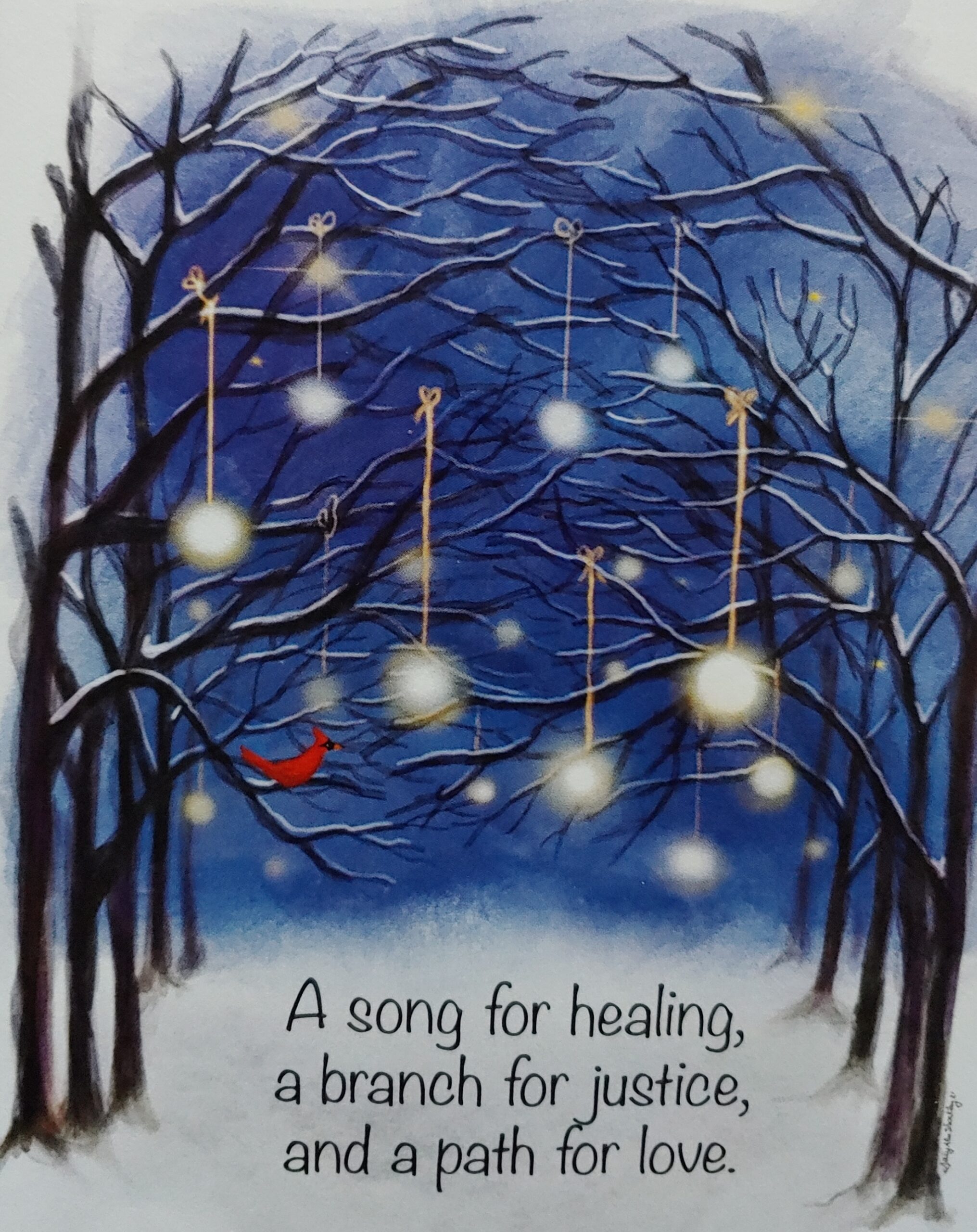
As We Ought

Readings: Psalm 113; Genesis 30:1-24; Romans 8:18-30

Likewise the Spirit helps us in our weakness; for we do not know how to pray as we ought, but that very Spirit intercedes with sighs too deep for words. And God, who searches the heart, knows what is the mind of the Spirit, because the Spirit intercedes for the saints according to the will of God. Romans 8:26-27, NRSV

Lord, it’s just a few days until I arrive at the manger, and I’m lost. I can’t find the words to pray, and I’m losing my way in the darkness of night. It’s all I can do to put one foot in front of the other. All I can do is trust the you will be with me, guiding my feet, guarding my spirit, giving me words.

Until I kneel beside you in Bethlehem, I will say Amen and Amen.

All Things Hold Together

Readings: Psalm 113; Genesis 30:1-24; Colossians 1:39-45

He is the image of the invisible God, the firstborn of all creation; for in him all things in heaven and on earth were created, things visible and invisible, whether thrones or dominions or rulers or powers – all things have been created through him and for him. He himself is before all things, and in him all things hold together. He is the head of the body, the church; he is the beginning, the firstborn from the dead, so that he might come to have first place in everything. For in him all the fullness of God was pleased to dwell, and through him God was pleased to reconcile to himself all things, whether on earth or in heaven, by making peace through the blood of his cross. Colossians 1:39-45, NRSV

It’s tempting to divide up the various parts of reality, but it’s a false division; the God of Abraham and Sarah created the world and called people to act with justice and compassion. God is intimately concerned with all of creation, and God-with-us isn’t limited to the years Jesus walked on the earth. There isn’t a single atom that exists in separation from God, nor a single person.

When my own limitations and lack of love move me to place anything outside God’s loving reach, I am reminded of the truth: all things hold together, not just some.

When I feel outside God’s loving reach, I’ll remember it as well.

Why Me?

Readings: Micah 5:2-5a; Luke 1:46b-55; Hebrews 10:5-10; Luke 1:39-45

In those days Mary set out and went with haste to a Judean town in the hill country, where she entered the house of Zechariah and greeted Elizabeth. When Elizabeth heard Mary’s greeting, the child leaped in her womb. And Elizabeth was filled with the Holy Spirit and exclaimed with a loud cry, “Blessed are you among women, and blessed is the fruit of your womb. And why has this happened to me, that the mother of my Lord comes to me? For as soon as I heard the sound of your greeting, the child in my womb leaped for joy. And blessed is she who believed that there would be a fulfillment of what was spoken to her by the Lord.” Luke 1:39-45, NRSV

“Why has this happened to me?” It’s a rare thing when these words are said with joy. Even rarer the recognition of God’s chosen in the form of a young woman. But Elizabeth was a rare one.

Perhaps being pregnant in her later years brought together two spiritual gifts: wisdom’s clarity of vision and a youthful trust in the newness of life.

Children

Readings: Psalm 80:1-7; Isaiah 66:7-11; Luke 13:31-35

At that very hour some Pharisees came and said to him, “Get away from here, for Herod wants to kill you.” He said to them, “Go and tell that fox for me, ‘Listen, I am casting out demons and performing cures today and tomorrow, and on the third day I finish my work. Yet today, tomorrow, and the next day I must be on my way, because it is impossible for a prophet to be killed outside of Jerusalem.’ Jerusalem, Jerusalem, the city that kills the prophets and stones those who are sent to it! How often have I desired to gather your children together as a hen gathers her brood under her wings, and you were not willing! See, your house is left to you. And I tell you, you will not see me until the time comes when you say, ‘Blessed is the one who comes in the name of the Lord.'” Luke 13:31-35, NRSV

When power and wealth become ends to achieve rather than means to love God and neighbor as well as self, spiritual blindness sets in and prophets arise with the corrective lenses that no one wants. And so the blind, lost in the dark, strike them down. The blind retain their possessions and their blindness.

Jesus doesn’t come to punish the blind, but to gather them together in love. He knows they won’t be gathered, and he knows his life is forfeit because of it. So why not walk away?

Because no good mother (hen) walks away from a child in need.

Questions

Readings: Psalm 80:1-7; Isaiah 42:10-18; Hebrews 10:32-39

But recall those earlier days when, after you had been enlightened, you endured a hard struggle with sufferings, sometimes being publicly exposed to abuse and persecution, and sometimes being partners with those so treated. For you had compassion for those who were in prison, and you cheerfully accepted the plundering of your possessions, knowing that you yourselves possessed something better and more lasting. Do not, therefore, abandon that confidence of yours; it brings a reward. For you need endurance, so that when you have done the will of God, you may receive what was promised. For yet “in a very little while, the one who is coming will come and will not delay; but my righteous one will live by faith. My soul takes no pleasure in anyone who shrinks back.” But we are not among those who string back and so are lost, but among those who have faith and so are saved. Hebrews 10:32-39, NRSV

Many years back, I lost out on a job because of my faith. It’s the only time it ever happened, and it didn’t cause me more than a momentary monetary setback. I’d hardly call that persecution or abuse. Unfair, yes, but that’s not the same thing. These words don’t apply to my circumstance, and I’d be telling tales if I said otherwise. But this passage does bring up questions:

For whose benefit would I cheerfully lose my possessions?

Do I value the blessings of faith more than what I earn or own?

In times of trouble, will I be among those who shrink back rather than endure?

Perhaps such questions are the reason for this part of the Lord’s Prayer:

Save us from the time of trial.

The Covenant Within

Readings: Psalm 80:1-7; Jeremiah 31:31-34; Hebrews 10:10-18

The days are surely coming, says the Lord, when I will make a new covenant with the house of Israel and the house of Judah. It will not be like the covenant that I made with their ancestors when I took them by the hand to bring them out of the land of Egypt – a covenant that they broke, though I was their husband, says the Lord. But this is the covenant that I will make with the house of Israel after those days, says the Lord: I will put my law within them, and I will write it on their hearts; and I will be their God, and they shall be my people. No longer shall they teach one another, or say to each other, “Know the Lord,” for they shall all know me, from the least of them to the greatest, says the Lord; for I will forgive their iniquity, and remember their sin no more. Jeremiah 31:31-34, NRSV

I’d put this one in the “too good to be true” category. Imagine a promise of God that the covenant will be written in our hearts. Jeremiah seems to be saying that someday we’ll be struck by a holy zap that will transform us. We won’t have to do anything. In an instant we will live as God wants us to live. We will love our neighbors as ourselves. We will no longer be victims of our own ego needs. We will turn the other cheek and give the shirt off our back. And it will all come easily, naturally. We’ll simply start to live that way. What a promise!

But there’s one word in this passage that should get our attention and help us see that the promise is not what it might seem at first glance. That word is covenant. Covenant is always mutual. It requires action from both parties. What Jeremiah is offering to us is a description of God’s side of the covenant. But there is still our side that needs to be fulfilled. As much as I resist using pietistic evangelical language, I have to admit that it has a way of getting at that side that is both simple and direct: “Let Jesus come into your heart.” You see, that is what the promise shared by Jeremiah is all about—the covenant being written in our hearts. And Jesus is what that covenant is all about, the sign and guarantee of God’s part of the covenant. Our part is a willingness to be open enough, honest enough, courageous enough to let Jesus in.

That, I believe, is one of the reasons for Advent. It is a time of preparation. That preparation isn’t always easy. It takes effort on our part. But in Advent we are more likely to be able to do what it takes, because in Advent we have before us the promise of a covenant fulfilled in the birth, ministry, death and resurrection of Jesus Christ. A covenant written in our hearts isn’t necessarily easy to fulfill, but it is radically different from the old covenant. It is no longer a matter of following rules and regulations, of obeying the law. Now it is a matter of living out the new reality of who we are because Jesus has in fact come into our hearts.

Offered by Jeff Jones, to light our path to Bethlehem.

Put the Glass Down

Readings: Isaiah 11:1-9; Numbers 16:20-35; Acts 28:23-31

But they fell on their faces... Numbers 16:22

Then a shoot will spring..and a branch…will bear fruit. Isaiah 11:1

For this people’s heart has grown dull, and their ears are hard of hearing, and they have shut their eyes; so that they might not look with their eyes, and listen with their ears, and understand with their heart and turn – and I would heal them. Acts 28:27

Growing up in a home ruled by the addictions of the resident adults, I learned early on it was critical to be hypervigilant. It was a survival skill. I kept that ability in my toolbox, and it helped me as a teacher; I could scan the room and intuit which of my students were feeling what. Other skills I developed during those dysfunctional years were to be responsible way beyond what was appropriate for my age; to constantly anticipate and serve the needs of others; and to mask the shame of our family situation by presenting myself as the perfectionistic overachiever I was. Again, these behaviors had positive effects in many situations. However, in 2020, after 53 years of intense striving in both work and personal life, I crashed. I fell on my face.

Thus began what I called my Year to Find Out (Thank you, Cat Stevens, for inspiring the name). I physically and consciously withdrew from the world – and not just because it was required by Covid – moving into a small casita in the New Mexico desert. I lived alone for six months.

The first part of my being to revive after years of abuse was my body. I studied nutrition and began applying it in my food choices. I exercised – another heretofore unknown activity (or at least an inconsistent practice) in my life.

Next came spiritual re-connection. My main ally in this endeavor was Nature. My days were bookended by admiring sunrises and sunsets; for the first time in my life, I paid close attention to the seasons and phases of the moon. Desert critters were often my only companions, and I would go for weeks without seeing or interacting with humans in person. The sky, stars, and most of all the mountains re-ignited my desire to pray and then listen.

Later in the year, I resumed living back in community with others. Then began psychological healing. With the help of a skilled therapist and EMDR trauma therapy, I delved into deep buckets of past memories, recognizing their impact, processing emotions I couldn’t feel at the time of their intense happening, and ultimately letting them go with love and understanding. Symbolically, I could feel shots springing and branches bearing fruit in my soul.

As an introvert who had always denied her need to refuel, I had plenty of social and emotional healing work to do during this significant year. As the pandemic would allow, I reconnected with family and friends. I traveled. Much to my surprise, I even joined a group of retired teachers and enjoyed sharing with them monthly. Before, it was all I could do to engage at work and with my family, then sleep to recover from all that “peopling.”

Big shifts were underway in every way during the Year to Find Out. I was seeing and hearing and understanding with my heart.

Having received the grace of healing, I enter this coming year with the hope that I will be able to maintain the practices that got me to where I now am, that I will humbly continue to surrender to each presenting moment without expectation or judgement; that the gifts of wisdom I was given during the Year to Find Out will stay infused in my being and will provide me with opportunities to minister to others in healthful, not compulsive, ways. To that end, I find this brief lesson inspiring:

https://www.upworthy.com/glass-of-water-lesson-about-stress

What I now understand with my heart is that God heals us if we open ourselves to healing and commit to the journey. I am going to try daily to put the glass down, to prevent more burdens from entering long-term – put the glass down and let it sit there. It doesn’t need my company.

Offered by Jill Fredrickson, to light our path to Bethlehem.

A Shoot Shall Come

Readings: Isaiah 11:1-9; Numbers 16:1-19; Hebrews 13:7-17

Art by Riley Anderson

A shoot shall come out from the stump of Jesse, and a branch shall grow out of his roots. The spirit of the Lord shall rest upon him, the spirit of wisdom and understanding, the spirit of counsel and might, the spirit of knowledge and the fear of the Lord.

He shall not judge by what his eyes see, or decide by what his ears hear; but with righteousness he shall judge the poor, and decide with equity for the meek of the earth; he shall strike the earth with the rod of his mouth, and with the breath of his lips he shall kill the wicked. Righteousness shall be the belt around his waist, and faithfulness the belt around his loins.

The wolf shall lie down with the lamb, the leopard shall lie down with the kid, the calf and the lion and the falling together, and a little child shall lead them. The cow and the bear shall graze, their young shall lie down together; the lion shall eat straw like the ox.

The nursing child shall play over the hole of the asp, and the weaned child shall put its hand on the adder’s den. They will not hurt or destroy on all my holy mountain; for the earth will be full of the knowledge of the Lord as the waters cover the earth. Isaiah 11:1-9, NRSV

Offered by Riley Anderson as a light on the path to Bethlehem.

[Originally posted in 2015; Riley Anderson created this with a branch from her yard.]

Near

Readings: Zephaniah 3:14020; Isaiah 12:2-6; Philippians 4:4-7; Luke 3:7-18

Rejoice in the Lord always; again I will say, Rejoice. Let your gentleness be known to everyone. The Lord is near. Do not worry about anything, but in everything by prayer and supplication with thanksgiving let your requests be known to God. And the peace of God, which surpasses all understanding, will guard your hearts and minds in Christ Jesus. Phil. 4:4-7, NRSV

I don’t want to live without peace. I don’t want to spend my soul’s energy regretting past mistakes, disregarding present blessings, and worrying about future possibilities. I want to live near God instead. Is it possible that being gentle with the lives of others opens a door into that place of peace? Could the reason it surpasses all understanding is that it’s just so simple?

Not easy, certainly. But simple.