Category Archives: Meditation

Seen and Unseen

To you I lift up my eyes, O you who are enthroned in the heavens!

As the eyes of servants look to the hand of their master, as the eyes of a maid to the hand of her mistress, so our eyes look to the Lord our God, until he has mercy upon us.

Have mercy upon us, O Lord, have mercy upon us, for we have had more than enough of contempt.

Our soul has had more than its fill of the scorn of those who are at ease, of the contempt of the proud. Psalm 123, NRSV

The tables were all set and the tray stands loaded with glasses of ice water. Our pre-ordered meals were on the long buffet table with our names above the rims to make it easier for us to find what we had chosen. My salad was pretty as well as tasty, and my water glass refilled whenever it was close to empty. Everything was set up to make lunch at the conference an enjoyable break between programs. The same was true of the coffee break beverages and snacks in the conference room, and of the afternoon dessert tray. It would be easy to assume that all these things just appeared from nowhere – a magical and instant answer to our wants and needs.

But meals and snacks don’t come from nowhere. Two women were hard a work setting up the rooms, putting out meals, refilling beverages, and cleaning up the plates and cups when we were done. They did their work quietly, blending into the background, easy to overlook.

Disregard can be proactive – the dismissive words, the look of contempt. That kind is easy to see and easy enough to avoid. Disregard can also passive – no words at all, eyes sliding past as if no one were there. It takes attention and effort to refrain from this. When we practice either form, we run the risk of burdening the hearts of others with a scorn that is poison to the soul.

Not exactly a good tip.

Gladly

I was glad when they said to me, “Let us go to the house of the Lord!”

Our feet are standing within your gates, O Jerusalem.

Jerusalem – built as a city that is bound firmly together.

To it the tribes go up, the tribes of the Lord,

as was decreed for Israel, to give thanks to the name of the Lord.

For there the thrones for judgment were set up, the thrones of the house of David.

Pray for the peace of Jerusalem: “May they prosper who love you.

Peace be within your walls, and security within your towers.”

For the sake of my relatives and friends I will say, “Peace be within you.”

For the sake of the house of the Lord our God, I will seek your good.

Psalm 122, A Song of Ascents. Of David

I was glad when they said to me, “Let us go to the house of the Lord!”

For most pilgrims, going to the house of the Lord, making the journey to Jerusalem, wasn’t an easy or casual thing. It involved lots of planning and a good amount of time and money (Perhaps, for the locals, it wasn’t quite as difficult – more like the issues locals have during peak tourist season.). I’m not sure glad would be how most were feeling. Determined, yes; expectant, perhaps; satisfied, or hoping for satisfaction, maybe. I could easily agree if the verse were along these lines: Once I got to the house of the Lord, I was glad I made the trip – an it-was-worth-it statement rather that a I’m-looking-forward-to-all-the-work-that’s-coming-as-well-as-the-end-result.

But then I think about times when I’ve traveled far to be with loved ones, devoting time and money for the chance to be together. Booking flights, renting cars, getting someone to take care of home and pets during my absence were things I did happily. The joy of being united with loved ones infused the necessary activities with its presence before it happened. Whatever needed to be done, I did gladly.

The same is true of the times I traveled to attend special services – weddings, baptisms, ordinations, even funerals. I was glad to do it because I could see where all the effort would bring me.

It makes me wonder if gladness just comes more easily when there’s a lot of work involved. Am I less able to be glad when it requires little effort? It’s counterintuitive, but just might be true.

Swept Off My Feet

I life my eyes to the hills – from where will my help come?

My help comes from the Lord, who made heaven and earth.

He will not let your foot be moved; he who keeps you will not slumber.

He who keeps Israel will neither slumber nor sleep.

The Lord is your keeper; the Lord is your shade at your right hand.

The sun will not strike you by day, nor the moon by night.

The Lord will keep you from all evil; he will keep your life

The Lord will keep your going out and your coming in from this time and forevermore.

Psalm 121, A Song of Ascents

Anyone who lives close by it knows: the water doesn’t have to be that deep, it just has to be moving quickly. An undertow at the beach, a slimy rock in the stream bed: add a misplaced foot and a moment of distraction and the dangerous power of water reveals itself. Only the ignorant and the arrogant doubt or disregard the possibility of being swept away by this elemental force. It’s happened to me a handful of times. In all cases but one, I was able to regain my footing quickly; in the one case, someone else pulled me to safety.

That feeling of losing my footing has happened to me a handful of times in the spiritual sense as well. When I thought I had it all figured out and was sure I could find my way through life easily; when death came for friends and relatives; when hatred revealed itself in words and actions; when confronted with the harmful aspect of my own inner life. It’s at such times that the big question arises: do I trust that God is the solid ground beneath my feet?

Do you?

Care of Souls

Philosophy is spiritual formation, care of the soul. Some need more care than others, just as some have a better metabolism or were born taller than others. The more forgiving and tolerant you can be of others – the more aware of your various privileges and advantages – the more helpful and patient you will be. Ryan Holiday and Stephen Hanselman

[The Daily Stoic, New York: Portfolio/Penguin, 2016, p. 225]

When I worked in catering, I memorized various ways to set up tables in a space because it wasn’t something I could do with ease. Eventually, I got proficient at setting up a room without memorization – but it took years and a lot of practice, and patient coworkers willing to show me how.

When my patience is tested due to someone else’s inability in something that comes easily to me, I do my best to remember the patience of others – and to remember that it isn’t just a set of skills or a completed task at stake: it’s the care of souls.

The Eye of the Beholder

The universe is full of magical things patiently waiting for our wits to grow sharper. Eden Philpott’s, English poet, novelist, and playwright

I suspect that beauty, magic, and holiness have surrounded me since I took my first breath. Darkness and cruelty, too. How ironic that I expect the latter and not so much the former…

[Quote from Daily Peace, Washington, D.C.:National Geographic Society, 2016.]

Choose Them Wisely

A word doesn’t merely say something, it does something. It brings something into being. It makes something happen. What do writers want their books to make happen?

I wish that I had told my writing students to give some thought to what they wanted their books to make happen inside the people who read them…

[Frederick Buechner; Listening to Your Life; San Francisco: HarperSanFrancisco, 1992, July 22/23 excerpts. Also online.]

What do I want my words to make happen inside the people who read them? If I’m writing a sermon, meditation, or Sunday school lesson, I want to offer just a glimpse of the marvelous and holy world that surrounds us and that lives inside us. The focus of my doctoral work was born in asking and answering that question.

Words open doors within our souls. They give voice to our deepest emotions, and they offer a particular perspective – a way of seeing life. They are tools that allow us to communicate, and they are also weavers of reality. They are powerful. They can heal and harm because they become part of the inner voice that speaks to us of our value from waking to sleeping – and sometimes even in our dreams.

Scripture is sacred because it is a word-constructed doorway that the Spirit draws us through into the love of God. Scripture is sacred because it is a word-constructed means to loving our neighbors more fully. It is the Living Word because it does something for us and with us.

It’s no wonder that Jesus is called the Word Made Flesh.

This is the disciple who is testifying to these things and has written them down, and we know that his testimony is true. But there are also many other things that Jesus did; if every one of them were written down, I suppose the world itself could not contain the books that would be written. John21:24,25

Life Changing

If we could see the miracle of a single flower clearly, our whole life would change. Buddha

[July 20, Daily Peace; Washington, D.C.: National Geographic Society, 2016]

It’s been a rainy, flooding, smoky, humid July in Vermont. For the past few days, I’ve had the added pleasure of a summer cold. But the sun came out today, and today’s Daily Peace quote prompted me to step out onto the back deck. The dozens of Jerusalem artichoke flowers I could see each had at least one bee. My potted thyme is also covered in blooms.

These are not rare species. They are as common as can be. In a world that values what is rare and delicate, it’s easy to undervalue, underestimate, and overlook the beauty in the common and hardy. It’s a peculiar and pervasive blindness – and one I might have kept had the words of the Buddha not intervened.

No Thanks Necessary

When you’ve done well and another has benefitted by it, why like a fool do you look for a third thing on top – credit for the good deed or a favor in return? Marcus Aurelius, Meditations 7.73

One of the main differences between icons and other paintings: icons are never signed. The person who writes an icon is creating beauty as an expression of prayer and faith – an expression that is designed to foster the prayers and faith of the ones who stand before it. An iconographer is creating something that is meant to be moved through – a beautiful means to a holy encounter with God. Signing it, taking credit for it, might impede that moving through and defeat the purpose of the icon.

If I think of everything I do as creating something beautiful as an expression of prayer and faith, I won’t need to claim credit or expect recognition and thanks. Seeking that third thing just might defeat the purpose of the act – and it certainly won’t help it.

[Quote from The Daily Stoic; Ryan Holiday and Stephen Hanselman; New York: Portfolio/Penguin, 2016, July 15th; Icon of Saint Matthew]

Expected

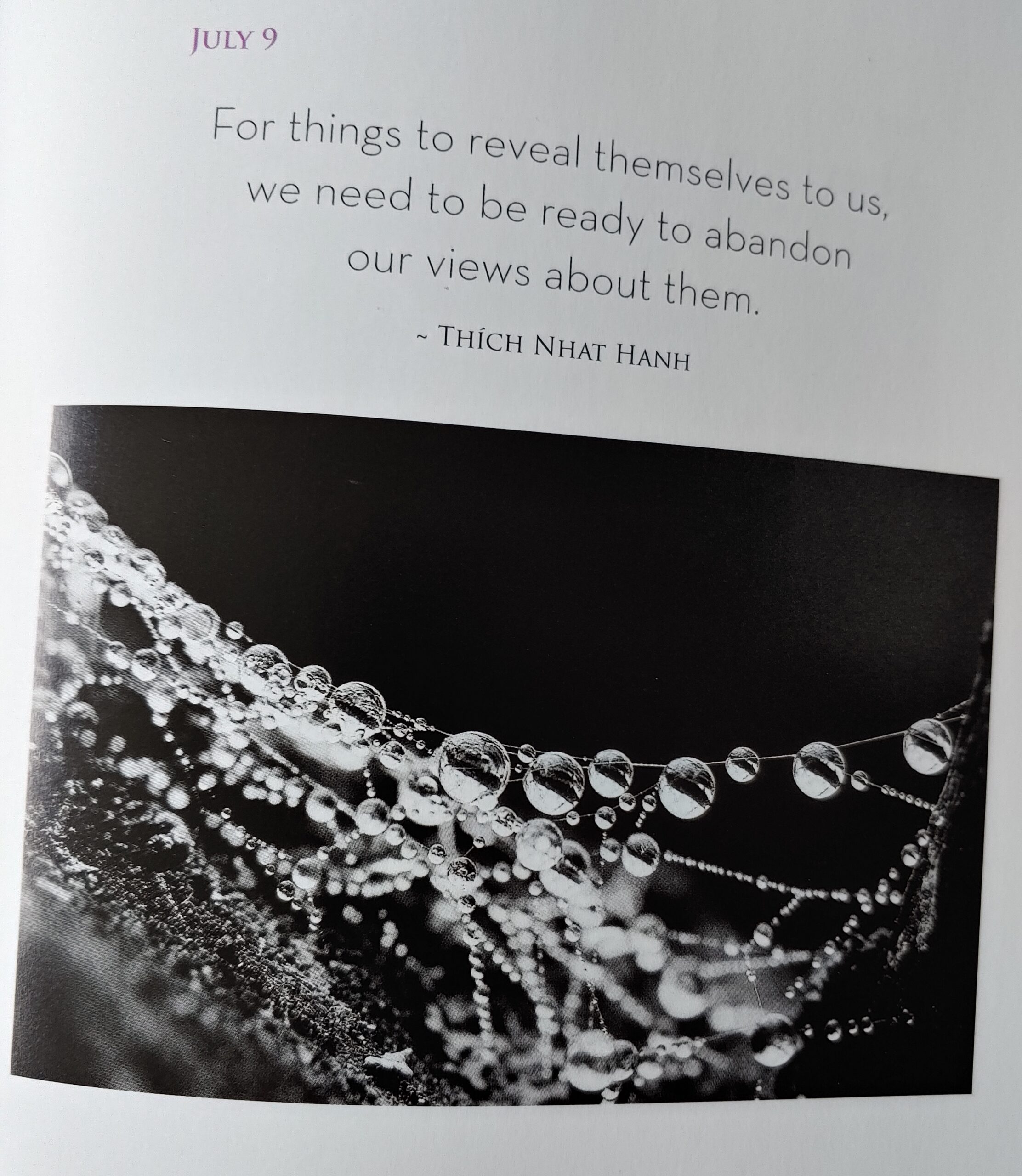
My assumptions will prevent me from a deeper understanding of almost everything – even if those assumptions were fairly accurate at some point. If I expect to find only weeds in an untended garden bed, I’ll be blind to the wild strawberries and chives gracing the space.

The same is true of God: how can I encounter God if I’m not willing to admit that any idea I have about God is partial, and may prevent me from living into a love so marvelous that it is beyond words to express?

Sadly, this unwillingness to let go of my current view of God is often commended as remaining true to the faith rather than seen as what it is: ignorance.

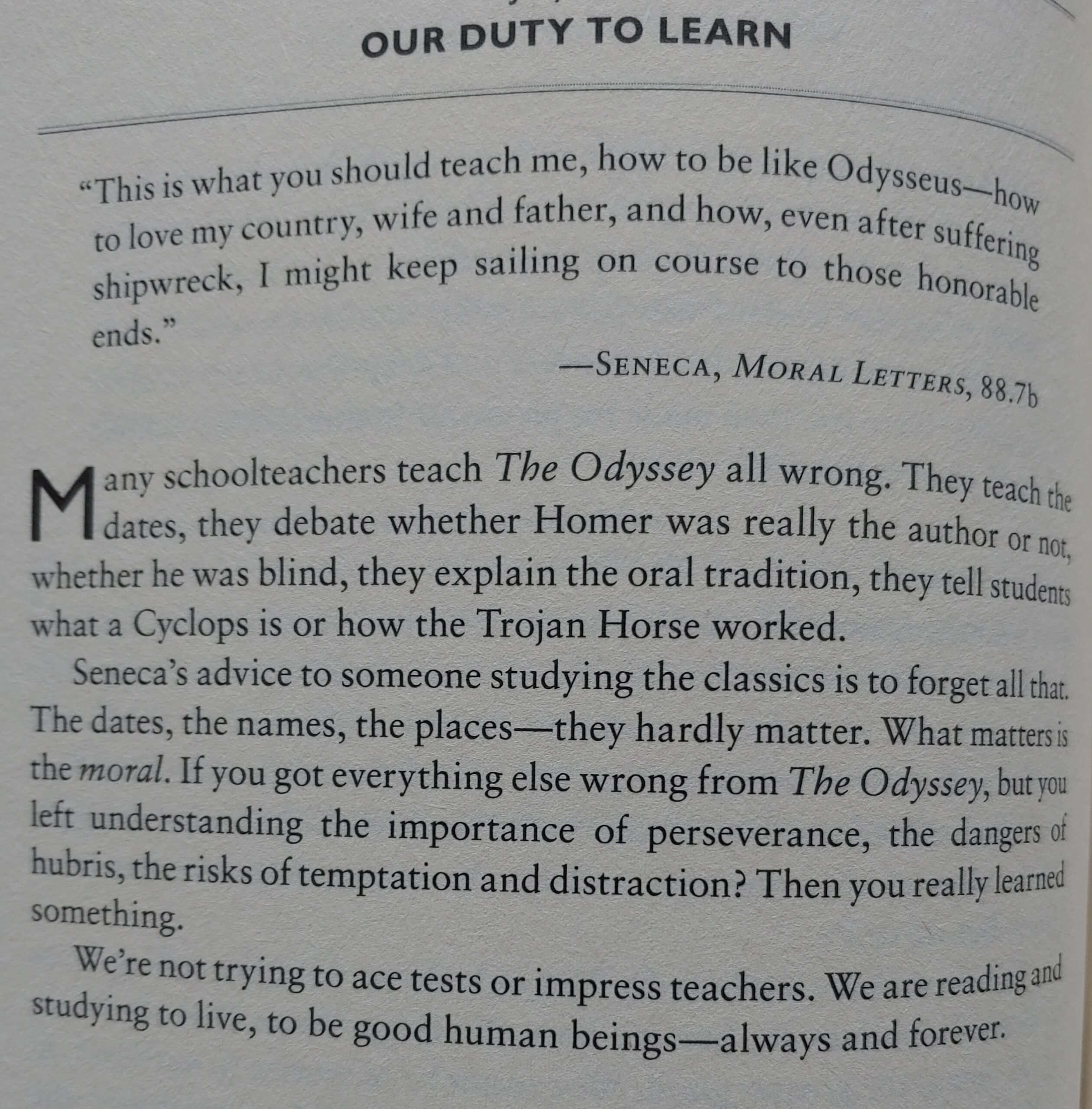
Learning For A Reason

The Daily Stoic; Ryan Holiday and Stephen Hanselman; New York: Penguin, 2016, p. 204

The difference between learning in a way that leads to a fruitful life for self and the world and learning that doesn’t go that way is the difference between wisdom and knowledge. A genius may use her or his knowledge and skills for irrelevant or harmful ends; a wise man or woman uses his or her skills in a way that deepens the spirit and gladdens the world.

There are evil geniuses, but no evil wise ones. Something to think about…