Category Archives: Biblical Reflection

Prayers for the Beginning of Advent

Readings: Jeremiah 33:14-16; Psalm 25:1-10; I Thessalonians 3:9-13; Luke 21: 25-36

The days are surely coming, says the Lord, when I will fulfill the promise I made to the house of Israel and the house of Judah. In those days, and at that time I will cause a righteous Branch to spring up for David; and he shall execute justice and righteousness in the land. In those days Judah will be saved and Jerusalem will live in safety. And this is the name by which it will be called: “The Lord is our righteousness.” Jeremiah 33:14-16

Lord, you are the flame coming into the world to usher in God’s

kingdom on earth. Please make us your sparks to bring your light

and love and peace and healing into the world,inflaming the entire

world with your Kingdom. Sparks that become a raging

conflagration of your goodness.
FullSizeRender-1

To you, O Lord, I life up my soul. O my God, in you I trust…make me to know your ways, O Lord; teach me your paths…Psalm 25:1-10

Lord, let us become one with You by growing and learning with You.

May we accept your forgiveness so we can feel at one with

you. May we forgive ourselves so guilt doesn’t hinder us from

knowing that we are your eyes, ears and mouth in the world. May

we proclaim your goodness with every breath we take and every word

we utter. Let our hands and mouth be instruments of your healing,

and bring Your kingdom to this battered and broken world.

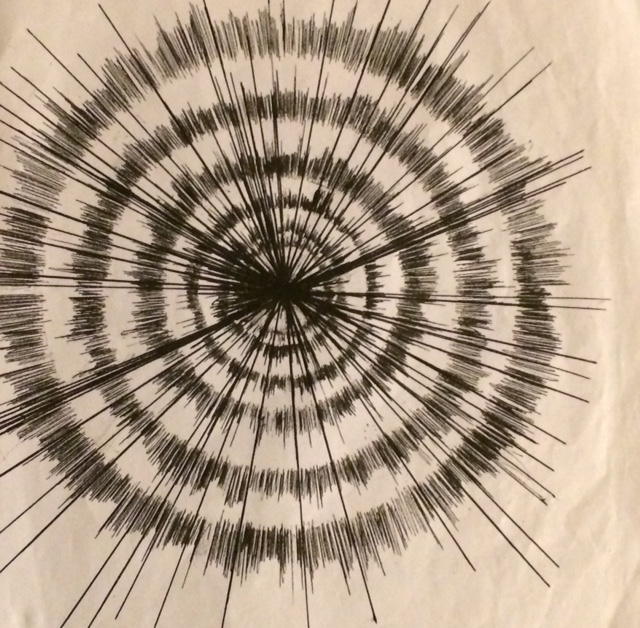
Prayers and art offered by Margaret Hill, child and seeker of God.
 

Not My Place (the sequel)

“It’s not my place to say, but…”

I’m sure almost everyone has heard these words, or something along the same lines. Whenever I’ve heard them, and the times I have said them, two things come to mind:

1. The speaker really feels it is his or her place to say.

2. They are usually followed by a negative assessment of someone or something – and often the someone or something isn’t around to reply.

For some reason, casting aspersions on someone else’s character or actions sounds a little less petty when couched in humility, false or not. But gossip is gossip, and making negative comments about someone else often says as much about the speaker as it does the hapless subject.

As far as I know, Jesus didn’t begin many of his words with “it’s not my place to say.” He talked to those who disagreed with him far more often than he made comments about them to a third party. It’s a practice I hope to follow more closely – in thought, word, and deed. When I’m tempted to dress up gossip with these words, these two thought just might stop my tongue:

Let anyone among you who is without sin be the first to throw a stone. (John 8:7)

If I speak in the tongues of mortals and of angels, but do not have love, I am a noisy gong or a clanging cymbal. (I Cor. 13:1)

If I take them to heart, they have the power to do more than stop me from spreading gossip: they can keep my mind from even thinking about it.

A Place for Everything…

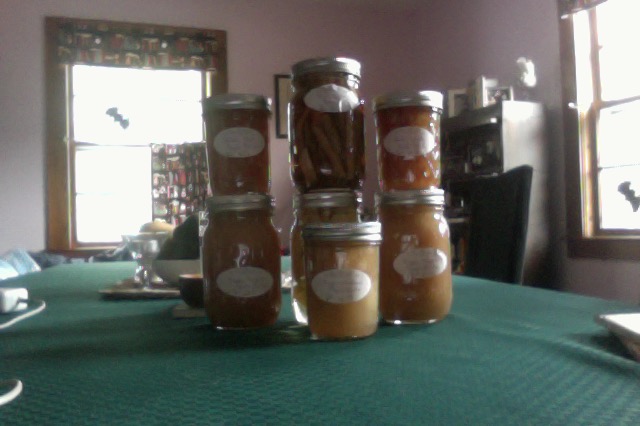
…except in canning season. There are seven jars of green tomato relish, four more with pickled beans, and eleven filled with applesauce. There are three more in the fridge – one of each already opened and tasted. Next week a dozen cranberry sauces will join the heavenly tasting host. Most of these are only here for a couple of months; they will depart in Thanksgiving baskets and Christmas boxes to take up space in the cupboards and iceboxes of friends and family. But for now, they are guests in and on my shelves, tables, countertops, and bookcases. My canning equipment is on the dishwasher, adding to the overcrowding. This year’s hot peppers are in bowls with the few remaining green tomatoes. I’ve made a dining table centerpiece of squash because they are beautiful – and I have no room in the kitchen for them. Herbs in jars have broken out of the spice drawer, claiming space next to the drinking glasses. They, too, will be gone over the holidays as tandoori rubs and cajun spice mixes. My house runneth over with the bounty of garden, bog, and orchard.
My home is just the right size for me and my family to live interesting lives. There is enough room for guests to feel at home, but they sleep on a sofa bed. The kitchen is a good size for a 1950’s Cape, but there’s no walk-in pantry. I have enough shelf space for the canned goods we will keep, the dried herbs we will use, and the usual grocery items needed for two weeks of meals. I wouldn’t trade home for a bigger one, but it’s an adventure in inventive storage and display right now. It’s a good thing I like the look of squash and mason jars.
I don’t want a larger-than-life place or life. It’s too much work to go too big, and the world is better for me staying at my current size. The jars that I can’t fit in place are meant to go elsewhere; I’m meant to give them away. I trust in the bounty of next year’s harvest, and the steadfast presence of God that holds me in love. There is a place for everything in my house…and if it doesn’t fit, then it’s not my everything to keep.

Photo on 10-9-15 at 4.50 PM

To everything there is a season, and a time for every purpose under heaven…a time to reap and a time to sow. (Ecclesiastes)

Displacement

There were twenty three of us in Advanced Biology that afternoon for Mr. Chamberlain’s famous water displacement contest/experiment. A couple of hoses, graduated test tubes, and water were all set. The directions were simple: blow into the hose attached to the tube filled with water. Breath becomes air pressure, moving the water into the second tube – water displacement via lung power. The experiment part: measure how much water is displaced by each person and figure out the class average. The contest: try to displace more water than everyone else. The prize: bragging rights and a spot on Mr. Chamberlain’s ongoing chart of winners.

Before we began, Mr. Chamberlain had everyone guess who would displace the most water. To a person, we picked Andy. He was well over six feet tall, played football, and was on the cross country ski team. After that, we picked skiers, long distance runners, and tennis players. Following them, the rest of us. With our predictions set, each of us took our turn moving water with breath.

As predicted, Andy displaced more water than anyone else. The male skiers and runners displaced around the same amount on their tries, clumping around third place. Then came the female athletes. The remaining students were spread out below that. But second place, between Andy and the male athletes, was mine. Five foot two inches, one hundred and fifteen pounds, and able to displace more water than everyone but Andy. It was such a surprising result that Mr. Chamberlain had me do the experiment twice. When the result was the same, he added me to the chart of winners (small letters, with my height, weight, gender, and second place status noted).

I doubt I had a lot more lung capacity than my classmates, but I did spend a lot of time in Chalk Pond. Swimming underwater taught me how to control my breathing. I knew how much air was in my lungs and how far I could swim on a single breath. I was aware that I had reserves of oxygen I usually didn’t need or notice. Perhaps I displaced more water because I knew just how much air I had in reserve, and what I could do with it; perhaps my classmates didn’t.

I think the same is true with my spiritual life. There are reserves that I barely notice and rarely call upon. They are there, ready to displace sadness, grief, anger, and fear. Even better, these spiritual reserves don’t end with my own strength and stamina: they are renewed by the one who gives life and breath to the whole universe.

In the beginning was the Word, and the Word was with God, and the Word was God…All things came into being through him, and without him not one thing came into being… (John 1:1-3)

Out of Place

There’s a single juice glass in my cupboard. I bought it with three others a decade ago, when larger glasses were too big for my four year old son’s grasp. It’s four and a half inches tall, with a seven-sided lower half and a circular top edge. There’s a fancy cursive “L” on the bottom. It’s sturdy, well balanced, and hard to knock over.

This leftover juice glass has no place among the glasses in current use. My son is well past needing miniature glasses, and it’s too breakable to use at the bathroom sink. It’s not worth any money and I have no important memories associated with it. Yet, it’s still here, out of place and alone.

Out of its original place and filled with modest chive flowers, it is a perfect centerpiece on the dinner table – too short to block anyone’s view or conversation, too narrow to be a hindrance when passing dishes, too solid to be knocked over by a careless hand. With a handful of daisies, it fits on the narrow shelves in my living room, and doesn’t tip when the cats pass by with flicking tails. It casts a rainbow when the sun hits it just right.

Out of place isn’t something I like be. It’s uncomfortable to be a loner among a group of like-minded and socially related people; it’s disconcerting when talents, appearance, and meaningful purpose are no longer useful or particularly appealing to the larger group. But being out of place, no longer in like company, may be the only way to grow past my past self. To every thing there is a season, and seasons change. Holding onto one particular season in my life, insisting that I am limited to one particular use or identity, won’t keep me from being out of place. What it will block is a future beyond it, where I hold beauty and find my place at the table and on the shelf. Sturdy and casting rainbows is a wonderful new reality, unseen when out of place but surely on the other side.Photo on 9-30-15 at 3.07 PM

In Place

underleavesMy daily routine happens in particular locations and times of day/week/month/year (Everyone’s does; is there anyone whose routine just happens in random places and times? It wouldn’t be a routine without placement, just a collection of happenings strung together through time and space.), interwoven in the fabric of my life. They are the warp and woof that create the mutable and unfinished tapestry that is my very existence. They matter to me, these times and locations – these places I live in.

Today, my prayers were offered from my old blue sofa, looking out on the birds, plants, and chairs in my back yard. Brick steps heard my Jesus prayer, the Weber grill witnessed the prayer list. A couple days ago, it was the flip-out sofa just inches and a screen away from the lavender-bloomed butterfly bush. End of August, these same prayers visited my in-laws’ patio, with its bird bath and rose-chomping mule deer. The time of day stayed the same, the locations didn’t – maybe not a huge difference, but it changed the flavor of the words in my mouth and on my heart. How could it not when I could see, feel, hear, and smell a different part of God’s great world? Even a change of room and window makes a difference in who I am as I pray.

Prayer is a living dialogue as much as an ongoing soliloquy. Alone or in the company of others, prayer is never done in isolation. We are surrounded by all those who ever prayed the words we pray, who ever prayed where we pray; we stand and kneel with pray-ers through all time and in all places. All the spontaneous words ever said, felt, and thought; all the indescribable moments when the words couldn’t be found. It is in this place that I pray and you pray. It is in this place that God embraces us, sometimes seen and felt, sometimes unseen and elusive. If I really embraced the holiness of my places of prayer, I doubt would ever get off my knees. If you did the same, I doubt you would, either.

(For more on place, clickPlace above…)

Darkness, deepening and dazzling

May the darkness of night deepen and dazzle

Not exactly what I think of when I think of the darkness of night. Over the years, it’s been cursing the darkness as a fearful child or as an adult seeing darkness as only the absence of light (an annoyance as I think of all I didn’t get done today). What a different thought to go off to sleep with: that tonight I may be deepened and dazzled. Cotter’s poetic imaging creates for me a new response to the night. He takes the oft used verse from the psalmist, “This is the day the Lord has made; let us rejoice and be glad in it” (Ps. 118:24), and makes it into a night made by God. Let us be deepened and dazzled in it. Now I can praise God for the night as well as the day. That’s pretty great! The light of the world still shines through the darkness, deepening and dazzling.

This blessing lacks only one word: Amen.

Offered by Bill Albritton, teacher of the gospel.

Friend and Lover, bless us and keep us; Light of the world, shine on our faces; Transfigured Yeshua, lift us to glory. May the darkness of night deepen and dazzle.
Prayer at Night’s Approaching,

Jim Cotter (Morehouse Publishing, 1998)

Lift us to glory

Transfigured Yeshua, lift us to glory…

(Offered by Bill Albritton, pray-er and child of God)

A few weeks back the Church celebrated the Transfiguration. In the last writing, we pondered the Light of the world. I often think of Peter’s reaction to the event up on that high mountain (most scholars assume Mount Hermon here which reaches  a height of some 9,000 feet—rarefied air for a rarefied event). He so reminds me of me, always feeling that he has to do something or say something even though he has no concept of the appropriateness of his words or actions. Peter wants to memorialize the moment but Jesus must move on. No time to dilly dally—the cross awaits. The Voice in the cloud tells Peter, James and John in that mountain top experience to “listen to him!”— “Peter (me), stop talking about things you know nothing of and listen to Jesus.” If we do this we will catch a glimpse of glory, indeed. Tonight may I take a moment to listen to Transfigured Yeshua, experience the attendant glory of that moment, and fall asleep in his arms, blessed and kept.

Friend and Lover, bless us and keep us; Light of the world, shine on our faces; Transfigured Yeshua, lift us to glory. May the darkness of night deepen and dazzle.

Prayer at Night’s Approaching, Jim Cotter (Morehouse Publishing, 1998)


What We Hand Down

My sons got their summer reading assignments a few days back; Colin and the rest of the seniors will read The Alchemist (Paulo Coelho, Alan R. Clarke, trans.; New York: HarperCollins, 1993) while Jared and the incoming 8th graders will read The Contender (Robert Lipsyte; New York: Harper Collins, 2003, reissue of the 1967 novel). They’ll have a home on our tilted, currently-being-read bookshelf for the next few weeks. When Colin is done with The Alchemist, it will return to its usual spot until I reread it in another year or so. The fate of Jared’s book is yet to be determined. If he loves it, it will stay; if he couldn’t care one way or the other, it will go to the library. Only what’s really valued remains in our family collection – everything else is released, finding a life in someone else’s hands and heart.

Words are important, holy even. A book, a poem, a saying, a song can change our inner worlds and the outer worlds we call home. The words that transcend their particular time and place earn the title classic, or the adjective masterpiece. Libraries all over the world offer these to their borrowers because in some indescribable way they enrich human life through their beauty and truth. These words that touch the best part of us, they are our verbal inheritance and our linguistic legacy – gifts from the past for our present, handed down from us to the future. Who we were, who we are, who we will be: all these found in the words, in the books, in the countless libraries.

There’s a library handed down in almost every time and place, such a common experience in this literate age that we take no note of it. It’s a collection, sometimes collections, of our encounters with God and neighbor. It’s a record of mistakes and tragedy, a song of praise and beauty and gratitude for the blessings of life. Sometimes it’s poetry, prose, history, and personal letters; it’s available in all kinds of languages and in all kinds of cultures. Extraordinary and common. Whether Buddhist, Hindu, Jewish, Muslim, or Christian, sacred scripture is handed down. It’s the deepest expression of our longing for God and our love (or lack of love) for one another, handed down in paperback and hardcover, downloaded on a Kindle or heard on tape.

For whatever reason, we often think of this library as a single book – impressive and weighty, but not particularly helpful. Such a tragedy to have the library of the soul at our fingertips, freely given but rarely opened…

ottableofcontentsPerhaps that’s the biggest lesson a library can teach: all the voices of the past, in all the words of today, have no power to transform us and our world unless we delve into them. All the voices of the present will have no power to bless future generations unless we hand them down.

For A Time

boarbooksI don’t buy many new books. Whenever possible, I borrow new stories from the library. If I love it, I’ll buy a copy; if not, I return it with no cost but the time it took to read. This keeps my shelves at home full of books I love and empty of ones I don’t, and it keeps the mental and physical clutter down to a minimum.

In years past, I did the same with books for my growing sons. Our favorites have shelf space at home. Outgrown favorites are passed on to the library or neighbors, giving them a life beyond our family. Our board book copies of A Very Hungry Caterpillar and Sheep Out to Eat, with duplicates of Harry the Dirty Dog and Mike Mulligan and His Steam Shovel are in the hands of other children, passing on the blessing they gave to me and my sons. The stories and pictures are still in our hearts and minds, and we can always borrow a copy if we feel nostalgic.

My older son will begin his senior year in September, my younger his eighth grade year. Both are well on their way to adulthood, no longer children who need me to read stories. I can’t put my sons on a shelf or stop them from growing up. Soon they will live lives beyond my home and help. Even if I could, I wouldn’t. Like library books, they aren’t mine: I’ve borrowed them for a brief time, keeping them safe and enjoying the adventures they bring. Besides, they are written on my heart and soul – no need to keep them when the time comes to let them go.

For everything there is a season, and a time for every matter under heaven. Ecclesiastes 3:1