Category Archives: Biblical Reflection

Save us, help us

Officiant: O God, make speed to save us.

People: O Lord, make haste to help us.

Why these words at the beginning of a noonday prayer service? It’s not likely that anyone praying them is in mortal danger. Anyone who is in such a predicament isn’t likely to have their BCP in hand, after all. As I pondered these words for the past few days, these thoughts arose…

The officiant is the one who asks God to save us, not the people. Although we shouldn’t need it, having a leader ask for God’s saving presence gives the rest of us permission to do the same. Everyone needs God’s saving love and presence, and asking for it is a sign of wisdom rather than a terrible weakness.

Most of us are okay with giving help, but needing help? It takes strength to admit to needing help; it’s easy to consider needing a help a character flaw rather than a universal human truth.

Asking God for help, admitting our need to be saved by God, is easier with practice. If the words become part of us, we will have them when we need them. Practice may not make perfect, but it certainly makes for sufficiency.

I may not need saving from a physical danger at the moment, but I do need saving from things that kill the soul and maim the spirit. Disdain for others and self, hopelessness, and a perspective so limited that I am unable to act with love and compassion are deadly if not in an obvious way. I may not wish someone harm, but without recognizing my limitations and my need for God’s saving love I may not wish them well – and I certainly won’t be willing to foster their wellbeing.

In the middle of the day, in the company of others, I am asking for help. Only with God’s help and saving grace can I hope to love God, myself, and others. I’m so very glad there are others asking for help, too…

Noonday Prayers

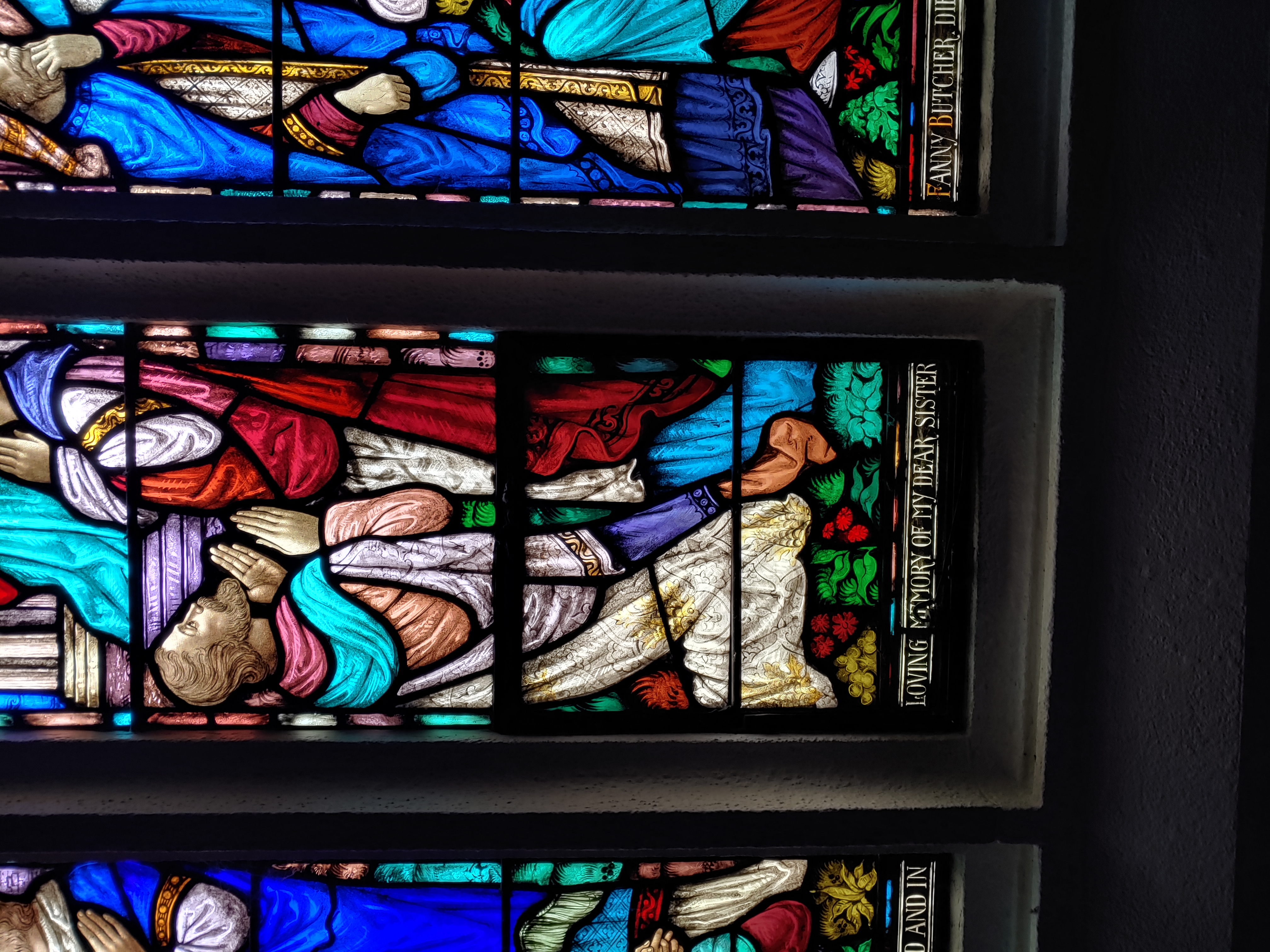
I pray in the morning, I pray in the evening, but I don’t pray at noon on any kind of a regular basis.

I’m familiar with Morning Prayer and Vesper liturgies, but not the Noonday service.

I say prayers throughout the day, depending on what I see, hear, and feel; I don’t say mid-day prayers as a routine activity. There’s no “noonday prayers” on my calendar. Why is this?

Our Muslim sisters and brothers pray at noon as part of their every day faith, stopping in the middle of activities to orient themselves toward God. Isn’t it time I give this a try?

I hope you’ll join me. With these words, let us begin…

O God, make speed to save us.

O Lord, make haste to help us.


Lettuce Leavings

It’s the bottom of the lettuce, the part I cut away to free the leaves for my salad. A rough, flat nub and an inch of tough ends that usually ends up in my compost pile. But set it in the garden bed, and a miracle happens: new leaves begin to grow from the stump overnight. Three or four days later, it’s enough to snip and add to the top of my taco. Even more amazing, the new growth is beautiful to see.

Life from a throwaway, from something that has already fulfilled its primary purpose. Beauty arising from the ordinary. If such remarkable regeneration comes from discarded things, how can anything be impossible?

A shoot shall come out from the stump of Jesse, and a branch shall grow out of his roots. 

Isaiah 11:1, NRSV

What Do You See?

The Words of My Mouth

July 16, 2021

Twenty years ago today, just after eight in the morning, Jared Embrey Fredrickson arrived. For these twenty years, I’ve watched him grow from an infant to toddler, elementary student to high school graduate. That first day, I didn’t know what his favorite color would be, what would make him laugh or cry, or where he would find God’s presence in his life. What I did know: the words I would say and the words I would leave unsaid would matter to him. Tone of voice and eye contact would make a difference; whether I was talking to him or at him mattered.

Words matter, and the heart behind the words matters even more. There are a few prayers that I say because of this truth.

Teach me to act firmly and wisely, without embittering and embarrassing others.

Direct my will, teach me to pray, pray thou thyself in me.

And most important:

May the words of my mouth and the meditation of my heart be acceptable to you, O Lord, my rock and my redeemer. Psalm 19:14

Marc Cohn, The Things We’ve Handed DownThe Best of Marc Cohn

Proud Thoughts

Keep back your servant also from the insolent; do not let them have dominion over me.

Then I shall be blameless, and innocent of great transgression. Psalm 19:13, NRSV

Keep back your servant also from proud thoughts – the alternate translation of that first part of the verse. This isn’t a prayer for God to keep me away from the insolence of others: it’s a prayer to God that I don’t become insolent. But, as like attracts like, if I hang with an insolent crowd I’m probably guilty of the same vice.

Proud thoughts (the ones that make me see myself as comparatively better than others) aren’t the same thing as self-confidence or self-love. Proud thoughts are those internal conversations that demean others so that I can feel inherently superior. They shrink my soul even as I diminish the worth of others. There is no doubt: this is a great transgression. Evil comes easily from such thoughts.

The Buddhists list right thought as one of the chief elements in a holy life. This is having the right perspective more than it is the lack of thinking mean thoughts. Their point is that everything else springs from this basic starting point. Wrong thoughts cannot lead to right judgement, speech, or action – harm will come from the wrong perspective, damaging others or damaging self, and often both.

Perhaps there’s no better way to avoid proud thoughts than asking for God’s help. Knowing I cannot rely on my own strength of character, and knowing I can rely on God’s love, is a good starting point.

 photo by Donna Eby

How Will We Find Our Way?

Moreover, by them is your servant warned; in keeping them there is great reward. 

But who can detect their errors? Clear me from hidden faults. Psalm 19: 11-12. NRSV

There’s more: God’s word warns us of danger and directs us to a hidden treasure.

Otherwise, how will we find our way? Or know when we play the fool? 

Clean the slate, God, so we can start the day fresh! Psalm 19: 11-12, The Message

[For the whole psalm, click Psalm 19 above.]

A couple of years back, just past midnight, street work closed my usual route to Logan airport. The detour signs put me on an unfamiliar road, then left me stranded in the middle of a bunch of warehouses. GPS was no help: it kept directing me back to the closed street and refused to guide me to another route.

I couldn’t see any familiar streets or landmarks, so I picked a street and drove. After a couple of attempts, I came upon a familiar place and was able to make my way through Boston and arrive at Logan from the North. My knowledge of Boston streets was just enough to get me to my destination.

At times, my spiritual life feels like that drive. My usual routine can’t get me where I need to go, and I end up in a dark and unfamiliar place. It’s during those times that I need to find a familiar intersection, somewhere that reveals where I am. Once I find that, I can reorient and find an alternate road. It may take some time, but I’ll find my way.

That night in Boston, the familiar place was South Station.

When my soul is lost, that familiar place is God’s word: Love the Lord your God with all your heart, soul, and mind – and love your neighbor as yourself.

 Art by Margaret Hill

Deeds of Justice

The fear of the Lord is pure, enduring forever; the ordinances of the Lord are true and righteous altogether.

More desired are they than gold, even fine gold; sweeter also than honey, and drippings of the honeycomb.

Psalm 19: 9-10, NRSV

Ps 19:7-10 – This is often viewed as the start of a separate psalm, due to the focus on law.But Torah connotes God’s “instruction” or will, which involves justice and righteousness on a cosmic scale; so “law” and creation belong together. The concept of justice is explicitly present in v. 9, where ordinances is more literally, “justices” or “deeds of justice.”

[the Discipleship Study Bible: New Revised Standard Version including Apocrypha; Louisville, KY: Westminster John Knox Press, 2008, p.752, footnote]

The fear of the Lord is pure, enduring forever; the Lord’s deeds of justice are true and righteous altogether; 

More desired are they that gold, even fine gold; sweeter also than honey, and drippings of the honeycomb.

Change that one small word and the whole thing has a different feel for it. This isn’t about ordinances, things that insure my property lines are honored and I get everything that I’m owed. This isn’t about dancing on the right side of the legal/illegal line, making sure I take whatever I can out of any situation. This is about justice, doing what is right by my neighbor and fostering whatever is holy and life-giving. This is how I walk through this world and my life doing good rather than harm.

Such a life is worth more than gold, isn’t it? Such a life is la dolce vita, isn’t it?

Such a life is worth lifting my voice to God in song/psalm. And dancing a happy dance, too.

It’s Not Just About Me

…the fear of the Lord is pure, enduring forever;

the ordinances of the Lord are true and righteous altogether.

More to be desired are they than gold, even much fine gold;

[Psalm 19:9-10a, NRSV. For the complete psalm, click psalm 19 above.]


English doesn’t quite get the point across. This isn’t fear in the sense of afraid-for-my-life/scared-to-death; this fear of the Lord is the quickening of the pulse, the scared-to-life sense when holiness shows up. This isn’t fear that harm will come, but keen awareness of the difference between creature and Creator.

This awareness of my own limitations, this encounter with the love that created all that is, this is what I should desire more than gold. My finitude in the presence of the loving Infinite doesn’t diminish me: it just gives me the slightest glimpse of God’s sacred love of everyone and everything else.

It’s a wonderful and humbling gift of truth: I am God’s beloved, and I walk a world full of other beloveds.


Big Picture, Human Law

The heavens are telling the glory of God; and the firmament proclaims his handiwork.

Day to day pours forth speech, and night to night declares knowledge.

There is no speech, nor are there words; their voice is not heard;

yet their voice goes out through all the earth, and their words to the end of the world.

In the heavens he has set a tent for the sun, which comes out like a bridegroom from his wedding canopy, and like a strong man runs its course with joy.

Its rising is from the end of the heavens, and its circuit to the end of them; and nothing is hid from its heat.

The law of the Lord is perfect, reviving the soul; the decrees of the Lord are sure, making wise the simple; the precepts of the Lord are right, rejoicing the heart; the commandment of the Lord is clear, enlightening the eyes;

the fear of the Lord is pure, enduring forever; the ordinances of the Lord are true and righteous altogether.

[Psalm 19:6-9, NRSV. For the complete psalm, click psalm 19 above.]

What revives your soul and makes your heart rejoice? What makes the simple wise and enlightens the eyes? My off-the-cuff answers:

Beautiful images revive my soul.

The moon path on the water makes my heart rejoice.

A compassionate heart makes the simple wise, and meeting a beloved enlightens the eyes.

I can’t say that law comes to mind as the answer to these questions, but it should – especially the law of the Lord. Maybe something like this…

Not looking at my neighbors’ possessions with envy makes it possible, even inevitable, that the sight of them will bring joy.

Avoiding eating and drinking to excess honors the work that went into growing and preparing the bounty on my table, and keeps my body nourished.

Laziness wastes the precious hours, days, years, and decades I have been given; using my time and energy wisely (including rest!) satisfies my body, mind, and spirit.

Loving God above all other things keeps me from enslavement to money, status, and other harmful masters.

Seen this way, the Law of God is a gift, the path to a loving, joyful, sacred life. Not fetters, but freedom.

How is it that the Law of God is so rarely framed in this way?

Like a Bridegroom

In the heavens he has set a tent for the sun, which comes out like a bridegroom from his wedding canopy,

and like a strong man runs its course with joy.

[For the whole psalm, click “Psalm 19” above.]


Anthropomorphism: the attribution of human characteristics to a god, animal, or object.


It’s frowned upon, this attributing human characteristics to non-human entities. It’s considered naive at best, woefully ignorant and dangerous at worst. This is something children do because they don’t know any better.

But poets do the same, as do holy women and men. Metaphorically, perhaps, but they do it. And our lives our better for it because we find ourselves in relationship with beings and things we would never be otherwise.

The sun rising like a bridegroom from his wedding canopy, finding joy in the daily run across the sky. The cosmology might be a bit off, but the gist of it is true: there is nothing in this entire creation that isn’t connected in one way or another.

It’s better to see in the arc of the sun a living spirit than to look upon this creation as nothing but a collection of objects without purpose or soul.