Category Archives: Biblical Reflection

High Holy Words

In the beginning was the Word, and the Word was with God, and the Word was God. He was in the beginning with God. All things came into being through him, and without him not one thing came into being. What has come into being in him was life,[a] and the life was the light of all people. The light shines in the darkness, and the darkness did not overtake it.

There was a man sent from God whose name was John. He came as a witness to testify to the light, so that all might believe through him. He himself was not the light, but he came to testify to the light. The true light, which enlightens everyone, was coming into the world.[b]

10 He was in the world, and the world came into being through him, yet the world did not know him. 11 He came to what was his own,[c] and his own people did not accept him. 12 But to all who received him, who believed in his name, he gave power to become children of God, 13 who were born, not of blood or of the will of the flesh or of the will of man, but of God.

14 And the Word became flesh and lived among us, and we have seen his glory, the glory as of a father’s only son,[d] full of grace and truth.

These are high holy words in this passage, themselves full of grace and truth.  One may well tremble as one reads them – I often do.  

It is well to heartfully reflect this passage on a day of triumph and celebration, like today, the Feast of the Incarnation of God.  Yet it is also a passage to draw strength from, in times of gloom and darkness, of despair and crushed hopes.  Over and over again in our life, we must be reminded and we must remember that The Light Shines in the darkness, and the darkness did not, does not, and never will overtake it.  This is the Great Truth of God, the insight of faith.  The true light, that Light whose smile kindles the Universe, which enlightens everyone – it has come into the world and it is all around us, dancing in every atom, shining in every star.  

Hail the Sun of Righteousness!  May we who walk in darkness be a Moon, reflecting His Holy Light.

Merry Christmas to all of you.

Christmas is Today and Every Day

At the heart of everything is one love;

the love that gave birth to all of creation

is the same love that was born on that 

first Christmas morning, in Bethlehem,

the light that shone in the darkness.

That same love is the light being born 

in you each day, without ceasing.

So, open yourself to this light, and

celebrate the coming of God into 

this world in your darkness—for

Christmas is not long ago and far away,

but here and now, today and every day.

 – Meister Eckhart

Offered by Michael Giordano, in whom God delights.

Night of Nights

Daily Readings: Isaiah 9:2-7; Psalm 96; Titus 2:11-14; Luke 2:1-20

While they were there, the time came for her to give birth. She gave birth to a son, her firstborn. She wrapped him in a blanket and laid him in a manger, because there was no room in the hostel.

Luke 2:6-7, The Message

Night of Nights

One blazing star outshines the cosmos

Illuminating the winding path to blessing.

A single note rings true

And the celestial chorus begins a song for the ages

In harmony with all creation.

Glory to God in the highest!!

The one true God

One young girl chosen from thousands

to deliver the one gift of salvation

to an overburdened world.

One tiny being,

An only son,

One last chance…

Night of Nights

Offered by Debbie Hill, in whom God delights.

Songs of Joy

Daily Readings: Luke 1:46b-55; 2 Samuel 7:18, 23-29; Galatians 3:6-14

When Elizabeth heard Mary’s greeting, the baby in her womb leaped. She was filled with the Holy Spirit, and sang out exuberantly,

Youre so blessed among women, and the babe in your womb, also blessed! And why am I so blessed that the mother of my Lord visits me? The moment the sound of your greeting entered my ears, the babe in my womb skipped like a lamb for sheer joy. Blessed woman, who believed what God said, believed every word would come true!

And Mary said,

I’m bursting with God-news; I’m dancing the song of my Savior God. God took one look at me, and look what happened – I’m the most fortunate woman on earth! What God has done for me will never be forgotten, the God whose very name is holy, set apart from all others. His mercy flows in wave after wave on those who are in awe before him. He bared his arm and showed his strength, scattered the bluffing braggarts. He knocked the tyrants off their high horses, pulled victims out of the mud. The starving poor sat down to a banquet; the callous rich were left out in the cold. He embraced his chosen child, Israel; he remembers and piled on the mercies, piled them high. It’s exactly what he promised, beginning with Abraham and right up to now. Luke 1:40-55, The Message

Two women pregnant – unexpectedly bringing precious life into the world. Two songs of joy neither expected. Not songs of contentment or mere happiness – songs of JOY, songs of THANKS BE TO GOD, songs that see in their lives and the lives that they carry the hand of the creator of all that is, was, and ever will be.

There is nothing small or tame or even close to containable here. This is God With Us on the way; this is business as usual shaken apart, shattered; this is joy that smashes the box we’ve done our best to shove God into.

We aren’t big enough to contain this joy, but it’s big enough to include each and every one of us. So get ready to sing at the top of your lungs.

Hope – In Extremity

Daily Readings: Luke 1:46-55; Isaiah 33:17-22; Revelation 22:6-7, 18-20

The angel said to me, “These are dependable and accurate words, every one. The God and Master of the spirits of the prophets sent his Angel to show his servants what must take place, and soon. And tell them, ‘Yes, I’m on my way!’ Blessed be the one who keeps the words of the prophecy of this book.”

I give fair warning to all who hear the words of the prophecy of this book: If you add to the words of this prophecy, God will add to your life the disasters written in this book; if you subtract from the words of the book of this prophecy, God will subtract your part from the Tree of Life and the Holy City that are written in this book.

He who testifies to all these things says it again: “I’m on my way! I’ll be there soon!”

Yes! Come, Master Jesus! Revelation 22:6-7, 18-20, The Message

War zones. Concentration camps. Death row. Places where most of us do not live, but where too many of us are in residence. Places where nothing an individual can do will make a difference, where no help is going to arrive in time. Hell on earth…

Psychiatric hospitals, where the hell is internal but just as devastating and real to the ones trapped within…

These hellscapes are where Revelation is truly a word of hope. The graphic images of utter chaos and punishment aren’t some glimpse of a future event, but a window into what already is. When no earthly force is able to bring relief, Revelation brings hope. When the world is going to hell, God will have the last word and act.

If I’m not in one of these extreme conditions, I don’t have the right to claim this as my truth or as the blueprint for a future event to scare others. If the violence and imagery of Revelation makes me uncomfortable, I don’t have the right to remove even a single word that brings hope to those for whom it is a lifeline.

Perhaps these words at the end of the last book of the Bible are included in the Advent readings to remind me that Mary’s baby soon-to-be-born is the Word and the Hope of the World in all circumstances – even and most especially in extremity.

Descent Into Hell

[Revelation is an apocalyptic writing – a prophetic book of hope for those in oppressive and hellish circumstances that cannot be changed. It is about the eschaton – the end times. Its images were never meant to be taken literally or as a map of future events.]

He Said Yes!

Daily Readings: Isaiah 7:10-16; Psalm 80:1-7, 17-19; Romans 1:1-7; Matthew 1:18-25

The birth of Jesus took place like this. His mother, Mary, was engaged to be married to Joseph. Before they enjoyed their wedding night, Joseph discovered she was pregnant. (It was by the Holy Spirit, but he didn’t know that.) Joseph, chagrined but noble, determined to take care of things quietly so Mary would not be disgraced…Matthew 1:18-19, The Message

Saint Matthew

Joseph was a decent man, even when he found out Mary was pregnant. Instead of subjecting her to public humiliation, he would just quietly end the engagement. Then came the dream, the wedding, a trek to Bethlehem, and a baby. Then a flight to Egypt to escape Herod’s extermination, a return to Nazareth, and life with a growing family.

It wasn’t just Mary who said yes. When Joseph said yes, God-With-Us got a good father, one who stayed with him and his mother through all that life threw at them.

He said/She said – Yes! And the world hasn’t been the same since.

In God I Trust?

Daily Readings: Psalm 80:1-7, 17-19; 2 Samuel 7:23-29; John 3:31-36

“The one that God sent speaks God’s words. And don’t think he rations out the Spirit in bits and pieces. The Father loves the Son extravagantly. He turned everything over to him so he could give it away – a lavish distribution of gifts. That is why whoever accepts and trusts the Son gets in on everything, life complete and forever! And that is also why the person who avoids and distrusts the Son is in the dark and doesn’t see life. All he experiences of God is darkness, and an angry darkness at that. John 3:34-36, The Message

Trust vs. Mistrust. According to Erik Erikson, it’s the first major crisis we face as human beings. Are the people who care for me trustworthy? Is this world trustworthy? How an infant answers this question, yes or no, sets her on a path, sets the tone for the next seven stages of psycho-social development. (Childhood and Society, Erik Erikson; New York: W.W. Norton & Company, 1993, original in 1950)

Do I trust God? Do I see in Jesus a God who is constant and trustworthy? Is the ground of my life solid? If I answer yes, then it becomes a gracious thing, an abundance given by God who loves me. If I answer no, then life becomes a trial, a punishment from a God who is angry with my inadequacy.

Trust or mistrust? Life hangs on the answer.

Because of Who You Are

Daily Readings: Psalm 80:1-7, 17-19; 2 Samuel 7:18-22; Galatians 4:1-7

King David went in, took his place before God, and prayed: “Who am I, my Master God, and what is my family, that you have brought me to this place in life? But that’s nothing compared to what’s coming, for you’ve also spoken of my family far into the future, given me a glimpse into tomorrow, my Master God? What can I possibly say in the face of all this? You know me, Master God, just as I am. You’ve done all this not because of who I am but because of who you are – out of your very heart! – but you’ve let me in on it. This is what makes you so great, Master God! There is none like you, nothing to compare with what we’ve heard with our own ears. 2 Sam. 7:18-22, The Message

David understood a fundamental truth: God acts to save because of who God is, not because of who we are. We don’t need to be perfect or particularly worthy of praise because God’s love is given, not earned. No wonder David asked: Who am I, my Master God, and what is my family, that you have brought me to this place in life?

What we do with our years doesn’t earn us God’s love – that’s already a given. Our strengths and weaknesses don’t determine or explain why God chose to be God-With-Us in Jesus. But perhaps, in response to being God’s beloved, how we love ourselves and others in our years can offer a glimpse of such divine love.

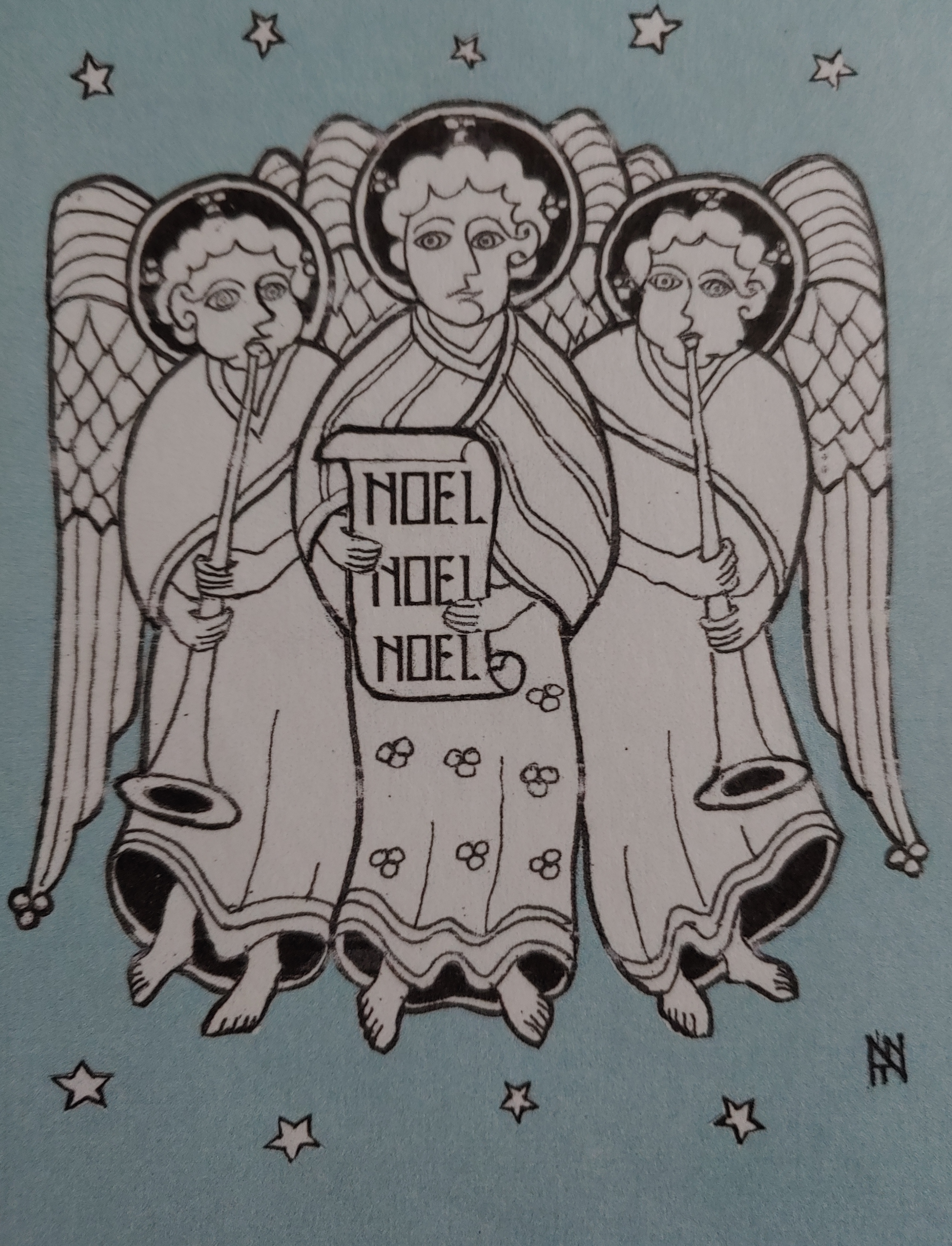
Angels, by Thom Nordquist

Thom Nordquist returned to God’s embrace, leaving behind his beautiful art.

Daring To Dream Large

Daily Readings: Psalm 80:1-7, 17-19; 2 Samuel 7:1-17; Galatians 3:23-29

Now when the king [David] was settled in his house and the Lord had given him rest from all his enemies around him, the king said to the prophet Nathan, ‘See now, I am living in a house of cedar, but the ark of God stays in a tent.’” 2 Samuel 7:1-2

David wasn’t an ordinary dreamer. He who had nocturnal visions of slaying giants had the kind of dreams that stretched the elasticity of what’s possible.  Here with the prophet Nathan, he’s lamenting the living quarters of the Ark of the Covenant, the holy treasure that defined, even embodied, his people’s relationship to God. The Ark was residing among tent curtains flapping in the desert wind, lugged about by nomadic Jews like a piece of luggage. David wanted the Ark to have a permanent home, one fit for a king.  

Nathan foresaw that the temple project would not be realized in David’s lifetime. The timing just wasn’t right. But David kept the dream alive and passed it along to his son, Solomon. From historical accounts, we surmise the temple that Solomon built was an awe-inspiring triumph of the imagination. The Ark of God had a beautiful new home. 

Today, we are fortunate to be a ble to visit such monuments to dreamers’ imaginations. For those who have crossed the thresholds of Gothic-style cathedrals such as Notre Dame, Chartres, St. Peter’s, Canterbury, or our own National Cathedral in Washington, D.C., we feel a visceral rising of the spirit as our eyes track high up fluted marble columns toward ribbed, vaulted ceilings. The stunning stained-glass windows nearly bring us to our knees in wonderment. Airy choral notes lift high on incense as a prayer, echoing in the vast reaches of the emptiness above. The sheer brilliance of architectural design and engineering prowess embodied in these holy structures are a testament to an unbounded spirit of boldness. Here in Santa Fe, the beautiful but more earthy Romanesque Cathedral of St. Francis, named after the city’s patron saint, was the daring brainchild of a French parish priest, Fr. Jean-Baptiste Lamy, who became the first Archbishop of Santa Fe. 

Rainier Maria Rilke wrote a poem about daring the spirit to dream large, to live life to the hilt, to take this gift of life seriously. The poem is from his Book of Hours.

God Speaks to Each of Us

God only speaks to us before we exist,

Then walks quietly beside us,

But the words, the cloudy words

We hear before we begin our lives,

Are sent forward into the world by our senses:

“Go to the edge of all your desire to make sense.

Be the clothing that gives me form. 

Standing behind the world of things,

Make yourself a flame

So that the shadow widens,

Always including me completely.

Let everything happen to you,

Terror and beauty.

You’re only required to go forward,

No feeling is unnatural.

Don’t let yourself be separated from me.

We have almost arrived

In the land they call Life.

This you will perceive

By how serious it will feel.

Give me your hand.”

Translation by David Keplinger

Offered by Bryan Fredrickson, in whom God delights.

State Your Business

Daily Readings: Psalm 42; Zechariah 8:1-17; Matthew 8:14-17, 28-34

By this time they were in front of Peter’s house. On entering, Jesus found Peter’s mother-in-law sick in bed, burning up with fever. He touched her hand and the fever was gone. No sooner was she up on her feet than she was fixing dinner for him.

That evening a lot of demon-afflicted people were brought to him. He relieved the inwardly tormented. he cured the bodily ill. He fulfilled Isaiah’s well-known revelation: He took our illnesses, he carried our diseases. Matthew 8:14-17, The Message

Matthew 8 in a nutshell: Jesus healed a leper, a Roman captain’s servant, then Peter’s mother-in-law. After our passage, Jesus questioned two would-be followers and calmed a raging storm at sea. The chapter ends with Jesus ridding two possessed men of their demons, a herd of pigs plunging off a cliff when the demons possessed them, and a mob from town demanding that Jesus leave and never return.

Without the first thirteen verses and verses eighteen to twenty seven, the focus is on Jesus and his ability to heal those sick in mind, body, and spirit. But I think something vital is lost when parts of chapter eight got snipped away. Beyond our knowing Jesus as a healer, what is the message? I think verses twenty-one and twenty-two offer a glimpse…

Another follower said, “Master, excuse me for a couple of days, please. I have my father’s funeral to take care of.”

Jesus refused. “First things first. Your business is with life, not death. Follow me. Pursue life.”

Following Jesus is pursuing life. It is healing those whose illnesses keep them from a good life. It is letting go of tasks and delays that focus on death rather than on life. It is keeping company with the socially questionable. It is healing a life because someone needs it, not because society says someone deserves it.

Jude, next to the last word…

Daily Readings: Psalm 42; Ezekiel 47:1-12; Jude 1:17-25

But you, dear friends, carefully build yourselves up in this most holy faith by praying in the Holy Spirit, staying right at the center of God’s love, keeping your arms open and outstretched, ready for the mercy of our Master, Jesus Christ. This is the unending life, the real life!

Go easy on those who hesitate in the faith. Go after those who take the wrong way. Be tender with sinners, but not soft on sin.

Jude 1:20-23, The Message

It’s a few hundred words between John’s three letters and Revelation – Jude’s neighboring books get a lot more time and attention. But Advent gives me the chance to spend some time in this next-to-the-last book, this penultimate letter.

The words above come right at the end of Jude’s letter, right before the words of blessing that bring Jude to an end. For some reason, this strikes me: the last words of advice are ones of compassion for others, a plea to be kind to those whose faith isn’t on solid ground, to go out and find those who go the wrong way even when common sense says to let them live with the consequences of their errors in judgement. Jude doesn’t say to condone errant behavior; he says to offer those who stray another chance.

What if I lived into this sequence of events? What if my final acts were reaching out to those who need it most? What follows is a benediction to end Jude’s words – then Revelation and the end of all things partial (albeit writ large with amazing and horrifying imagery).

Perhaps seeking the hesitant and lost is the only way to appreciate a benediction and let go of the partial in favor of a new heaven and a new earth…

[This book is ascribed to the apostle Jude, also called Thaddeus – a brother of James and half brother of Jesus. Tradition also links this Jude to Saint Jude, the patron saint of hopeless causes – perhaps why he advocates for seeking those who are lost…]