Category Archives: Advent

I’m Thirsty and I can Sing

Readings: Isaiah 12:2-6; Amos 6:1-8; 2 Corinthians 8:1-15

Have you ever been lost in the wilderness and became so dehydrated and thirsty you thought it was over?  Maybe not.  After all you have your cell phone that can give you directions, survival tips, and encouraging podcasts to keep you going.  But try to imagine this scenario:  

You’ve been wandering around in the wilderness for a very long time, lost and disoriented.  Your tongue is swollen, fuzzy, and stuck to the sides of your cheeks.  Your head is pounding and your vision is blurry.  Suddenly, you stumble upon a high mountain spring flowing with clear sweet water. Odd, it’s almost as if you were drawn there by unseen forces.   You see a metal cup hanging from a hook beside a weathered sign that reads “Free water.  Come and drink, help yourself.”  You can make out more weathered words on the sign, something about a King from Nazareth.  It must be his well.

You look around to see if this is a trick or a mirage.  Is someone scamming you, going to ask for your credit card and six easy payments?  But, against your astute mental capabilities and “with-it-ness”, you give in, grab the cup and start drinking.  Desperation is sometimes why we take risks isn’t it?  

After your first few gulps of fresh clean water, you are so filled with joy you began to sing.  Why not, you’ve come this far haven’t you?  Your voice blasts out over the airwaves – “Ah, sweet mystery of life, at last I’ve found you.”  (In 1936 this song was one of the top-selling singles, recorded by Nelson Eddy and Jeannette MacDonald. Originally written in 1910, It is a poetic exploration of love as the central purpose of human existence. Say that out loud.  Love is the central purpose of human existence.)

Isaiah 12:2-6 says that with joy we will drink deeply from the fountain of salvation, and in that wonderful day we will sing, thanking the Lord, praising His name.  We will be praising Him for His never-ending love and salvation.  Verse six says we will sing to the Lord for he has done wonderful things.  Jesus says “Anyone who is thirsty may come to me!  Anyone who is thirsty may come and drink! For the scriptures declare rivers of living water will flow from his heart.” (John 7:37-38) Whose heart?  The one who drinks, believes and receives the Holy Spirit.   

“Is anyone thirsty?  Come and drink, even if you have no money! Come take your choice of wine or milk – It’s all free!” (Isaiah 55:1 NLT)   

In the passage 2 Corinthians 8:1-15, we learn that many of the members of the churches in Macedonia were dirt poor.  But they drank Jesus’ water and were filled with abundant joy.  Their joy overflowed in rich generosity to each other and the church. This passage talks about how having a willing mind (toward our Savior) is accepted according to what we have, not what we don’t have.  We can open our minds, be willing to accept the free cup of water at the fountain in the wilderness.  We can accept the salvation Jesus Christ came to give us with His birth.   The real reason for this Advent season?  God wrapped up in flesh, holding out the water we need to survive.  We can have joy this Advent season, and every season.   We can be a flood of living water for others lost in the wilderness.  Just think of all that singing!

The Maker of all things loves and wants you!  Take a good long drink.

Offered by Linda Benningfield-Hashman, God’s beloved child.

Advent Theme: Peace

Readings: Psalm 126; Isaiah 35:3-7; Luke 7:18-20

Week Two Advent

Most of us recognize these words (or something close to them) from our Sunday services:

The Peace of the Lord be with you.

And also with you (and with thy spirit).

Let Us Pray

When thoughts are chasing each other around my mind, the chaos makes it almost impossible for me to pray. I get a few words in and they get lost in the internal babble. When everything feels rushed and in constant motion, I can’t find a quiet inner space to pray. Perhaps you have had that same experience. It’s why I begin my day with these words from the Greek Orthodox tradition: Lord, grant me to greet the coming day in peace.

There’s wisdom in praying for peace in the worship service. That peace helps us be present enough to find God within our souls, recognize God in our neighbors, and see the Spirit in our own time and place. That peace makes it possible to make that walk to Bethlehem – and to dance with joy on our journey home.

David’s Psalm

Readings: Psalm 126; Isaiah 19:18-25; 2 Peter 1:2-15

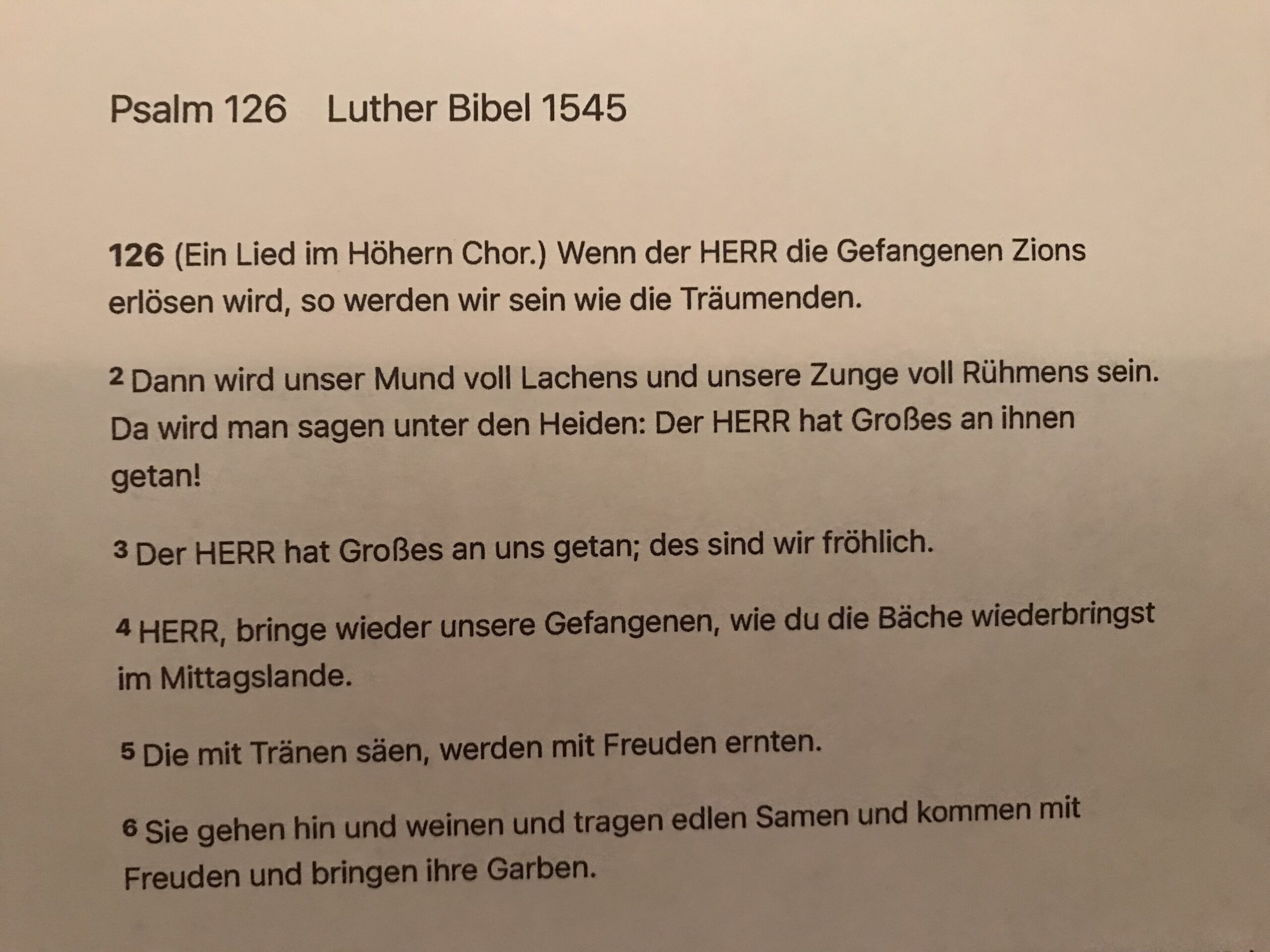
When the Lord restored the fortunes of Zion, we were like those who dream. Then our mouth was filled with laughter, and our tongue with shouts of joy;

then it was said among the nations, “The Lord has done great things for them.

The Lord has done great things for us, and we rejoiced.

Restore our fortunes, O Lord, like the watercourses in the Negeb. May those who sow in tears reap with shouts of joy.

Those who go out weeping, bearing the seed for sowing, shall come home with shouts of joy, carrying their sheaves. Ps. 126, NRSV

One title of Psalm 126 is called “Harvest of Joy”… during this penitential season of preparing and anticipating and soon to be halfway through our time of Advent, the feeling of joy in our hearts and minds is a wonderful and never ending  gift from our Lord and Savior Jesus Christ. 

Here you will be able to read this beautiful psalm in both English and German.

Also, a lovely version sung in German by Musicians Botschafter.

Offered by Robin Nielsen, God’s beloved child.

How’s Your Pain?

Readings: Psalm 126; Isaiah 40:1-11; Romans 8:22-25

We know that the whole creation has been groaning in labor pains until now; and not only creation, but we ourselves, who have the first fruits of the Spirit, groan inwardly while we wait for adoption, the redemption of our bodies. For in hope we were saved. Now hope that is seen is not hope. For who hopes for what is seen? But if we hope for what we do not see, we wait for it with patience.

Romans 8:22-25, NRSV

Everything worthwhile takes time, effort, and patience – its creation and birth a painful process.This is even more true when it comes to bringing life into the world. The messiness of it, the endurance required, and the pain that is so hard to bear all come beforehand. And God only knows who will enter the world through it.

There’s a holiness in going through it all without knowing who will arrive, a blessing to the shrouded future that is asking so much of us. Perhaps, if we knew who was coming beforehand, it wouldn’t be our pain that seems unbearable: it would be our uncontainable joy.

Be Piglet

Readings: Malachi 3:1-4; Philippians 1:3-11; Luke 3:1-6

I thank my God every time I remember you, constantly praying with joy in every one of my prayers for all of you, because of your sharing in the gospel from the first day until now. I am confident of this, that the one who began a good work among you will bring it to completion by the day of Jesus Christ. It is right for me to think that this way about all of you, because you hold me in your heart, for all of you share in God’s grace with me, both in my imprisonment and in the defense and confirmation of the gospel. For God is my witness, how I long for all of you with the compassion of Christ Jesus. And this is my prayer, that your love may overflow more and more with knowledge and full insight to help you determine what is best, so that in the day of Christ you may be pure and blameless, having produced the harvest of righteousness that comes through Jesus Christ for the glory and praise of God.

A.A. Milne & E.H.Shephard

It seems to me that most everyone is hanging on by a thread these days, not just because of the high level of anxiety our recent election created, but in general. I’ve written more condolence letters in the last year than in all the rest of my life combined. Ergo — many people I know are grieving. Losses abound: loss of long-held dreams and expectations; loss of health; loss of stability. People are struggling financially. We are experiencing an epidemic of social isolation and deep loneliness.

Who isn’t hurting? I survey my friends and am struck by their challenges and their strengths in the face of it all. I try to be encouraging without coming across as someone who has it all together which I don’t. In the face of their pain, I acknowledge that words are usually inadequate. What my friends want and need are what A.A. Milne’s character Piglet offered Pooh on a Difficult Day. They want me to sit beside them quietly not offering advice or platitudes, not even hope. Not forcing conversation. Simply being together. All things are easier when we know we have someone there for us. The side-by-side assurance that I am there for them goes a long way. Just that.

For those who I can’t physically sit beside, I try to convey, as the Philippians’ verses above opine, that “I have [them] in my heart.” This image seems more powerful than just words. Words, however, like John O’Donohue’s definition of a blessing can help capture a helpful image:

“A blessing is a circle of light drawn around a person to protect, heal and    strengthen.”

Between imagining a hurting friend surrounded by a healing circle of light and mindfully holding them and their pain close within my heart as a means of standing long-distance witness to their situations, that is what I can do from afar to show my love and support.

Mainly, though, what I’ve personally found helpful when I’ve experienced high anxiety or low depression is knowing that I’m not unique and alone in my misery. Knowing that other people are struggling with my same issues is powerful and at the heart of why 12 Step peer support groups are so successful. When we’re ministered to via shared vulnerability and sincere empathy — no judgments, no comparisons, no advice — we are comforted.

I aspire to be like Piglet. He. Is. There. That’s enough, more than enough.

Offered by Jill Fredrickson, God’s beloved child.

And You, Child

Readings: Luke 1:68-79; Malachi 4:1-6; Luke 9:1-6

And you, child, will be called the prophet of the Most High; for you will go before the Lord to prepare his ways, to give knowledge of salvation to his people by forgiveness of their sins. By the tender mercy of our God, the dawn from on high will break upon us, to give light to those who sit in darkness and in the shadow of death, to guide our feet into the way of peace. Luke 1:76-79, NRSV

Forgiveness, mercy, light in the darkness, and guidance – these are the signs and actions that prepare for God’s coming. John the baptizer was born and raised for this work. Condemnation, animosity, blindness, and misdirection – these are the signs and actions that destroy the spirit and remove all hope. John shouted out against these.

The times have changed since then, but darkness is still darkness and the signs of God’s coming are still the same.

And you, child, are born for this work, too: forgiveness, mercy, light in the darkness, and guidance. You, me, and everyone else.

Prepare the Way

And You, My Child

Readings: Luke 1:68-79; Malachi 3:13-18; Philippians 1:18b-2:6

In response to “what is this child going to be?,” John’s father, Zechariah, sings the Benedictus Dominus Deus, which ends:

And you, my child, will be called a prophet of the Most High;
    for you will go on before the Lord to prepare the way for him,
77 to give his people the knowledge of salvation
    through the forgiveness of their sins,
78 because of the tender mercy of our God,
    by which the rising sun will come to us from heaven
79 to shine on those living in darkness
    and in the shadow of death,
to guide our feet into the path of peace.”   (
Luke 1:76-79)

Talk about high expectations! Is that even fair to impose such onto a new- born child? Well, God seems to have high expectations for John – and for us. This can be a heavy burden but only if we believe we have to carry it by ourselves.

Am I not also called to prepare the way of the Lord?—to give people the knowledge of salvation? Do I know someone living in darkness (maybe moi)?

Is it time to let the sun shine in this Advent and allow our feet to be guided into the path of peace?

Or are my expectations too low? My God too small? 

My prayer is that I never underestimate God.

Offered by Bill Albritton, God’s beloved child.

Moving Away

Readings: Luke 1:68-79; Malachi 3:5-12; Philippians 1:12-18a

Then I will draw near to you for judgment; I will be swift to bear witness against the sorcerers, against the adulterers, against those who swear falsely, against those who oppress the hired workers in their wages, the widow and the orphan, against those who thrust aside the alien, and do not fear me, says the Lord. For I the Lord do not change; therefore you, O children of Jacob, have not perished. Ever since the days of your ancestors you have turned aside from my statutes and have not kept them. Return to me, and I will return to you, says the Lord of hosts. But you say, “How shall we return?” Malachi 3:5-7, NRSV

A former rector of our church was fond of saying that if you don’t feel as close to God as you used to, make no mistake about who has moved.

    Advent can be a time to take stock of our current  relationship with God as we prepare for the coming of the Messiah. Have I moved away? Has my time spent in prayer and meditation become too routine and less reflective? Sometimes during my devotions, I find myself thinking about what I’ve got to do afterwards, looking forward to getting back to “work”. Really? Not a very effective way to worship, now is it?

    I’m not a big fan of the  word intentionality, and yet Malachi, which means My messenger , has a message for me here. “How shall we return?”, he asks. Being more focused, more intentional, in the time I carve out for prayer and devotion is a good start. As I do this, I find myself returning.  The old gospel hymn goes: In moments of despair and grief, my soul has often found relief, And oft escaped the tempter’s snare by thy return, sweet hour of prayer.

Offered by Bill Albritton, God’s beloved child.


The Sign of Jonah

Readings: Psalm 90; Isaiah 1:24-31; Luke 11:29-32

When the crowds were increasing, he began to say, “This generation is an evil generation; it asks for a sign, but no sign will be given to it except the sign of Jonah. For just as Jonah became a sign to the people of Nineveh, so the Son of Man will be to this generation. The queen of the South will rise at the judgement with the people of this generation and condemn them, because she came from the ends of the earth to listen to the wisdom of Solomon, and see, something greater than Solomon is here! The people of Nineveh will rise up at the judgment with this generation and condemn it, because they repented at the proclamation of Jonah, and see, something greater than Jonah is here! Luke 11:29-32, NRSV

“As the crowds increased, Jesus said, ‘This is a wicked generation. It asks for a sign, but none will be given it except the sign of Jonah.’” Luke 11:29

As the crowds increased suggests popularity, lots of people glomming on for the magic show, signs and wonders. You want a sign? Jesus says. You want a sign? Ok, I’ll give you one: Jonah.

People who want a sign are generally looking for something hopeful, positive,  something to help them keep hanging on. “Give me some kind of sign, God!” But Jesus uses some pretty strong language to push back against that kind of signal. “This,” he says, “is a wicked generation” of uplifting sign-seekers. What he offers—the only thing he offers—is the sign of Jonah, the one who descended, who rode Moby Dick all the way to the bottom of the sea. It’s an ancient, sea-faring version of the paschal mystery—three days down, down in the belly of the beast, and only then salvation. 

Best not to read this story to your kids around the Jesse Tree. This is an adults-only Advent message. The “coming” we await at Advent is a coming down, a divine “humbling” (Phil. 2:7) that leads to exaltation. Perhaps we should, in addition to the oxen, cattle and sheep, add a nice little whale to our creche scenes this year. 

Offered by David Anderson, God’s beloved child.

Who Am I?

Readings: Psalm 90; 2 Samuel 7:18-29; Revelation 22:12-16

Then King David went in and sat before the Lord, and said, “Who am I, O Lord God, and what is my house, that you have brought me thus far? (2 Samuel 7:18, NRSV)

He wasn’t the obvious choice, and he didn’t kid himself into thinking he had earned or somehow deserved to rule. He was chosen for God’s own purpose for reasons beyond his own grasp. So what else would David pray except for this: Who am I, O Lord God, and what is my house, that you have brought me thus far?

There are other ways to say the same thing: Why do you care so much about me? What makes me different, and what makes you think I’m worthy of this life? Why am I here?

We would do well to ask such questions, particularly during this season of reflection. But God’s answer will not be a list of talents, accomplishments, or potential. A question this profound is usually answered with an equally profound and holy truth:

Because you are my child, my beloved, and a delight to me.

Advent 2024: Hope