I am a Christian educator and writer.I have worked in churches, denominational offices, and seminaries. I have a PhD in Theology from Princeton Theological Seminary, with a focus on Practical Theology and educating in faith. In 2010, my book, "How the Other Half Lives: the challenges facing clergy spouses and partners," was published by Pilgrim Press. I believe that words can build doorways that lead to encounters with God through the Spirit.
It’s a mystery, why life finds us; why do atoms, molecules, cells, membranes come together to form our physical bodies? Why the mind, heart, and spirit that only we can bring to this time and this place – or any time and place, for that matter.
Rejoice in the life given to you, because you are the only one who will ever have it. Find the joy in the dreary days, the pain, the struggle – and especially in the days that seem to hold nothing of consequence.
There are any number of reasons to feel angry, hurt, or bored.
When was the last time you pulled a sled up a snowy hill, jumped on it, and whooshed all the way back to the bottom? Do you remember what it feels like – wind whipping, snow spraying, the sound of the sled against the snow? How many times did you tromp up and fly down the white hill before it was time to go home? Can you remember the sheer joy of it all, or do you remember only the cold feet and hands, the chapped lips? If given the chance, would you grab a sled and do it again?
Of course, it doesn’t have to be a sled on a hill. It could be a tire swing in the back yard, a pile of crisp leaves, waves on the beach, a polished bannister. Floating sticks a la Winnie the Pooh works, or any number of other things. They offer us wonder and drop us into the mystery of this world and our own lives. And that is no small thing.
I suspect that it might be the most direct way most of us come to what is most sacred – the sheer joy that there is this creation, and the wonder that you and I are part of it.
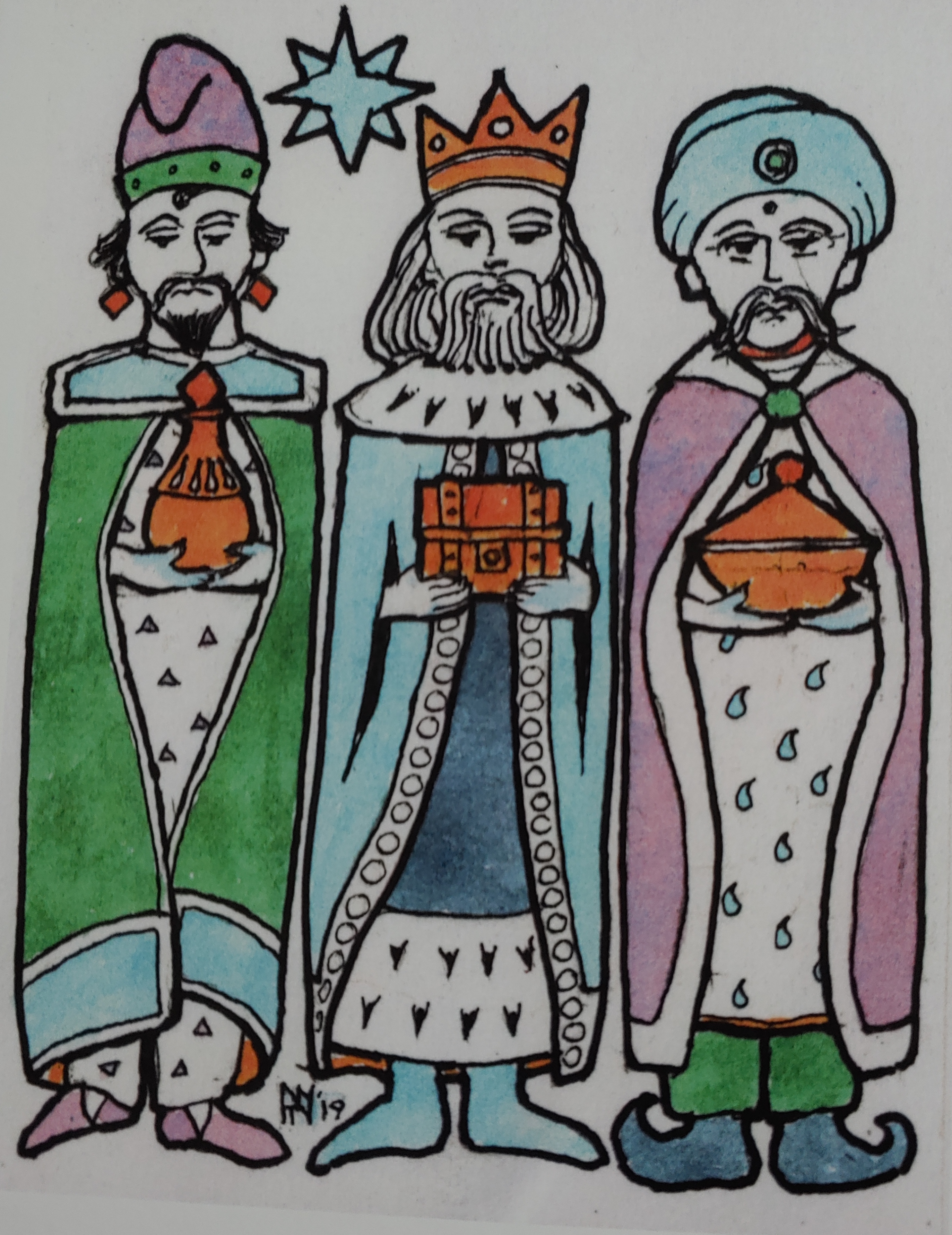
Every year, Thom Nordquist created a new card. I’m lucky enough to have several of them. This is one that came in 2020 – a lovely piece of art and connection in a time of isolation.
Magi by Thom Nordquist
Thom created the Magi card for an Advent activity – mailing post cards of Advent travelers out into the world to connect the Christ Church community in Plymouth with family and friends near and far a la Flat Stanley.
After Thom’s death, his wife Ellen gave me framed editions of the originals. They are in my work space year round and in my living room during the holiday season.
I admire the artistry in these cards. Even more, I am touched by the effort and intention that went into their creation. They are reminders that love and kindness, regard and concern, can show up in many forms. Such blessings make their way though that holy gate commonly known as a mailbox.
I have a couple of boxes filled with ones my husband sent, ones my sons created at school or home, and even one with my grandmother’s handwriting preserved inside. I use my favorites as bookmarks long after the day they arrived in my mailbox. They are little pieces of words and images that remind me of the ones who sent them and the occasion for the sending. Cards.
The one above is Saint Matthew, sent as a Christmas card from my mentor and college advisor, John Rouman. He was the one who introduced me to Greek Orthodoxy – something that ended up being the beginning of what would years later become my dissertation. Every time I see this card holding my place in my latest read, I think of him and how he changed my life.
Not all cards are touchstones to such things, but many are signs of care and concern offered in a particular place and a particular time. As I begin this new year, I’m going to take a look at some of them. If you are inclined to do the same, get your stack of cards ready…
Welcome to the world, Christ Child! Our souls rejoice at your coming!
Many thanks to God’s beloved children who offered their talents to this year’s daily offering…
Bill Albritton continues to lead Coffee & Conversation, a weekly study at Saint John’s in Duxbury; he also coordinates the parish’s prayer ministry. His thoughtful additions to this yearly offering began in its first year, and continued every year since.
David Anderson is a retired Episcopal Priest living outside Philadelphia. He is the author of Breakfast Epiphanies and Losing Your Faith, Finding Your Soul. He assists his wife, Pam Anderson, in running the Copper House retreat center. You can find more of his writings on his blog, Finding Your Soul.
Linda Benningfield-Hashman listens for God and writes to foster the spirits of others.
Donna Eby takes pictures of sunsets and writes poetry in the Plymouth area. She finds her faith home at Christ Church.
Bryan Fredrickson moved to Santa Fe, New Mexico, after retiring, and is taking full advantage of all it has to offer. He found his worship community at the Unitarian church there. His words have been an Advent gift many times over the years.
Dave Fredrickson is the priest-in-charge of Zion Episcopal church in Manchester Center, Vermont. He is a coauthor of Being Church in a Liminal Time: Three Images to Shape Your Congregation’s Future.
Jill Fredrickson lives in Santa Fe, New Mexico, living in a way that honors the earth and life. She practices the art of Japanese floral arranging. Her words and images have graced this devotional for many years.
Michael Giordano is a member of Zion Episcopal Church, and serves on the Vestry. He serves as a reader in worship and leads the congregation in morning prayer when the priest is away.
Debbie Hill is a singer, artist, and calligrapher who offers her talents at Christ Church Episcopal in Plymouth, Massachusetts. She and her husband, Don, have provided music for the Saturday evening service there for many years, to the great delight of the congregation.
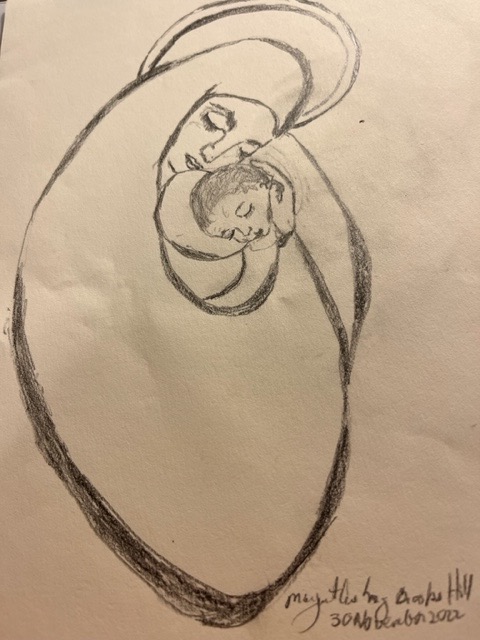
Margaret Hill loves God, self, and neighbor in Duxbury, Massachusetts and at Christ Church Parish in Plymouth, Massachusetts. Her art has graced this blog and many homes.
Jeff Jones is a retired minister and field education teacher for seminarians. His book, Being Church in a Liminal Time: Three Images to Shape Your Congregation’s Future, was last year.
Robin Nielsen serves God and neighbor at Christ Church in Plymouth, Massachusetts. She has led the altar guild for many years, both at church and in the local region.
In that region there were shepherds living in the fields, keeping watch over their flocks by night. Then an angel of the Lord stood before them, and the glory of the Lord shone around them, and they were terrified. But the angel said to them, “Do not be afraid; for see – I am bringing you good news of great joy for all the people: to you is born this day in the city of David a Savior, who is the Messiah, the Lord. This will be a sign for you: you will find a child wrapped in bands of cloth and lying in a manger.”
And suddenly there was with the angel a multitude of the heavenly host, praising God and saying, “Glory to God in the highest heaven, and on earth peace among those whom he favors!”
When the angels had left them and gone into heaven, the shepherds said to one another, “Let us go now to Bethlehem and see this thing that has taken place, which the Lord has made known to us.” So they went with haste and found Mary and Joseph, and child lying in the manger. When they saw this, they made known what had been told them about this child; and all who heard it were amazed at what the shepherds told them.
But Mary treasured all these words and pondered them in her heart.
The shepherds returned, glorifying and praising God for all they had heard and seen, as it had been told them.
Luke 2:8-20, NRSV
A Cradle In Bethlehem, Nat King Cole, Capitol Records, 1966
Readings: Micah 5:2-5a; Luke 1:46b-55; Hebrews 10:5-10; Luke 1:39-45
My soul magnifies the Lord, and my spirit rejoices in God my Savior, for he has looked with favor on the lowliness of his servant.
Surely, from now on all generations will call me blessed; for the Mighty One has done great things for me,
and holy is his name. His mercy is for those who fear him
from generation to generation. He has shown strength with his arm;
he has scattered the proud in the thoughts of their hearts. He has brought down the powerful from their thrones,
and lifted up the lowly; he has filled the hungry with good things
and sent the rich away empty. He has helped his servant Israel,
in remembrance of his mercy, according to the promise he made to our ancestors,
to Abraham and to his descendants forever.
Luke 1:46-55
Imagine what it must have been like for Mary. Engaged – looking forward to having a husband who would love, care and provide for her. It would be a simple life in small village – never great wealth, but every reason think they would have what they needed to live and raise a family. And then this angel shows up. And she learns she is going to get pregnant before she’s married. And the baby she’s going to have is not just any baby; he’s God’s son. I can picture her imagining her life falling apart around her. What was a time to celebrate, to look forward in joy to marriage and married life had all of sudden become a time of stress, strain, ridicule, criticism and condemnation. And it was all God’s fault!
This is what God does. God continually disrupts the complacency of our lives. When we think we’ve got the answers God lets us know we don’t. When we think it’s all settled God stirs things up. When in our pride we relish our own ability to handle all of life on our own, God confronts us with the harsh reality of our own inadequacy and weakness, God whittles us down, reminding us that something beyond ourselves is needed. And when we’re caught in a web of despair, seeing no possibilities and having no hope, God offers a vision of a new life of joy. And this doesn’t just happen to us as individuals. It happens to the world.
God does this to reverse the way things are because God knows the way things are is not the way they are supposed to be. That’s why it’s important during Advent to acknowledge the struggles and problems of living – so we’ll be open to the great reversal God is about. If we don’t do that, if Advent was only about hope, peace, joy and love, there would be no reason for reversal, no reason for God, no need of a savior. So, we need to talk about the fear, the guilt, the anxiety of our living. And, following Mary’s lead, we take it one step further. In her hymn of praise Mary helps us see it’s not just about personal reversals. It’s also about the world, about all creation. Mary sings praise to God because God has looked with favor on her lowliness, done great things for her and shown great mercy. But she also sings praise to God because God scatters the proud, brings down the powerful, lifts up the lowly, fills the hungry and sends the rich away empty.
Because this is our faith – because we know this is the work God is up to, because we have experienced this reversal in our own lives, even as Mary did – we now have the strength, the courage, the fortitude not just to sit by and wait for God to do God’s thing, but to join in doing it. Because God has provided assurance for our fear, forgiveness for our guilt, and courage for our anxiety, we can join God in the work of turning the reality of injustice into a reason for joy. We can do it with conviction and hope because we know we are not the powerful of this nation or this world: God never chooses the powerful. We may not be among the movers and shakers: God never chooses the movers and shakers. We can do it because we are precisely the kind of people God chooses to do the work God wants to do. And when we’re chosen by God we too can be about reversing the way things are. We too can bring joy to injustice. We too can really and truly turn the town, the nation, the world upside down. This is the meaning of incarnation. This is how the Word is made flesh. It’s the thing God does – and it’s the thing God has chosen us to do.
Daily Readings: Psalm 80:1-7; Isaiah 66:7-11; Luke 13:31-35
At that very hour some Pharisees came to him [Jesus] and said, “Get away from here, for Herod wants to kill you.” He said to them, “Go and tell that fox for me, ‘Listen, I am casting out demons and performing cures today and tomorrow, and on the third day I finish my work. Yet today, tomorrow, and the next day I must be on my way, because it is impossible for a prophet to be killed outside of Jerusalem.’ Jerusalem, Jerusalem, the city that kills the prophets and stones those who are sent to it! How often have I desired to gather your children together as a hen gathers her brood under her wings, and you were not willing! See, your house is left to you. And I tell you, you will not see me until the time comes when you say, ‘Blessed is the one who comes in the name of the Lord.'” Luke 13:31-35, NRSV
There’s a time when children no longer want their mother hugging them, no longer want their father to say I love you. They don’t return the embrace or the words in public, sometimes for years. It’s part of growing up, this separation from those who have loved and cared for them since birth – and continue to do so! Their inner dialogue is no longer shared, and they do their best to keep their longing for comfort hidden.
The good news: it’s a stage that most outgrow. The loving words and embraces return.
The same seems to be true in our relationship with God. When we are growing, we go through a time of pushing God’s offer of love and help away; we refuse the very love we most desperately want and need. Sadly, we don’t always grow out of this.
Perhaps one of the reasons God-With-Us came as a helpless infant is so that we could say I Love You and gladly embrace the divine.