Fear, reworded

The fear of the Lord is the beginning of knowledge; fools despise wisdom and instruction. Proverbs 1:7

Trust in the Lord with all your heart, and do not rely on your own insight. Proverbs 3:5

Do not be wise in your own eyes; fear the Lord, and turn away from evil. Proverbs 3:7

NRSV

Fear is not a good translation in this modern age because it’s understood as an emotional response rather than a philosophical or religious perspective. For most of us, fear is the same as terror, fright, dismay, or anxiety. Fear understood this way leaves no room for trust, much less a whole-hearted trust!

A more accurate definition of Fear in these verses would be something like this: 1)awareness of both our own mortality and limitations and 2) of God’s eternal, infinite, and loving nature, and 3) respect for the difference.

I favor Eugene Peterson’s translation, found in The Message:

Start with God – the first step in learning is bowing down to God; only fools thumb their noses at such wisdom and learning.

Trust God from the bottom of your heart; don’t try to figure out everything on your own.

Don’t assume you know it all. Run to God! Run from Evil!

The Message (NavPress, 2016 – online at Bible Gateway)

The world did not begin with us, and it will not end when we die. Life managed to exist before us and will continue on after us. There are untold marvels that came before us and countless miracles that we won’t live to see. Everything begins with God, even you and even me. The wise experience this truth as a blessing; the foolish reject it for the curse they assume it to be.

Proverbial Knowledge

The proverbs of Solomon son of David, King of Israel:

For learning about wisdom and instruction; for understanding words of insight,

for gaining instruction in wise dealing, righteousness, justice, and equity;

to teach shrewdness to the simple, knowledge and prudence to the young – 

let the wise also hear and gain in learning, and the discerning acquire  skill,

to understand a proverb and a figure, the words of the wise and their riddles.

Proverbs 1:1-6 NRSV


Grocery bags are cut to cover the new chemistry book. A pencil is sharpened. A turkey wrap joins some grapes and pretzels to fill up the gecko covered insulated lunch box. Such are the simple, ordinary things that mark the beginning of a new school year. Studying and acquiring knowledge happen in the larger context of a gracious life, and this context contains so much that isn’t often noticed or appreciated (until or unless something goes awry!).

The book of Proverbs is advice on this larger context, a pithy poetic essay on how to live a good life. Much of it is practical – be honest in your negotiations, find good friends, keep your word. Some of it is “advice to a child,” and some just general advice to no one in particular. The questions it answers: what does a life well lived look like? What is a wasted life? Will you choose the path of the wise or will you stray into foolishness?

It’s been some time since I reflected on the wisdom of Proverbs. With the yellow school buses soon on their way, it seems like a good to crack it open…I hope you join me.

18 Years and Counting…

I’ve lived in this 1950’s Cape longer than I’ve lived in any other home. When we moved in, my older son was just starting preschool, and my younger son had just learned how to walk. Many things have changed since then: kitchen appliances, beds, sofas, curtains, and wall colors. Some things have been added (several bookcases, tables, chairs) and some things subtracted (high chair, crib, vcr). The bathroom has been redone and recently tiled. Garden beds were added along the front walkway, on the side of the house, and in the front corners inside the shrubs along the front of the yard. Some of the books on the shelves moved in with us, but many more have come along since. Life within these walls has changed this house, but so incrementally that it almost escapes notice. It’s only when I take the time to count the changes that the magnitude of it is revealed.

I think the same is true for my interior life. My prayer life is different than it was 18 years ago, but I can’t say that I made any huge or sudden changes. How I understand “love God, self, and neighbor” has undergone renovation as well, growing out of one awareness and into anther. Taken altogether, though, these accumulated adjustments have kept my inner life relevant to who I am rather than who I was.

The life my family and I have been given within these walls, and the interior growth living in this place has brought, hasn’t always been convenient and has never been perfect. But it has always been gracious and precious. Another house in another town might have brought as many blessings, but they would have been different ones. I wouldn’t trade the ones I have found in this home. What I have is enough, where I am is sufficient, and God has dwelt in this place. And I am thankful.

A Carriage House in New Hope

Attached to a barn, with beat-up linoleum in the kitchen and wide plank boards of uneven width and length on the second floor, was the loveliest home I could ever want. I didn’t own it – it was part of a larger estate, rented for less than a cramped apartment cost in that area. The owners offered us the carriage house not for the money, but to see a mother and father walk the grounds with their young son.

It was a quirky place, converted from the carriage house to an artist’s studio with a kitchen in the 1950’s. Seems the owner/artist’s wife had died and he didn’t want to live in the main house without her, so he added paintbrush shelves to the walls and new glass to the windows. He offered the place to other artists – Jackson Pollack took him up on the offer, leaving a few paint splatters that were buffed off the floors long before I walked them.

It seemed to me a house all about love and loss, a refuge for a man who lost his beloved wife and later for me and my husband to delight in our older son’s growing and to welcome our younger son into life. The carriage house offered a rich life that had nothing to do with money.

Some years ago, for reasons unknown to me, the carriage house was torn down. Only in pictures and memory does that lovely old home live on. In another couple of decades, I may be the only one who remembers with love its walls, stairs, windows, and doors. But like all things lost to the passage of time, its value is safe in the blessings of the lives made better by its existence.

It gladdens my heart to know this truth: nothing is lost that was loved. God holds all things and all people – sometimes in carriage house shaped hands.

Between Garden and 10th Avenue

It’s now the High Line Hotel. Before that, the Desmond Tutu Conference Center; right before that, the Chelsea apartment I called home for a year. It stretched the width of the building, wrapping around the grand marble staircase leading to General Seminary’s vaulted refectory. Windows on one side revealed dumpsters, a dilapidated parking lot, and the 10th Avenue municipal maintenance facility for Manhattan’s trash and utility trucks. The window on the opposite side offered a leafy view of a quiet garden alive with birds, butterflies, squirrels, and brown rabbits. This gothic building, along with several others, formed the wall that surrounded the entire block along 9th and 10th avenues, between 20th to 21st streets. My older son learned to walk on its painted wooden floors and its hosta-lined garden paths while my husband learned how to be an Episcopal priest and I wrote my dissertation.

It’s a curious space to occupy, the residential barrier betwixt garden and city traffic. In recent years, I’ve come to see it as an image of the spiritual life. Cultivating a quiet space of reflection and communion with God on the inside while living in the world of noise, opportunity, strife, and beauty. Without the larger world as a reference point, my spiritual life can become disconnected – something that only has to do with me and my particular understanding of God. Without a quiet space of reflection and worship, the noise of everyday life drowns out angel song and prophetic vision alike.

There were a lot of inconvenient things about living between garden and avenue – car exhaust sprinkled fine black powder on the window sills every day, the closest exit to the street was a half block walk, and there were three keys necessary to get from street to my front door. But I am grateful for all of them: a deeply faithful life that connects inner peace with the broken, beautiful world isn’t lived at my convenience – nothing true and sacred ever is, was, or could be convenient.

[For images, go to www.thehighlinehotel.com or gts.edu.]

103 Farber Road, Apt. 7b

It was a second floor apartment, circa 1950’s. The balcony was concrete with decorative cinderblock walls. A walk-through galley kitchen, a Pepto Bismal pink bathroom, large bedroom, and a living/dining space that made the best of its 650 square feet. It was the first home my husband and I shared. The first time we set foot in our new home, we found champagne on ice, a cooler full of smoked salmon and cheese, and a basket with crackers and chocolate mints. A vase of flowers sat on the cooler with a “Congratulations!” balloon attached – gifts of kindness from our friends, Tim and Joicy.

There were many meals together and many with friends in the four years we lived on Farber road. We had a cat to love and good neighbors below and on each side. It was where we welcomed our first son into the world.

A few years back, the seminary tore it down and replaced it with something more modern – WiFi enabled with energy star windows and a basement that doesn’t flood in the Spring. There are some nice extras in the new places, but that’s what they are: nice extras, not necessities.

Many people look back on their first apartments with sentimental fondness, but wouldn’t want to live in such a place again. I can’t say the same. If a time comes when I no longer need the extra square footage I have now, I’d be pleased to end up in a place like Apartment 7b. I’d have to lose some of the nice extras I’ve collected, but I doubt my life would be the poorer for it.

This is one in a series. Click “No Place Like Home(s)” above for more in the series.

2nd Floor Alex

It was the first thing I saw when I drove onto campus. Alexander Hall, Princeton Theological Seminary’s first building: four stories of beige and brown stone, mortar, with the old lecture and worship hall on its second floor, it was one of the three dorms for seminary students. I called it home for the better part of three years – rooms 205b and 203.

It wasn’t a place I chose for myself, and dorm living brought its share of frustrations – sharing a bathroom with twenty or so other women and the necessity of cafeteria food because I had no kitchen. I hadn’t planned on moving to New Jersey, so far from family and the New England coast that I called home. But I soon found my place among new people. I also discovered that New Jersey had a lot to offer.

Before returning to New England, New Jersey gave me many friends and several years of deeply satisfying study and work. I also met my husband there, and gave birth to both of my sons. Who would have guessed that a small room on the second floor of Alexander Hall could contain such marvels?

610 State Street, Apartment F

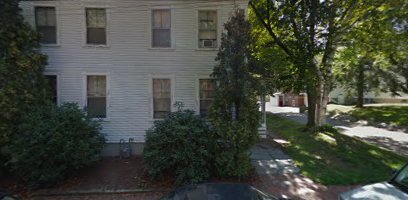
[Google Maps image]

It’s a block from the John Paul Jones house, half a mile from Prescott Park, and across the street from the old Whipple Elementary School. After a brief search and a good scrubbing, it was my first home that wasn’t my parents’ or a student apartment. 

It took a bit of paint and some wallpaper, but it felt like home within weeks of moving in. My bedroom was three stories above street level; when fog rolled in, the ground disappeared in streetlamp haloes. The kitchen window was my doorway to the flat roof and thank-God-never-needed fire escape. I registered to vote and settled in. It was my refuge when work was difficult, and a place I shared with friends, family and roommates. Until I drove to graduate school in New Jersey, its four rooms-plus bath and large entry hall were where I laughed, cried, smiled, and mourned.

To this day, part of me considers Portsmouth, New Hampshire home. I learned to love coastal small city life because of its people and places. Had I not lived here in an old three story house, I doubt I’d be in this Southcoast Cape style home I’ve loved for the past sixteen years…

For four walls and a roof, thanks be to God.

For more on this series, click “No Place like home(s)” above.

A Choice of Convenience and Necessity

It was an attic room in a four bedroom apartment, just a few miles from UNH and $140 a month. Eight months stood between me and college graduation: I could live with three strangers in an in-town Dover Colonial until then. It was a roof over my head and a short commute to work and school. It didn’t need to be any more than that.

Seven roommates came and went in the sixteen months I lived on Horne Street. Save one, the rest were luck-of-the-draw choices made by the landlady. But out of our sharing the same cheap apartment came some amazing things:

I was a bridesmaid in two of their weddings (Sharon and Marilyn).

I got one of them to the hospital for emergency surgery when no one else was around (Sue).

In the other attic room, in the four months we both lived there, I found a friend for life (Maryann).

In January a year later, Maryann and I celebrated our 25th birthdays in my Portsmouth apartment. A few weeks beyond that, an abnormal pap smear turned into aggressive cancer. Eighteen precious months of surgeries, hospital visits and driving to radiation treatments later, I sat in a church with her family to give her back to God.

I don’t think there’s any such thing as a choice of necessity and convenience that doesn’t hold within it the possibility to be life altering in unimaginable ways. Every so often, when I’m passing through the Dover area, I drive past my Horne Street home to remind myself of this.

A beautiful day in the neighborhood…

Twenty-four years and two months ago, I served Mr. Rogers dinner. He was visiting Princeton Theological Seminary, lending his expertise to the media department as it moved into the 21st century. Other than the slight disappointment that he didn’t change into sneakers and a sweater when he arrived at the seminary president’s house, he was everything I’d hoped and expected he’d be: kind, soft spoken, and attentive. When I served rolls, refilled glasses, or set dessert in front of him, Fred Rogers looked me in the eye and thanked me. But that wasn’t all that happened…

Toward the end of the meal, one of the dinner guests mentioned to Mr. Rogers that I would be starting a PhD program in the Fall.

“Make sure to look at the robes worn by the PhD grads,” he said. “One day, you will wear those colorful robes.”

I thought it an odd comment, but nodded politely. It was then that I had my Mr. Rogers moment. He turned in his chair, looked directly at me and said, “It’s what’s on the inside that counts.”

“I think so, too,” I said.

Fred Rogers was an ordained Presbyterian minister whose work with children blessed countless numbers of pre-schoolers. Rather than entertain, he chose to engage, moving at a pace most suitable to the under five crowd. He chose to interpret Jesus’ summary of faith – love God, self, and neighbor – literally, by being a good neighbor and a kind presence in a medium that too often only wanted to sell toys or breakfast cereal.

One of the most profound truths of faith is that we are all connected. Through prayer, work, and play, we touch the lives of those around us in this time and place – and well into the future. In a world that values sarcasm over kindness and speed over intention, it’s a marvelous thing to have a neighbor like Fred Rogers – even if it’s only through the tv set. When others went for cleverness, he stayed with sincerity. His message at all times: You are lovable, loved, and unique. You are a delight to God and a gift to the world. I don’t know anyone who can live a good life without someone saying these truths to them.

Thank you, Fred Rogers. I’m so glad you were my neighbor.

[Won’t You Be My Neighbor? is playing in theaters. It’s wonderful, bring tissues.]

Moving into God’s presence through words