On Not Finding You At Home

Usually you appear at the front door

when you hear my steps on the gravel,

but today the door was closed,

not a wisp of pale smoke from the chimney.

I peered into a window

but there was nothing but a table and a comb,

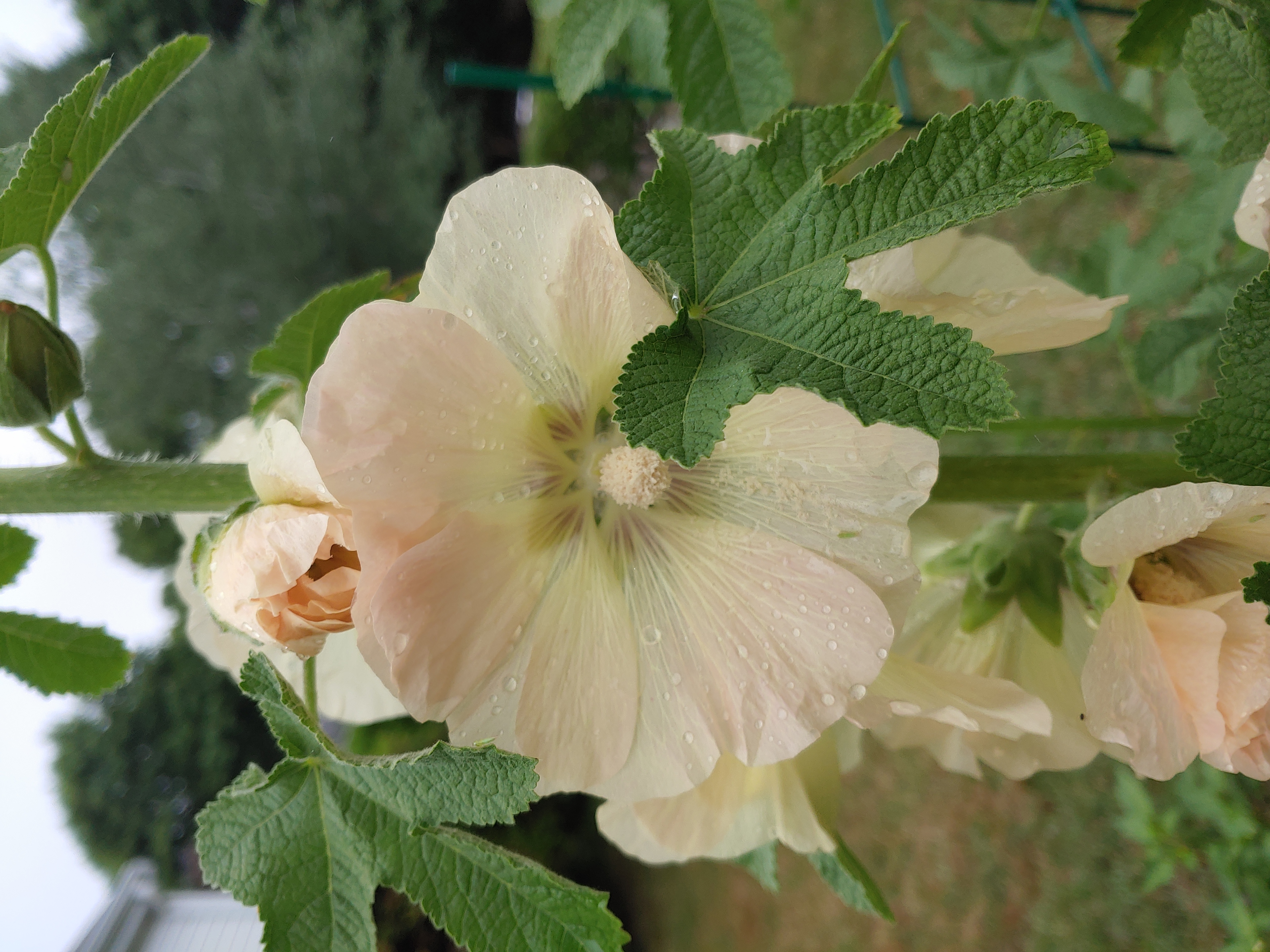
some yellow flowers in a glass of water

and dark shadows in the corner of the room.

I stood for a while under the big tree

and listened to the wind and the birds,

your wind and your birds,

your dark green woods beyond the clearing.

This is not what it’s like to be you,

I realized as a few of your magnificent clouds

flew over the rooftop.

It is just me thinking about being you.

And before I headed back down the hill,

I walked in a circle around your house,

making an invisible line

which you would have to cross before dark.

[Billy Collins, The Trouble With Poetry (and other poems); New York: Random House, 2005, p. 58]

I’ll never know what it’s like to be you, only what it’s like to pretend to be you. I’d be wise to remember that. The best I can do: join hands with you and share the secrets of our holy and wholly different lives.

Contemporary Announcement (1983)

Contemporary Announcement 

Ring the big bells,

cook the cow, 

put on your silver locket.

The landlord is knocking on the door

and I’ve got the rent in my pocket.

Douse the lights,

Hold your breath,

take my heart in your hand.

I lost my job two weeks ago

and rent day’s here again.

[Maya Angelou, Contemporary Announcement; Shaker, Why Don’t You Sing?; New York: Random House, 1983]

That wonderful feeling when there’s enough money to cover the basics: food, clothing, shelter. The dread and shame when there’s not enough money to cover the basics: food clothing, shelter. In just two paragraphs and a word short of a full deck’s count, Maya Angelou puts us in that rented apartment.

These words are being lived out by millions today, thirty plus years after Angelou published them. Will we ever learn that poverty is not a moral shortcoming or a character flaw?

Jesus, Saint Francis, and Gandhi all figured that out. I have hope the rest of us can, too.


A Minor Bird

I have wished a bird would fly away

And not sing by my house all day;

Have clapped my hands at him from the door

When it seemed as if I could bear no more.

The fault must partly have been in me.

The bird was not to blame for his key.

And of course there must be something wrong

In wanting to silence any song.  Robert Frost

[Frost, A Minor Bird; A New Anthology of Robert Frost’s Poems; New York: Washington Square Press, 1971, p.199]

Sometimes, the songs I try to silence are beautiful. Other times, perhaps they are the ones I most need to hear.  In a world full of people singing their truth or spinning lies, the least I can do is pay attention.

Rumi’s Star

A Star Without A Name

When a baby is taken from the wet nurse,

it easily forgets her

and starts eating solid food.

Seeds feed awhile on ground,

then lift up into the sun.

So you should taste the filtered light

and work your way toward wisdom

with no personal covering.

That’s how you came here, like a star

without a name. Move across the nightsky

with those anonymous lights.

[Rumi, Say I Am You, John Moyne and Coleman Barks, trans.; Athens, GA: MAYPOP, 1994, p. 59]

My friend Eldon firmly believed that the name you were given influenced the person you would become. Unlike a rose, Eldon wouldn’t be the same (man) under any other name. He has a point.

God’s name isn’t spoken or written out in Hebrew – assigning a name might lead to the erroneous conviction that any human mind or heart could encompass all that God is (was/will be). It’s a valid point.

Maybe it’s not such a bad idea to embrace a nameless state, just as before we were born and grown. We might have an easier time remembering that we cannot be contained by whatever letters comprise our monikers; and we might dare believe that the infinite God dwells within us as surely as in the limitless beyond. Just maybe, our life’s point.

The Pasture – An Invitation

I’m going out to clean the pasture spring;

I’ll only stop to rake the leaves away

(And wait to watch the water clear, I may):

I shan’t be gone long. – You come  too.

I’m going out to fetch the little calf

That’s standing by the mother. It’s so young,

It totters when she licks it with her tongue.

I shan’t be gone long. – You come too.

[Robert Frost, The Pasture, Anthology of Robert Frost’s Poems; New York: Washington Square Press, 1971, p. 15. It’s the first poem in many Frost collections – his invitation to his readers to join him in seeing the wonder that waits just outside the door. Or inside it, for that matter. ]

This isn’t an invitation to a party or a once-in-a-great-while gathering. This is an invitation to come along on the mundane traipsings of daily life, and to help out with the day’s work – lending a hand, or at least providing good company.

Only a select few are asked to come along for these little trips that will add up to a lifetime.

Treasure such invitations, and for God’s sake as well as your own, grab your jacket and go.

Invisible to Visible

A portrait of the Reader with a Bowl of Cereal

[“A poet…never speaks directly, as to someone at the breakfast table.” Yeats]

Every morning I sit across from you

at the same small table,

the sun all over the breakfast things – 

curve of a blue-and-white pitcher, 

a dish of berries – 

me in a sweatshirt or robe,

you invisible.

Most days, we are suspended

over a deep pool of silence.

I stare straight through you

or look out the window at the garden,

the powerful sky,

a cloud passing behind a tree.

There is no need to pass the toast,

the pot of jam,

or pour you a cup of tea,

and I can hide behind the paper,

rotate in its drum of calamitous news.

But some days I may notice

a little door swinging open

in the morning air,

and maybe the tea leaves

of some dream will be stuck

to the china slope of the hour – 

then I will lean forward,

elbows on the table,

with something to tell you,

and you will look up, as always,

your spoon dripping milk, ready to listen.

[Billy Collins, Picnic, Lightning; Pittsburgh, PA: Univ. of Pittsburgh Press, 1998, 3-4]

One of the surest signs that a relationship is in trouble: ignoring a partner’s attempt to get attention.

Looks like these two are doing just fine.


A Great Gray Elephant

A great gray elephant,

A little yellow bee,

A tiny purple violet,

A tall green tree,

A red and white sailboat

On a blue sea –

All these things

You gave to me,

When you made

My eyes to see –

Thank you, God.

[National Society for the Prevention of Blindness, Inc]

God gave me the world when God gave me sight – and touch, smell, taste, and hearing. Through these senses, I discover the world.

But I have to remember that all these things aren’t my personal possessions. God-given is an offer of sharing, not a transfer of ownership.

(A Great Gray ElephantPoems and Prayers For The Very Young; selected by Martha Alexander; New York: Random House, 1973)

Gospel According to Shel

THE SEARCH

I went to find the pot of gold

That’s waiting where the rainbow ends.

I searched and searched and searched and searched

And searched and searched, and then –

There it was, deep in the grass,

Under an old and twisty bough.

Its’ mine, it’s mine, it’s mine at last…

What do I search for now?

Shel Silverstein, Where the Sidewalk Ends; New York: HarperCollinsPublishers, 1974, p. 166

It’s the last poem in the collection, followed by a couple of blank pages and an index. I could just pass it off as a clever rhyme, but I’ve spent too much time reading works of wisdom and mystical theology to do that. When I reach the last couple of pages in the book that is my life, I hope that I’ve done more than search for some coins in a pot. With just a couple of blank pages to go before I reach the obituary/index, I pray that the decades of pages I was given hold words of love and beautiful illustrations – not just the tracks of someone running as fast as possible to reach the end.

What are you listening to?

Listen To The Mustn’ts

Listen to the MUSTN’TS, child

Listen to the DONT’S

Listen to the SHOULDN’TS

The IMPOSSIBLES, the WON’TS

Listen to the NEVER HAVES

Then listen close to me – 

Anything can happen, child,

ANYTHING can be.

Shel Silverstein, Where the Sidewalk Ends; New York: HarperCollins Publishers, 1974

Children aren’t old enough to know what can and cannot happen. Anything is possible because immutable laws, probability, and rigidity of thinking haven’t arrived quite yet.

On one level, Silverstein is wrong. No matter how hard I flap my arms, I won’t achieve lift-off.

On the deepest level, Silverstein is spot on: miracles happen every day, and nothing can be taken for granted. It’s amazing that I forget this, considering I claim these words as gospel truth:

But there are also many other things that Jesus did; if every one of them were written down, I suppose that the world itself could not contain the books that would be written. (John 21:25, NRSV)

Upper Case, lower case

VIII

There are four doors which open on the skies.

The first is truth, by which the living word

Goes forth to seek the spirit and be heard;

Lost in the universe, the spirit lies.

Then justice with her veiled and quiet eyes

Stands at the second portal; at the third,

Faith and her sparrow, the immortal bird;

And the last gate is love’s, to paradise.

These are the doors by which the mighty pass.

Yet in the wall there is one wicket more,

With rusty hinges and a splintered floor,

A shattered sill half hidden in the grass.

Small is the gateway as the Scriptures tell;

Its name is pity, and God loves it well.

Truth, Justice, Faith, and Love: often, their importance is conveyed by capitalizing their first letters. Yet Nathan keeps them lower case – except for Faith, and that only because it is the first word of the line.

Pity is something different. Just about anyone can show pity, although we might call it by its fancier name: compassion.

I wonder. With the four big ones in lower case, just like pity, perhaps Nathan is trying to tell me something about who God is, and how I expect to be drawn into God’s holiness. Jesus, God-With-Us, embodies all of them. Maybe Nathan’s point is that while I won’t discount the value of Truth, Justice, Faith, and Love, I just might overlook pity.  That would be a shame, because Jesus certainly did not.

Then Jesus went about all the cities and villages, teaching in their synagogues, and proclaiming the good news of the kingdom, and curing every disease and every sickness. When he saw the crowds, he had compassion for them, because they were harassed and helpless, like sheep without a shepherd. (Mt. 9:35-36)

Then Jesus mad a circuit of all the towns and villages. He taught in their meeting places, reported kingdom news, and healed their diseased bodies, healed their bruised and hurt lives. When he looked out over the crowds, his heart broke. So confused and aimless they were, like sheep with no shepherd. (Mt. 9:35-36, The Message)

Lord Have Mercy, Christ Have Mercy. Lord Have Mercy.

[Robert Nathan, A Winter Tide, VIII; New York: Alfred A. Knopf, 1940, p. 10]
Moving into God’s presence through words