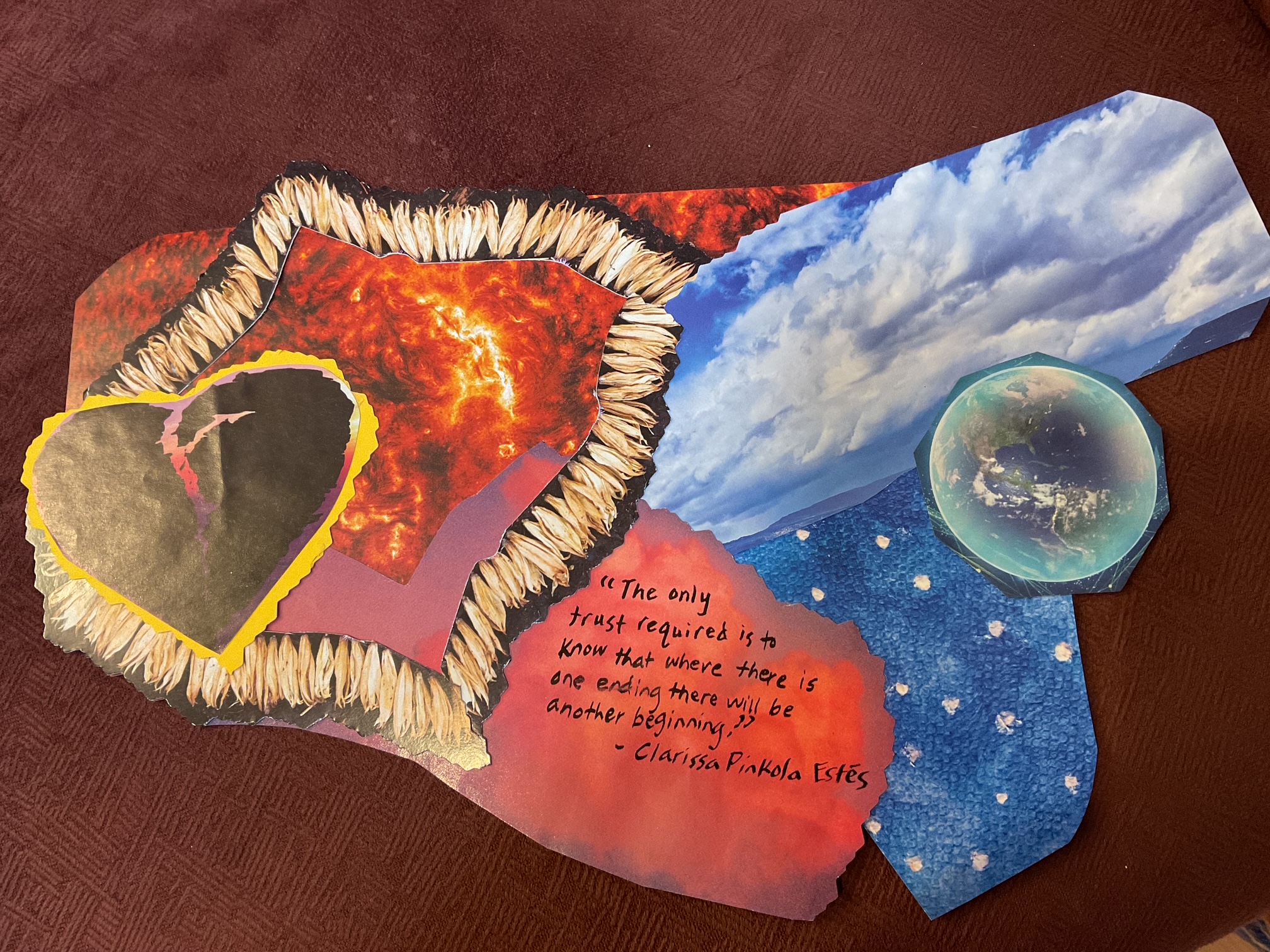
Daily Readings: Psalm 80:1-7, 17-19; 2 Samuel 7:23-29; John 3:31-36
“The one that God sent speaks God’s words. And don’t think he rations out the Spirit in bits and pieces. The Father loves the Son extravagantly. He turned everything over to him so he could give it away – a lavish distribution of gifts. That is why whoever accepts and trusts the Son gets in on everything, life complete and forever! And that is also why the person who avoids and distrusts the Son is in the dark and doesn’t see life. All he experiences of God is darkness, and an angry darkness at that. John 3:34-36, The Message
Trust vs. Mistrust. According to Erik Erikson, it’s the first major crisis we face as human beings. Are the people who care for me trustworthy? Is this world trustworthy? How an infant answers this question, yes or no, sets her on a path, sets the tone for the next seven stages of psycho-social development. (Childhood and Society, Erik Erikson; New York: W.W. Norton & Company, 1993, original in 1950)
Do I trust God? Do I see in Jesus a God who is constant and trustworthy? Is the ground of my life solid? If I answer yes, then it becomes a gracious thing, an abundance given by God who loves me. If I answer no, then life becomes a trial, a punishment from a God who is angry with my inadequacy.
Daily Readings: Psalm 80:1-7, 17-19; 2 Samuel 7:18-22; Galatians 4:1-7
King David went in, took his place before God, and prayed: “Who am I, my Master God, and what is my family, that you have brought me to this place in life? But that’s nothing compared to what’s coming, for you’ve also spoken of my family far into the future, given me a glimpse into tomorrow, my Master God? What can I possibly say in the face of all this? You know me, Master God, just as I am. You’ve done all this not because of who I am but because of who you are – out of your very heart! – but you’ve let me in on it.This is what makes you so great, Master God! There is none like you, nothing to compare with what we’ve heard with our own ears. 2 Sam. 7:18-22, The Message
David understood a fundamental truth: God acts to save because of who God is, not because of who we are. We don’t need to be perfect or particularly worthy of praise because God’s love is given, not earned. No wonder David asked: Who am I, my Master God, and what is my family, that you have brought me to this place in life?
What we do with our years doesn’t earn us God’s love – that’s already a given. Our strengths and weaknesses don’t determine or explain why God chose to be God-With-Us in Jesus. But perhaps, in response to being God’s beloved, how we love ourselves and others in our years can offer a glimpse of such divine love.
Angels, by Thom Nordquist
Thom Nordquist returned to God’s embrace, leaving behind his beautiful art.
Daily Readings: Psalm 80:1-7, 17-19; 2 Samuel 7:1-17; Galatians 3:23-29
“Now when the king [David] was settled in his house and the Lord had given him rest from all his enemies around him, the king said to the prophet Nathan, ‘See now, I am living in a house of cedar, but the ark of God stays in a tent.’” 2 Samuel 7:1-2
David wasn’t an ordinary dreamer. He who had nocturnal visions of slaying giants had the kind of dreams that stretched the elasticity of what’s possible. Here with the prophet Nathan, he’s lamenting the living quarters of the Ark of the Covenant, the holy treasure that defined, even embodied, his people’s relationship to God. The Ark was residing among tent curtains flapping in the desert wind, lugged about by nomadic Jews like a piece of luggage. David wanted the Ark to have a permanent home, one fit for a king.
Nathan foresaw that the temple project would not be realized in David’s lifetime. The timing just wasn’t right. But David kept the dream alive and passed it along to his son, Solomon. From historical accounts, we surmise the temple that Solomon built was an awe-inspiring triumph of the imagination. The Ark of God had a beautiful new home.
Today, we are fortunate to be a ble to visit such monuments to dreamers’ imaginations. For those who have crossed the thresholds of Gothic-style cathedrals such as Notre Dame, Chartres, St. Peter’s, Canterbury, or our own National Cathedral in Washington, D.C., we feel a visceral rising of the spirit as our eyes track high up fluted marble columns toward ribbed, vaulted ceilings. The stunning stained-glass windows nearly bring us to our knees in wonderment. Airy choral notes lift high on incense as a prayer, echoing in the vast reaches of the emptiness above. The sheer brilliance of architectural design and engineering prowess embodied in these holy structures are a testament to an unbounded spirit of boldness. Here in Santa Fe, the beautiful but more earthy Romanesque Cathedral of St. Francis, named after the city’s patron saint, was the daring brainchild of a French parish priest, Fr. Jean-Baptiste Lamy, who became the first Archbishop of Santa Fe.
Rainier Maria Rilke wrote a poem about daring the spirit to dream large, to live life to the hilt, to take this gift of life seriously. The poem is from his Book of Hours.
God Speaks to Each of Us
God only speaks to us before we exist,
Then walks quietly beside us,
But the words, the cloudy words
We hear before we begin our lives,
Are sent forward into the world by our senses:
“Go to the edge of all your desire to make sense.
Be the clothing that gives me form.
Standing behind the world of things,
Make yourself a flame
So that the shadow widens,
Always including me completely.
Let everything happen to you,
Terror and beauty.
You’re only required to go forward,
No feeling is unnatural.
Don’t let yourself be separated from me.
We have almost arrived
In the land they call Life.
This you will perceive
By how serious it will feel.
Give me your hand.”
Translation by David Keplinger
Offered by Bryan Fredrickson, in whom God delights.
Daily Readings: Psalm 42; Zechariah 8:1-17; Matthew 8:14-17, 28-34
By this time they were in front of Peter’s house. On entering, Jesus found Peter’s mother-in-law sick in bed, burning up with fever. He touched her hand and the fever was gone. No sooner was she up on her feet than she was fixing dinner for him.
That evening a lot of demon-afflicted people were brought to him. He relieved the inwardly tormented. he cured the bodily ill. He fulfilled Isaiah’s well-known revelation: He took our illnesses, he carried our diseases. Matthew 8:14-17, The Message
Matthew 8 in a nutshell: Jesus healed a leper, a Roman captain’s servant, then Peter’s mother-in-law. After our passage, Jesus questioned two would-be followers and calmed a raging storm at sea. The chapter ends with Jesus ridding two possessed men of their demons, a herd of pigs plunging off a cliff when the demons possessed them, and a mob from town demanding that Jesus leave and never return.
Without the first thirteen verses and verses eighteen to twenty seven, the focus is on Jesus and his ability to heal those sick in mind, body, and spirit. But I think something vital is lost when parts of chapter eight got snipped away. Beyond our knowing Jesus as a healer, what is the message? I think verses twenty-one and twenty-two offer a glimpse…
Another follower said, “Master, excuse me for a couple of days, please. I have my father’s funeral to take care of.”
Jesus refused. “First things first. Your business is with life, not death. Follow me. Pursue life.”
Following Jesus is pursuing life. It is healing those whose illnesses keep them from a good life. It is letting go of tasks and delays that focus on death rather than on life. It is keeping company with the socially questionable. It is healing a life because someone needs it, not because society says someone deserves it.
But you, dear friends, carefully build yourselves up in this most holy faith by praying in the Holy Spirit, staying right at the center of God’s love, keeping your arms open and outstretched, ready for the mercy of our Master, Jesus Christ. This is the unending life, the real life!
Go easy on those who hesitate in the faith. Go after those who take the wrong way. Be tender with sinners, but not soft on sin.
Jude 1:20-23, The Message
It’s a few hundred words between John’s three letters and Revelation – Jude’s neighboring books get a lot more time and attention. But Advent gives me the chance to spend some time in this next-to-the-last book, this penultimate letter.
The words above come right at the end of Jude’s letter, right before the words of blessing that bring Jude to an end. For some reason, this strikes me: the last words of advice are ones of compassion for others, a plea to be kind to those whose faith isn’t on solid ground, to go out and find those who go the wrong way even when common sense says to let them live with the consequences of their errors in judgement. Jude doesn’t say to condone errant behavior; he says to offer those who stray another chance.
What if I lived into this sequence of events? What if my final acts were reaching out to those who need it most? What follows is a benediction to end Jude’s words – then Revelation and the end of all things partial (albeit writ large with amazing and horrifying imagery).
Perhaps seeking the hesitant and lost is the only way to appreciate a benediction and let go of the partial in favor of a new heaven and a new earth…
[This book is ascribed to the apostle Jude, also called Thaddeus – a brother of James and half brother of Jesus. Tradition also links this Jude to Saint Jude, the patron saint of hopeless causes – perhaps why he advocates for seeking those who are lost…]
Dignify those who are down on their luck; you’ll feel good – that’s what God does. Psalm 42:1, The Message
Christmas does not begin in perfection. It begins in longing.
Psalm 42 speaks aloud what many carry quietly into this season: thirst of the soul, exhaustion of hope, tears that keep time through the night. And yet this longing is personal. It is not a crowd crying out, it is a soul. God meets us not as a mass of humanity, but heart by heart. Christmas proclaims that God knows the shape of your ache and draws near.
Isaiah widens the circle. God’s promise is to a people being remade together. The land becomes fruitful, the confused gain understanding, the gentle are lifted up. This restoration is communal. God heals not in isolation, but in relationship, reweaving trust where it has been torn. Christmas announces that no one is forgotten and no one is restored alone.
Then Acts shows us what God-with-us looks like when faith becomes flesh in the world. The people bring the sick into the streets. They carry one another. They make space. Healing happens in public, shared places. God works through proximity, through hands willing to lift, through doors left open, through a community daring to believe that mercy belongs to everyone. The miracle is not only that shadows heal, but that people place one another where healing can happen.
This is the church revealed at Christmas, not a building lit beautifully, but a body moving together. A community that holds sorrow without fear, joy without possession, and hope without conditions. We need one another because God has chosen to come among us that way. God shows up personally, but never privately. Grace always makes room.
Daily Readings: Isaiah 35:1-10; Psalm 146: 3-10; James 5:7-10; Matthew 11:2-11
Don’t put your life in the hands of experts who know nothing of life, of salvation life.
Mere humans don’t have what it takes; when they die, their projects die with them.
Instead, get help from the God of Jacob, put your hope in God and know real blessing!
God made the sky and soil, sea and all the fish in it. He always does what he says – he defends the wronged, he feeds the hungry. God frees the prisoners – he gives sight to the blind, he lifts up the fallen. God loves good people, protects strangers, takes the side of orphans and widows, but makes short work of the wicked.
God’s in charge – always. Zion’s God is God for good! Hallelujah!
Psalm 146:3-10, The Message
Sewing new valances for the kitchen windows; reformatting a year’s worth of curriculum and writing another; canning the two pounds of cranberries sitting on my cupboard. There’s nothing wrong with working on such projects, as long as I realize and accept that none of them are going to matter much beyond a limited number of people for a short period of time. There’s an impermanence about them that cannot be changed – foolishly denied, yes, but not changed.
What if I embrace the impermanence, seek to make of my work and life something beautiful, holy? I guess that life would reflect God’s priorities: defending the wronged, lifting up the fallen, freeing the prisoners, feeding the hungry. Such a life may not be considered successful or even worth much by the larger society, but what do cultural experts know of true life?
I want my life to be a sand mandala. I want to create it out of love and care and live it as a spiritual practice. When the time comes, I want to say a prayer, draw a line through it, and let it be swept away.
Impermanence, photographer and subjects unidentified
Sand mandalas are created by Tibetan buddhist monks as a spiritual practice and a reminder of life’s beauty and impermanence.
Daily Readings:Psalm 146:5-10; 2 Peter 3:11-18; Luke 3:1-18
The winnowing fork cleans out the threshing floor and gathers the wheat into the barn; but the chaff will be burned up with unquenchable fire. Luke 3:17, paraphrased
…we are looking for new heavens and a new earth. 2 Peter 3:12
Offered by Jill Fredrickson, in whom God delights.
Daily Readings: Psalm 146:5-10; Ruth 4:13-17; 2 Peter 3:11-18
In 2 Peter 3:11-18, Peter is tasking Jesus’ followers with a few points to remain faithful. He first describes the condition of the world and the coming destruction. In verse 14 he says while you are waiting for these things to happen, make every effort to be found living peaceful lives that are pure and blameless in his sight. And remember, our Lord’s patience gives people time to be saved. Concluding with verse 18, rather you must grow in the grace and knowledge of our Lord and Savior Jesus Christ. All glory to him, both now and forever! Amen. This verse reminds me of the words at the beginning of the gospels (also describing the last days before Jesus comes) “Sin will be rampant everywhere, and the love of many will grow cold. But the one who endures to the end will be saved.” Matthew 24:12-13
There may be something we are supposed to be striving for these days, but it sure doesn’t look like it should be power, money, or status. It looks like patience and endurance smothered in love. And to me it doesn’t mean stockpiling enough rice and beans to get through it. If this is part of enduring for you, hopefully you’ll share a dish later on when I need it.
I am among the generation of baby boomers. God has given me the task of caring for my ailing husband. He is almost 80, and has a list of disabilities and illnesses a mile long related to Vietnam and his as-long-as-possible adult life of extreme motocross racing. But we endeavor to persevere together, and some days are better than others.
Recently we were in a doctor’s waiting room full of women who were caregivers for their husbands. I noticed two of them. One man in a wheelchair, head in hands and looking tired and depressed was being hovered over by his wife as she tried to comfort him and meet his needs. His response was rude remarks of impatience and despair. Her face was strained and sad. The other wife came and sat beside me, making the statement “I am sick of this. I am out of here. I am not wasting the rest of my life taking care of him. I’ve got a life to live.” I didn’t say much back to her, I wasn’t sure how to respond. But I understood. I felt great empathy for these ladies.
I had been considering starting a caregiver support group for wives in my small town. It became plain to me this group would be needed and helpful. So, I was off and running. I contacted several women, all of whom I barely knew but had witnessed their daily lives from afar. I organized our first meeting and gave them all kinds of data and statistics to them about why the support group could be helpful. Every woman jumped at the chance to be a member.
The husbands of the wives in our group have varied conditions: Parkinson’s with hallucinations, extreme heart failure or heart conditions, dementia and memory issues, and failing mobility. As wives, we are all dealing with fear and anxiety. Each wife has different challenges to navigate, but we all are trying to “do it right” and we all are facing the impending departure of our husbands.
We laugh about the funny things when we can. One husband listens to full volume television programs that are only spoken in Chinese. Does he speak Chinese? No. One wife came home to find all of the doors to her kitchen cupboards removed. Another’s husband accuses her of cheating and having affairs with other men when she has to leave him for a bit. We answer the same questions repeatedly. We experience the men’s frustration with their own declining abilities, depression and their need to remain in control. We have taken on tasks and responsibilities that were once handled by the husbands. In every case the wives pretty much now shoulder all of the responsibilities. Yes, there are assisted living opportunities, but none of our group has the means to make that choice. And most of us do not have family near to help.
We wonder – where am I in all of this? We feel like we are losing and ignoring ourselves and our needs. And we all have our own physical limitations, health issues and emotional stress to manage. Of course, we all are enduring to the end. And while we are waiting, we are making every effort to live peaceful lives.
And that ain’t easy. We are in a constant whirlwind of appointments, medication schedules, bathing fights, dressing and feeding them, finding things to keep them motivated and content, financial, home and vehicle maintenance. All as we listen to repetitive stories and questions all day long. In between tasks, we are seeking to grow in the grace and knowledge of our Savior. We know love is the only thing that can endure. Love never fails, never grows tired of doing good. But the ability and desire to endure in love only comes through the tender support Jesus offers us. He has promised to be with us until the end. Even to your old age and gray hairs I am he, I am he who will sustain you. I have made you and I will carry you; I will sustain you and I will rescue you. Isaiah 46:4 NLT
However, Jesus could use your help.
As this year winds down with all of the celebrations and family encounters, you might take special notice of a caregiver. Until you’ve done it, you don’t understand. But you might offer some kind of acknowledgement. If you have experienced this loving task, share tips and resources, or just sit quietly with a caregiver over a cup of tea and listen. Better yet, think of what you needed at that time. Stock their pantries with rice and beans, and maybe their table with a big bouquet of flowers.
It could mean the world to a caregiver to be acknowledged and genuinely heard. Help them accept that being a caregiver for someone is an act of courage and strength, not a burden of obligation. Maybe let Jesus use your arms to wrap them in a hug.
Offered by Linda Benningfield-Hashman, in whom God delights.
Daily Readings: Psalm 146:5-10; Ruth 1:6-18; 2 Peter 3:1-10
One day Naomi got herself together, she and her two daughters-in-law, to leave the country of Moab and set out for home; she had heard that God had been pleased to visit his people and give them food. And so she started out from the place she had been living, she and her two daughters-in-law with her, on the road back to the land of Judah.
After a short while on the road, Naomi told her two daughters-in-law, “Go back. Go home and live with your mothers. And may God treat you as graciously as you treated your deceased husbands and me. May God give each of you a new home and a new husband!” She kissed them and they cried openly…
Orpah kissed her mother-in-law good-bye; but Ruth embraced her and held on. Naomi said, “Look, your sister-in-law is going back home to live with her own people and gods; go with her.” But Ruth said, “Don’t force me to leave you; don’t make me go home. Where you go, I go; and where you live, I’ll live. Your people are my people, your God is my god; where you die, I’ll die, and that’s where I’ll be buried, so help me God – not even death itself is going to come between us!”
When Naomi saw that Ruth had her heart set on going with her, she gave in. And so the two of them traveled on together to Bethlehem. Ruth 1:6-10, 14-18, The Message
Three deaths and a famine in a foreign land – that’s what Naomi faced. Dead husbands and a famine – that’s what Orpah and Ruth faced. Three women dealt a hand that could very easily win them death or a life on the streets. The best option was for them to return to their families – Naomi’s in the land of Judah, Moab for Orpah and Ruth.
After a lot of crying, Orpah did the sensible thing and returned to the protection of her family – and to the possibility that she might marry again. Naomi did the sensible but hazardous thing, heading back to Judah and whatever family she had. Ruth, did not. Ruth chose to leave the safety of family ties and head to a land and a people that had no vested interest in her life. Out of love for her mother-in-law, with trust in Naomi’s God, she set out for Bethlehem.
Against all common sense and odds, it worked out. Naomi introduced Ruth to her relative, Boaz. A few batted eyelashes and some negotiations later, Boaz and Ruth are married. A few months later, Obed is born. What could have ended in tears and tragedy ends in joy.
Obed grew up, married, and had a boy named Jesse; Jesse grew up and had a boy named David, who later became king. Naomi and Ruth’s road trip, their love and care for one another, blessed the world (as all instances of love and care do, even if they aren’t written down).
Not from Moab, and not because of a famine, but from Nazareth and due to a Roman census, two more people set out on the road to Bethlehem. That trip, care for one another, and trust in God that their journey would lead to something good led to another baby being born in Bethlehem. And to this Advent journey we take every year…