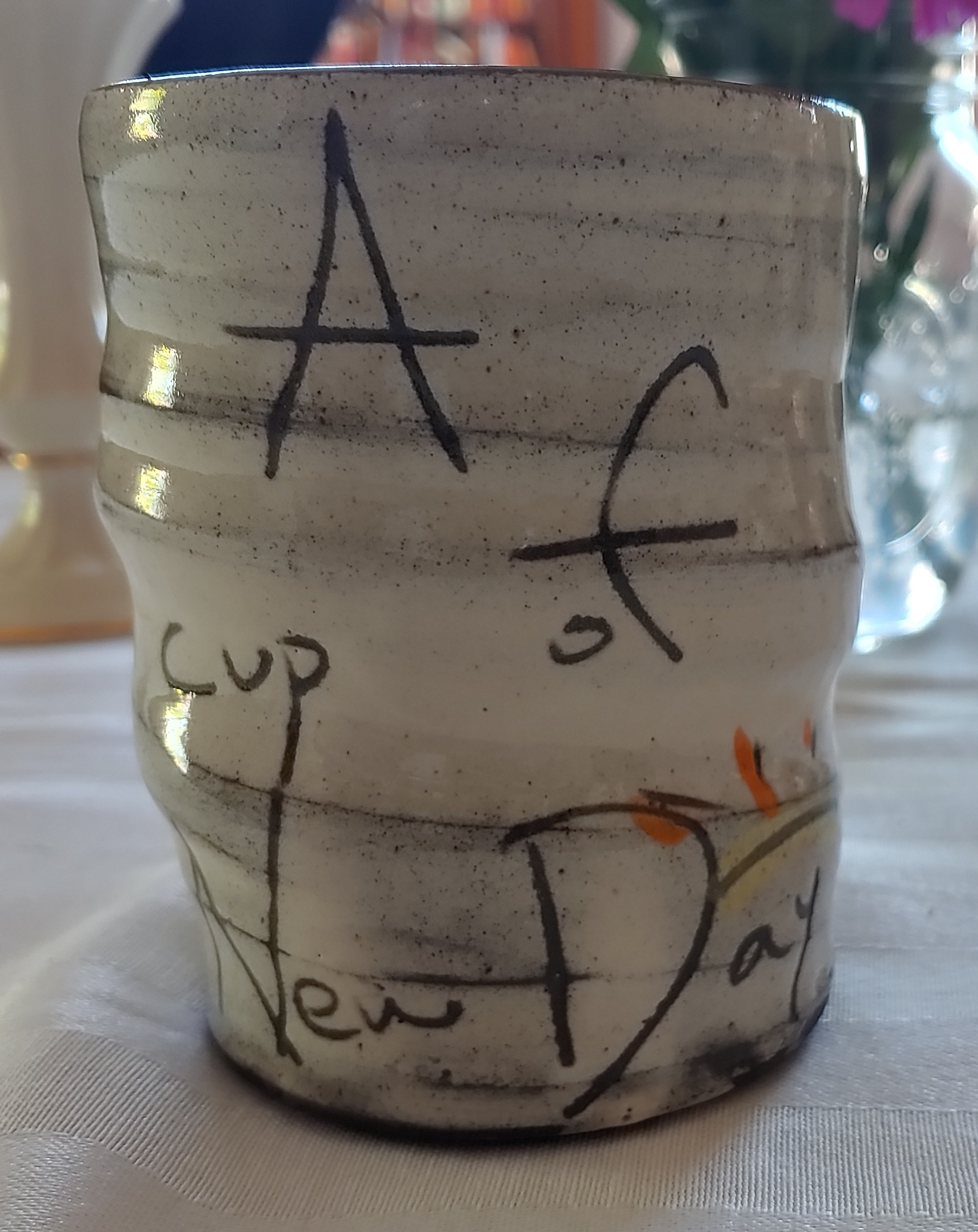
(Love) It bears all things, believes all things, hopes all things, endures all things.
I Corinthians 13:7, NRSV
Love may bear all things, but I can’t. I don’t always react with compassion to every person in every situation; I don’t give the benefit of the doubt universally; I make snap judgements and am reluctant to recognize, much less honor, the holiness of every life God has created. I don’t have eyes to see the transfiguring light or ears to hear the voice of God – sometimes because I can’t, sometimes because I won’t.
I’m not love personified. Neither was Paul. But in his imperfection, he knew and lived into a profound truth: when I cannot love, love will bear me, holding me and whomever I cannot love in an infinite, all-encompassing embrace.
Love did the same for Paul. Love does the same for you.
Love does not rejoice in wrongdoing, but rejoices in the truth. I Cor13:6, NRSV
Gifts, like a knife, can be used for good or harm. The people in the church at Corinth had a nasty habit of valuing certain gifts over others – speaking in tongues over hospitality, preaching and prophecy over acts of care and compassion. This valuing of some gifts over others led to a valuing of the people with those gifts over those with the more subtle ones. What was intended to increase love and appreciation among the congregation was used to tear it apart – a wrongdoing that caused internal damage to the community, diminishing love for one another, self, and for God. How could anyone rejoice over such behavior?
The truth that was overlooked in this wrongdoing: every single person brings something unique and valuable to this world – even when it isn’t obvious. Loving self, each other, and God gives us the ability to value the gifts of others and our own gifts without jealousy or judgement. If we can’t rejoice in such an amazing truth, can we rejoice in anything at all?
Love is patient; love is kind; love is not envious or boastful or arrogant or rude. It does not insist on its own way; it is not irritable or resentful; it does not rejoice in wrongdoing but rejoices in the truth. I Corinthians 13:4-6, NRSV
When I resent someone else’s good fortune, I can feel my heart constrict – squeezed by a giant fist of jealousy and envy. I think that’s as much a lack of love and appreciation for what I do have as it is a lack of love for the person who has what I don’t. With some effort and a larger perspective, I can let go of resentment over such things.
But what about that feeling of irritation that comes over someone else’s behavior? Talking too much, not talking enough; laughing too loud, not laughing at all; correcting my mistakes to be helpful or to be annoying – the list goes on and on. Perhaps I don’t usually ascribe my own irritability to a lack of love because it’s so easy to believe it’s the result of the other person’s shortcoming rather than my own.
Why is it so easy to see someone else’s irritability as self-generated, but so difficult to see mine as the same? If I ask myself this question, perhaps with some effort and this larger perspective I’ll be able to let go of irritability as well.
[For the full text, click I Corinthians 13 above.]
It does not insist on its own way. I Corinthians 13:5, NRSV
[For the full text, click I Corinthians 13 above.]
The coffee pot was moved back to the corner, and thus began the battle…
The church kitchen had been a disorganized mess for years, so the youth group took it on as a way to contribute to the life of the community. Cupboards that hadn’t been opened in years, much less emptied, were given a thorough scrubbing; what was broken or dangerous was removed; what was left was cleaned, organized, and labeled. The walls were degreased and repainted. It took hours, but the transformation was spectacular.
One of the best things: the coffee station had been relocated to a space near the service window. Everything was within easy reach, and it made coffee hour so much easier for hosts and guest alike. The youth group did the honors that first Sunday after the reorganization, hosting the coffee hour and revealing the new kitchen.
The grumbling started within hours. How could the teens change the kitchen without asking (they had permission from the church leaders)? How could they toss things out without permission (only broken and expired things were thrown away)? What right did they have to change anything?
The next Sunday, the coffee pots and machine had been moved back to the corner by persons unknown, recreating the old set-up. The youth, assuming someone didn’t know about the new place, moved it again. The next Sunday, it happened again. And again. And again. Finally, the youth gave up. Their hard work and best intentions had run into a communal unwillingness to change. The coffee making status quo was restored, but the damage was significant: the youth no longer believed that their efforts or their presence were welcome.
I doubt the adults who moved the coffee pots were intentionally causing damage to the teens of the church. I’m almost positive that there wasn’t a conspiracy intent on rejecting and dismantling the gift of time and effort given by the youth. This was just a typical knee-jerk reaction, a reclaiming of turf, an exercise of power. I wish the adults had asked themselves this question:
What is more important: keeping things the way I want them or honoring the gift offered by others?
The true and most disturbing question: what would have been their answer?
Love is patient; love is kind; love is not envious or boastful or arrogant or rude. I Corinthians 4, NRSV
The pained smile. The back-handed compliment.
The constant reminders of feats accomplished. Superiority flaunted to make others feel their inferiority.
Bad behavior tolerated or excused because of exceptional accomplishment, no matter how it hurts others.
Whether on the giving or receiving end, harm is done and people are left broken. Faith communities and the people in them aren’t immune. They can be torn apart by such things because it diminishes the lives of everyone involved.
Like everything else, I suspect it boils down to a lack of love for one of the big three: God, Self, Other. If we had eyes to see our own value, would we waste any time on worrying how we compared to others? If we had eyes to see the worth of others, wouldn’t we honor that in word and deed?
If we trusted that we were created and loved by God, would any other recognition be necessary?
Sometimes, what we do not do is as powerful as anything we do.
God,give me eyes to see and a heart to love. Amen.
To be kind is to see through the brokenness, the fear, the mistaken assumption that competition is the only true reality; to be kind is to reach for the holy person hiding inside the shell such things create. To be kind is to see the lovable in what looks to all the world unlovable.
To be unkind is to see in even the most beautiful and holy a threat; to be unkind is to forget one’s own holiness, to forget who one truly is.
When we see others for who they truly are, when we know who we truly are, to be kind will be as natural as breathing.
Instant answers via google; next-day delivery; lunch ordered, prepared, and handed over without getting out of the car; they are conveniences that most people take as necessities, and they’ve made the daily practice of patience obsolete.
If love is patient, then patience is a sign of love. Does this mean that loving God, self, and neighbor may be more difficult because we’ve come to value and expect immediacy?
[For the full text, click I Corinthians 13 above.]
If I give away all my possessions, and if I hand over my body so that I may boast, but do not have love, I gain nothing. I Cor. 13:3, NRSV
Lent has arrived, and all kinds of people are giving up alcohol, chocolate, online gaming, and other treasured activities they consider possible vices. All kinds of people are taking on volunteer projects, daily prayer, and exercise – not-so-treasured activities they consider virtues. I have a couple of things in mind myself – ‘Tis the season, right?
It’s so easy to miss the point of these activities, to take them on as some sort of punishment or correction for past mistakes or bad behavior. Even sadder, to imagine that such acts will slide a few of our beads from the negative to the positive side in God’s mighty morality measuring abacus.
The point of these activities is not to diminish ourselves, or to exhaust our bodies, hearts, minds, and souls. It’s the exact opposite: such things can enlarge who we are, granting us a glimpse of God’s transforming love in the face we see in the mirror each morning. But only if we do them as a means to bring about good things, not as a means to hurt ourselves or an attempt to prove that our faith is bigger and better than someone else’s.
So as we begin such things, let’s ask ourselves a simple question: Is this a way to love ourselves, others, and God? If it is, dive right in. If it isn’t, consider this: without love, we gain nothing.
(PS. There is no mighty morality measuring abacus…)
[Paul understood such things, because he did all kinds of these things when he was called Saul – acts without love for others, seeking to correct nonconforming worship practices and punish their practitioners. So he did his best to keep others from making the same mistake. It’s why he wrote this love letter. For the full text, click I Corinthians 13 above.]
If I speak in the tongues of mortals and of angels, but do not have love, I am a noisy gong or a clanging cymbal. And if I have prophetic powers, and understand all mysteries and all knowledge, and if I have all faith, so as to remove mountains, but do not have love, I am nothing.
[For full text, click I Corinthians 13 above.]
Let’s assume I have good intentions, and my wishes for prophetic powers, perfect understanding and knowledge, and abiding faith are all answered. All I lack is love – meaning good things for others and sacrificing to bring them to fruition. I could still do so much good if I don’t use my gifts to harm, couldn’t I?
Doubtful. Not because I couldn’t accomplish amazing things, but because I’ll miss the point and purpose of those amazing things. Intelligence, knowledge, accurate prediction, and belief aren’t enough. Add them all up, and they still won’t give me the one thing I need: wisdom.
Wisdom assumes love – it’s why there are evil geniuses but no evil wise women and men. If I perform miracles without love for every living thing, I’m likely to manipulate others rather than invest in their uniqueness.
Wisdom recognizes limitations. Amazing abilities take their toll if fueled only from personal resources. The well runs dry eventually because no one is meant to live outside loving relationships with God and others. A car with an empty tank cannot fulfill its potential, even if it’s a top-of-the-line model.
Without love, I would be destroyed by my own abilities, a null and void self – nothing. God being gracious to everyone else, whatever I did manage to accomplish would bring blessing. God being gracious to me, creating me to be something rather than nothing, the wish wouldn’t be granted in the first place.
If I speak in the tongues of mortals and angels, but do not have love, I am a noisy gong or a clanging cymbal.
Words have the power to shape reality, pointing us to what is good and holy and staring us in the face. Words have the power to maim reality, and wound all that is good and holy and seeking life. What I say to you and about you, what you say to me and about me – these words matter.
As I write, the airways are full of words and the Ukraine full of violence. A string of words from a powerful leader, words without love or thought for the lives that will be lost and damaged, has put this whole world on a dark path. The noise of gongs and the crashing of cymbals, the whistle of bombs and report of gunfire are in that string of words without love.
What words can I say or write? How can I speak a quiet word of love in the cacophony of loveless syllables? Without love, my words will add to the destruction – no matter how beautifully or cleverly I craft them.
I best watch my tongue and do my best to speak love in this time that most desperately needs to hear it.