Category Archives: Biblical Reflection

Say What You Mean

Parable of the Two Sons, Matthew 21:28-31(32)

“What do you think? A man had two sons; he went to the first and said, ‘Son, go and work in the vineyard today.’ He answered, ‘I will not’; but later he changed his mind and went. The father went to the second and said the same; and he answered, ‘ I go, sir’; but he did not go. Which of the two did the will of his father?” They said, “The first.” Jesus said to them, “Truly I tell you, the tax collectors and the prostitutes are going into the kingdom of God ahead of you.” (For John came to you in the way of righteousness and you did not believe him, but the tax collectors and the prostitutes believed him; and even after you saw it, you did not change your minds and believe him.)

Be careful what you say; you can’t take those words back.

I don’t remember when my parents told me this, or if these were the exact words. These are the words I hear when I’m about to tell a secret or a lie. I hear them when discussion starts to go south, turning into argument. And the companion that goes along with this truth:

If you say it, you mean it.

I don’t mean that words said in anger are the ones that people live by at all times. Still, when angry and bitter words come, they come from somewhere; there is a time and a place in the heart where the words are true. When they are spoken, they take on a life in the heart of the hearer as well as in the speaker, changing each. Grace and forgiveness are needed to grow past them.

When the first son said no, he meant it. Later he thought better of it and his actions show he meant a yes. When the second son said yes, he meant it. Later he thought worse of it and his actions meant a no. Neither of these sons can take back their words. They can make good on them or they can turn away from the reality they created, living out their father’s request or letting it go unfulfilled.

This parable gives me hope even as it confirms what I’ve believed about words: they count, and they can’t be unsaid. But I can think better of them and work to change the reality they created. And when I pay lip service without true service, even then, there is a place in my heart that holds the yes. With grace and forgiveness, I just may find it.
Parable of the Two Sons


“What do you think? A man had two sons; he went to the first and said, ‘Son, go and work in the vineyard today.’ He answered, ‘I will not’; but later he changed his mind and went. The father went to the second and said the same; and he answered, ‘ I go, sir’; but he did not go. Which of the two did the will of his father?” They said, “The first.” Jesus said to them, “Truly I tell you, the tax collectors and the prostitutes are going into the kingdom of God ahead of you.” (For John came to you in the way of righteousness and you did not believe him, but the tax collectors and the prostitutes believed him; and even after you saw it, you did not change your minds and believe him.) 
Matthew 21:28-31(32) NRSV

The first son had no intention of doing what his father asked and said so without so much as an “excuse me,” or “sorry, no.” Some time later, he changed his mind and went into the vineyard to do the work his father asked of him.

The second son was just the opposite – a positive reply with a deferential “sir” attached, the very image of respect and courtesy. Quickly, he turned away from making good on his pretty words and whatever work he might have accomplished evaporated into a fog of good intention.

I’ve snapped a rude no to a task then later thought better of it; I’ve said an enthusiastic yes to a request and never followed through. Honest to God, I have. But the staggering truth Jesus shows me in this parable: there’s no such thing as good intentions that don’t lead to action. Sometimes circumstances interfere and I can’t follow through as quickly or directly as I had hoped. In rare cases, I never get out to the vineyard because something beyond my control makes it impossible. But most of the time, if I don’t act, then I didn’t really intend to do the work in the first place. I just hate to admit this to myself or reveal it to others.

NO

Photo on 2015-02-12 at 08.27Do not let the foot of the arrogant tread on me,

or the hand of the wicked drive me away.

Psalm 36:11 (NRSV)

It’s been one long snowstorm in Massachusetts. In the past three weeks, the snow banks have grown into mountains and sidewalks are out of sight. It’s not that any one of the storms created havoc, but the steady onslaught of snow laden clouds that have covered the sun for weeks. Snow accumulation has accumulated: too much too close together.

Not a single incident, but a collection of slights and plans gone awry that accumulated into paralyzing, insurmountable banks. A cry to God for help, for a place to stand, for a reprieve from something too big to overcome. Whoever wrote this psalm had too much too close together.

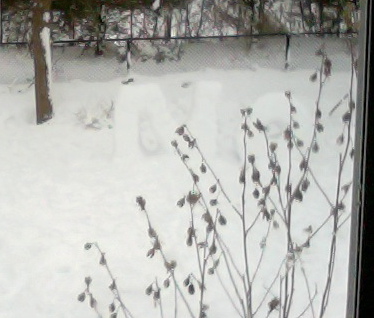
My sons built a snow NO a few days back. They’ve each had fun events cancelled and school days missed – life veering from its expected track. But they had a great time building the snow NO and spending time outdoors together. I see their NO every time I feed the birds or glance out the window.

I think the psalmist was creating his own snow NO – a complaint against life going wrong and the ones responsible for some of it. Snow falls on the wicked and the good and a sense of proportion and humor kept bitterness from settling in his or her heart permanently. Why do I think this? Because these words are also in psalm 36:

Your steadfast love, O Lord, extends to the heavens, your faithfulness to the clouds. (Psalm 36:5)

No amount of blinding white can hide the truth: we are never lost to God. Snow or no snow.

In the dark, into the light

For evils have encompassed me without number; my iniquities have overtaken me, until I cannot see;

they are more than the hairs of my head, and my heart fails me…

As for me, I am poor and needy, but the Lord takes thought for me. You are my help and my deliverer; do not delay, O my God.

Psalm 40:12, 17

What I see inside colors what I see outside. If my inner life is a wasteland of fear and anger, I’ll see enemies all around, dark projections that threaten to overwhelm me. Overtaken by my inner darkness, I am blind. Disheartened by the dangerous world, so very aware of my own inadequacies, there is no place for me to hide.

When I rely on my own strength, intelligence, and courage, the world shrinks to the size of my own inner resources. There’s nothing beyond the end of my nose. In such a small place, there is no help. For I am ready to fall, and my pain is ever with me. (Ps. 38:17) There is no way to get myself out of the box I created. I need help, and so I cry to God: I confess my iniquity; I am sorry for my sin. (Ps. 38:18). Sin isn’t a tally of all my bad deeds and shortcomings, it’s an admission that I’ve lost my way in the darkness. I need someone else to bring me back into the light.

Some people don’t believe in miracles. Walking on water, oil lamps that never run dry, and earthquakes that open jail cells don’t seem believable to some or necessary to others. But under all that is a miracle that’s easy to miss: the miracle of being brought out of darkness into light. To see the light, to take the hand of God when it’s offered (and it’s always offered) is miraculous. Out of the shadows, I can sing:

He drew me up from the desolate pit, out of the miry bog,

and set my feet upon a rock, making my steps secure.

He put a new song in my mouth, a song of praise to our God.

Psalm 40:2-3

Shattering

The nations are in an uproar, the kingdoms totter;

he utters his voice, the earth melts.

The Lord of hosts is with us; the God of Jacob is our refuge.

Come, behold the works of the Lord;

see what desolations he has brought on the earth.

He makes wars cease to the end of the earth;

he breaks the bow, and shatters the spear;

he burns the shields with fire.

“Be still, and know that I am God!

I am exalted among the nations, I am exalted in the earth.”

The Lord of hosts is with us; the God of Jacob is our refuge.

Psalm 46:6-11

Psalms bring together images that don’t usually travel in the same circles. In this case, God bringing desolation to the earth and God making wars cease. Melting earth and broken bow, both changing reality in unimaginable ways. Be Still and shattered spear, exaltation and burnt shields. God is with us, God is our refuge – the very God who guided Jacob from his trickster days to being Israel.

What would this world look like if everyone called it even, dropped their deadly toys and went home? Diplomacy would be the only way to get things done. Peace takes a lot more work and time, friendly relations a lot more flexibility and respect. Everyone would have to play by the rules…eventually.

In a way, I think that would be a desolation of the earth. A reversal of how power is exercised on a global scale destroys the violent reality that justifies and even encourages war. This isn’t just taking away the weapons: this is destroying the acceptance of pervasive violence as a way to live as a country, culture, and species.

How does such Godly, war-ending desolation begin? I guess it depends on the starting point. It takes such courage and faith to stop shooting arrows and hiding behind shields, and no one can do it alone. It takes reacting not in fear but in trust and hope – something I can’t do on my own. I guess that’s why I read the Psalms. When I am scared to death they assure me that…

God is our refuge and strength,a very present help in trouble.

Therefore we will not fear, though the earth should change,

though the mountains shake in the heart of the sea…

Psalm 46:1-2 (NRSV)

White Wonder

256px-SnowflakesWilsonBentley 

On the glorious splendor of your majesty,

and on your wondrous works, I will meditate.

Psalm 145:5

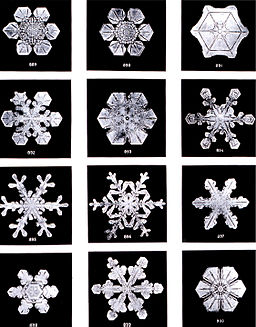
Last Saturday at the library, the young girl in front of me checked out Snowflake Bentley, the story of snowflake photographer Wilson Bentley. Bentley’s life-long love of snowflakes moved him to study them, to see and capture their hexagonal beauty.

It’s not easy to photograph a snowflake; they are tiny and fragile and they melt when held too long or brought inside the house. But Wilson Bentley wanted to share their beauty and structure with the world, so he developed a way to photograph them. Snowflake Bentley’s passion and effort brought snowflakes to the tropics and the deserts, giving them to people who will never see snow flying outside the window.

That young girl’s book choice couldn’t be more perfect: what better to read during a blizzard than Snowflake Bentley? The illustrations and words have come alive right outside the window – millions of unique snowflakes just waiting for someone with eyes to see and a heart to appreciate them.

I love snow, but I don’t spend a lot of time meditating on each individual snowflake. Even with so many outside my window, it takes seeing a book in the hands of a child to open my eyes to the one-of-a-kind beauty of each snowflake. A passing glance just isn’t enough to see what is right in front of me.

The same can be said of God’s wonder-filled world: sometimes it takes a psalm in my hands to give me eyes to see it and a heart to appreciate it.

Images of Wilson Bentley’s photographs are from Wikipedia, Snowflake Bentley.

(Jacqueline Briggs Martin, Snowflake Bentley, Houghton Mifflin Harcourt, 1998, ISBN 0395861624)

Stormy

Be merciful to me, O God, be merciful to me,

for in you my soul takes refuge;

in the shadow of your wings I will take refuge,

until the destroying storms pass by.

Psalm 57:1, NRSV

The sky is cloudy this morning, and snow is coming. High winds, almost hurricane strength, are on their way. Towns on the seacoast are preparing for storm surge. A blizzard is a fierce storm, and sometimes a destroying one. The last time this happened, the power was out for two days.

Storms are giant reminders that I cannot control the world I live in. I can and do prepare – pulling in trash cans and other things that might blow away, filling the bird feeders, having food and candles and batteries at hand – but I cannot control or avoid the storms that visit my home. Unless I leave.

For most storms, I’ll stay home; losing power and mobility for a day or two is just an inconvenience. But for those storms that threaten to destroy my home, ones that threaten my life and the lives of those I love, I’ll leave home and possessions to find a safer place. Houses can be rebuilt. There’s a big difference between inconvenience and death dealing destruction.

The same is true of the storms in my life that aren’t weather related. Heartache, pain, loss, and death. They hit home, wreaking havoc in my heart, mind, and soul. It’s easy to get lost in these storms; I’ll stay put and take the consequences for most of these, but seek a safe place when it’s beyond my strength.

Whatever type of storm comes, I’ll say a prayer for mercy and refuge. I’ll pray for myself and for others. I’ll seek shelter in the storm in the home that can never be destroyed: God’s loving embrace.

Old and New

What has been is what will be,

and what has been done is what will be done;

there is nothing new under the sun.

Ecclesiastes 1:9

2014 is on the way out, 2015 not yet arrived. My sons and I spent yesterday with my side of our family at our yearly New Hampshire post-Christmas gathering. In one way, there was nothing new about this year’s version of the decades old tradition. Most of the same characters showed up, with three absences due to work or other engagements. The menu was a mix of past favorites (chowder, chili, veggie sticks, and wine) and one or two new items (bread bowls and icebox cake). In another way, everything had changed. Last year, MacKenzie hadn’t been born yet, Kristen and Jay weren’t married, and my brother was still living in Arizona. The children have grown in ways seen and unseen, and the adults have changed in ways hidden and obvious. Life continues along its course, but everyone involved lives it in uniquely blessed ways. The same is true for countless other families coming together in countless other places; what has been done is what will be done.

But a new year is coming just as surely as an old year is leaving. Giving thanks for what has been, living into what is, and entrusting God with what will be – old and new, endings and beginnings. Letting go of the past to embrace the present and future – that’s my working definition of faith, December 28, 2014. Nothing new under the sun, and all things new every minute of every day.

Let it be

UnknownLuke 1:26-38

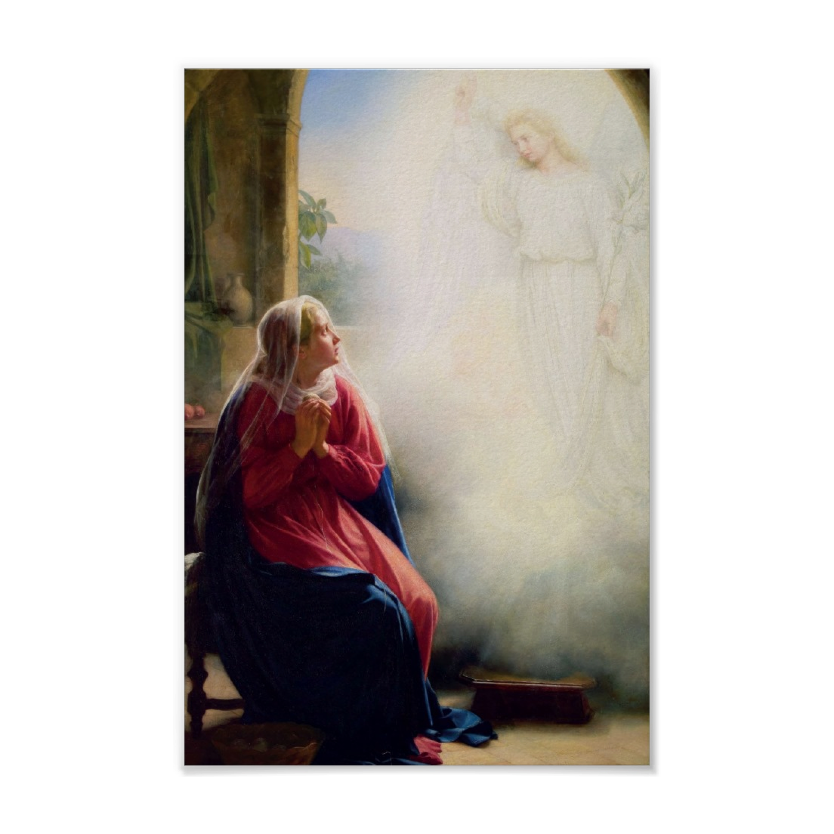
In the sixth month the angel Gabriel was sent by God to a town in Galilee called Nazareth, to a virgin engaged to a man whose name was Joseph, of the house of David. The virgin’s name was Mary. And he came to her and said, “Greetings, favored one! The Lord is with you.” But she was much perplexed by his words and pondered what sort of greeting this might be. The angel said to her, “Do not be afraid, Mary, for you have found favor with God. And now, you will conceive in your womb and bear a son, and you will name him Jesus. He will be great, and will be called the Son of the Most High, and the Lord God will give to him the throne of his ancestor David. He will reign over the house of Jacob forever, and of his kingdom there will be no end.” Mary said to the angel, “How can this be, since I am a virgin?” The angel said to her, “The Holy Spirit will come upon you, and the power of the Most High will overshadow you; therefore the child to be born will be holy; he will be called the Son of God. And now, your relative Elizabeth in her old age has also conceived a son; and this is the sixth month for her who was said to be barren. For nothing will be impossible with God.” Then Mary, said, “Here am I, the servant of the Lord; let it be with me according to your word.” Then the angel departed from her. Luke 1:26-38 NRSV

There is a rich selection of scripture readings for this day, but how can one not choose the Annunciation even if the chronology is truncated? At least I couldn’t. This enduring and endearing story is at the heart of the Nativity for many of us, I imagine. Growing up in a “progressive” Protestant church environment (yes, even in Tennessee many moons ago there was such a thing) one didn’t much deal with the virgin birth (or one explored the hermeneutics to determine if Isaiah was properly translated regarding such an event and debates ensued as to its relevance – yada, yada, yada). How we loved the sound of our intellectual bloviations.

These days I’m not as smart as I used to be. These days I just welcome the Christ Child, Messiah, Yeshua, into my heart as Mary did so long ago – no questions asked, no explanations necessary – and even with God’s grace occasionally mutter “let it be with me according to your word.” Not only is this story enduring and endearing — it is life-changing.

Come, Lord Jesus, quickly come.

Offered on December 24, 2014, by Bill Albritton, prayer ministry leader, ponderer, child of God.