Category Archives: Biblical Reflection

Ordinary Miracles

Readings: Psalm 42; Zechariah 8:1-17; Matthew 8:14-17, 28-34

When Jesus entered Peter’s house, he saw his mother-in-law lying in bed with a fever; he touched her hand, and the fever left her, and she got up and began to serve him. That evening they brought him to many who were possessed with demons; and he cast out the spirits with a word, and cured all who were sick. This was to fulfill what had been spoken through the prophet Isaiah, “He took our infirmities and bore our diseases.” Matthew 8:14-17, NRSV

Most of the healings in the gospels are pretty dramatic. Leprosy, withered hands, paralysis, violent demon possession. This one is not so spectacular. There’s no dramatic confrontation with a wild man in a synagogue, no thunderous rebuke of an evil spirit. It’s just a tender scene: Jesus goes into Simon Peter’s house and finds his mother-in-law sick in bed with a fever. Like most fevers it’ll probably run its course in a few days. No one said, Come quickly and heal this woman! Jesus was just there to have lunch and finds, by the way, that Peter’s mother-in-law is sick. He simply walks over to her bed and takes her by the hand. He lifts her up, and the fever leaves her.

It’s very ordinary. Very domestic. That scene is repeated a thousand times over every day in hospitals and nursing homes, and in homes like our own. Anytime anybody gets touched, reached out to in their pain, lifted up, it’s nothing short of miraculous.

Most of us wouldn’t think of ourselves as healers, wouldn’t claim we had the touch of miracle in our hands. But we have all been laid low—by physical diseases of body or mind, by grief in loss, by trauma of wind or fire or water. Then all that mattered was that we were not alone, that someone was there to stand with us, put an arm around our shoulder, hold our hand.

On a May night in 1998 I received a call that got me out of bed. My church was on fire. By the time I drove three minutes to the scene, the building was engulfed in flames. For the next five or six hours I stood and watched the horror, as the fire spread from the school—where it had started—to the beautiful parish hall with its oak-beamed cathedral ceiling, and finally to the sanctuary itself. The night air was cool and I began to shake and shudder. I didn’t realize it, but my body was in shock. Thankfully, others realized what was happening to me and came to hold me, to make me sit down, wrap a blanket around me, hug me, tell me we were going to get through this, together.

That’s a healing. That’s a miracle. That touch was as divine as the famous finger of God reaching across the Sistine ceiling to touch the outstretched hand of Adam with the life of all creation. And just because it happens all the time is no reason not to be momentarily dumbfounded.

After lecturing learnedly on miracles, a great theologian was asked to give a specific example of one. “There is only one miracle,” he answered. “It is life.”

That is what we acknowledge in one another when we reach out, whenever we stand beside a sickbed, whenever we receive a troubling story. When we touch another person in need, when we refuse to let them be alone in their suffering, we are healers (even if we’d never say that of ourselves!), we are witness to a miracle.

Offered by David Anderson, child of God.

On Our Own Two Feet

Reading: Psalm 42; Ezekiel 47:1-12; Jude 17-25

But you, beloved, must remember the predictions of the apostles of our Lord Jesus Christ; for they said to you, “In the last time there will be scoffers, indulging their ungodly lusts.” It is these worldly people, devoid of the Spirit, who are causing divisions. But you, beloved, build yourselves up on your most holy faith; pray in the Holy Spirit; keep yourselves in the love of God; look forward to the mercy of our Lord Jesus Christ that leads to eternal life. And have mercy on some who are wavering; save others by snatching them out of the fire; and have mercy on still others with fear, hating even the tunic defiled by their bodies.

Now to him who is able to keep you from falling, and to make you stand without blemish in the presence of his glory with rejoicing, to the only God our Savior, through Jesus Christ our Lord, be glory, majesty, power, and authority, before all time and now and forever. Amen. Jude 17-25, NRSV

[Just before Revelation, you’ll find Jude – just a few short verses before it’s the end of the world as we know it finishes out the canon. This is the end of the letter, the last few words of advice and farewell, and a benediction to end it all.]

We spend years getting to the point where we can stand on our own two feet. From helpless infancy through dependent childhood, from prickly adolescence to self-sufficient adulthood, we go from being carried to standing on our own. But in the process, we can lose sight of something important: we don’t grow through it all just for our own benefit. We grow so that we can move from needing a helping hand to offering one. Growth and greater independence isn’t for moving away from everyone else so much as it is for becoming a solid presence when others need stability.

If we happen to grow in wisdom as well as stature, we just might remember something important: no matter how sturdy our legs, we will waver and fall without God’s embrace keeping us steady.

Lord, hold my hand and keep me steady on this road to Bethlehem. Amen.

God Who Heals

Readings: Psalm 42; Isaiah 29:17-24; Acts 5:12-16

As the deer pants(longs) for flowing streams, so my soul longs for you, O God. Psalm 42:1

[Note: Jehovah Rapha is a Hebrew name for God, meaning God Who Heals.]

It seems Jehovah Rapha is always busy restoring things. All three of the texts for this Advent reading have the beautiful thread of restoration woven through them.

In Psalm 42 David is experiencing a season of deep depression. He likens it to a very thirsty deer running, seeking, and panting for water, for cool springs of life-giving water. His description of the deer as panting is so deep and beautiful, it speaks to others who are also panting. Yes, I can recognize that feeling. 

Deep calleth to deep. David knows that he is depressed, his whole soul is cast down. You can almost picture his face, head bowed, eyes cast down, deep frown line across his brows, his skin color waxy gray. He even falls prey to the usual self-talk of those whose thoughts are in trouble, he rebukes himself for his feelings. He looks for comfort from himself, for restoration, but finds none there. Later in his song journaling he realizes that it is when he recognizes his only hope comes from God that he can begin to be fully restored. He sees a glimmer of hope in the covenant of love he and God have made together. Restoration is dawning on the dark horizon. Deep calls to deep at the noise of your waterfalls . . . Hope in God; For I shall yet praise Him. The help of my countenance and my God [Psalm 42:7, 11].

Isaiah could see the darkness that was in the present condition of his people, but he could also see the light of the future coming. Though Israel was down, the time was coming when God would bring a restoration. Every enemy who opposes the onward progress of the work of God will eventually be destroyed. There is hope for even the most hardened and rebellious among us. God is a God of – well – Jehovah Rapha! Hang on, it’s coming.

In Acts the early Christian church is growing rapidly, and many miraculous healings are happening every day. Were they taking the newest medication? Were they on the internet watching the 1.8 bazillion posts and videos about how to heal their bodies? No. The disciples were moving among them, laying their hands on them as the channel from Jehovah Rapha to them for their healing.  Their only hope for restoration was from God and it was flowing to them through the disciples, God’s hands here on earth. Jesus healed a multitude while he walked around the last three years of His life, and He gave all the glory to His Father. People were restored physically, but more importantly emotionally and spiritually. Their belief and faith in the one true Healer were springing forth. And you can bet their cast down faces were radiating the joy and peace that can only come through Him.

Perhaps God has not yet restored you? Or at least restoration has not come according to the prescription you wrote Him, or the list of suggestions you gave Him to consider. Perhaps you cannot see it?   But make no mistake – He is restoring all, or part of what needs restored. The time it happens is not for us to know. Look deeper. Go check around behind the pain. Something good and right sits there. Can you find your gratitude? How about your faith?  Or even better, can you see the faithfulness of Jesus, working always for your good?

 I, myself, am a clear example of restoration. Jehovah Rapha led me out of a very deep hole, and into life. I know you have a similar experience. We have nothing to fear unless we forget where God has led us in the past. Right now, we are celebrating the birthday of the greatest restoration expert ever known, that will ever exist. Let us give Him the chance to restore us and let us lead others to His hands this season.

Offered by Linda Benningfield-Hasham, child of God.

A Morning Resolve

Readings: Psalm 145:5-10; Ruth 4:13-17; 2 Peter 3:11-18

But grow in grace and knowledge of our Lord and Savior Jesus Christ. To him be glory both now and to the day of eternity. Amen. 2 Peter 3:18, NRSV

I will try this day to live a simple, sincere, and serene life, repelling promptly every thought of discontent, anxiety, discouragement, impurity and self-seeking; cultivating cheerfulness, magnanimity, charity, and the habit of holy silence; exercising economy in expenditure, generosity in giving, carefulness in conversation, diligence in appointed service, fidelity to every trust, and a childlike faith in God.

In particular, I will try to be faithful in those habits of prayer, work, study, physical exercise, eating, and sleep, which I believe the Holy Spirit has shown me to be right.

And as I cannot in my own strength do this, nor even with a hope of success attempt it, I look to thee, O Lord God my Father, in Jesus my Savior, and ask for the gift of the Holy Spirit. Amen

[Back Page Prayer, Forward Day By Day, Forward Movement, Cincinnati, Ohio]

Offered by Sharon Walker, child of God.

Walk the Advent Trail

Readings: Psalm 146:5-10; Ruth 1:6-18; 2 Peter 3:1-10

Then she started to return with her daughters-in-law from the country of Moab, for she had heard in the country of Moab that the Lord had considered his people and given them food. So she set out from the place where she had been living, she and her two daughters-in-law, and they went on their way to go back to the land of Judah. But Naomi said to her two daughters-in-law,”Go back each of you to your mother’s house. May the Lord deal kindly with you, as you have dealt with the dead and with me. The Lord grant that you may find security, each of you in the house of your husband.” Then she kissed them, and they wept aloud. They said to her, “No, we will return with you to your people.” But Naomi said, “Turn back, my daughters, why will you go with me? Do I still have sons in my womb that they may become your husbands? Turn back, my daughters, go your way, for I am too old to have a husband. Even if I thought there was hope for me, even if I should have a husband tonight and bear sons, would you then wait until they were grown? Would you then refrain from marrying? No, my daughters, it has been far more bitter for me than for you, because the hand of the Lord has turned against me.” Then they wept aloud again. Orpah kissed her mother-in-law, but Ruth clung to her.

So she said, “See, your sister-in-law has gone back to her people and to her gods; return after your sister-in-law.” But Ruth said, “Do not press me to leave you or to turn back from following you! Where you go, I will go; Where you lodge, I will lodge; your people shall be my people, and your God my God. Where you die, I will die – there will I be buried. May the Lord do thus and so to me, and more as well, if even death parts me from you!”

When Naomi saw that she was determined to go with her, she said no more to her.

Ruth1:6-18, NRSV

Here I sit, my desk cluttered with paper; with a half filled cup of too-cold-to-drink coffee;  a laptop with a cursor that flusters me as it moves around faster than I can think; two Bibles ( I like to compare translations); and an oil lamp in need of filling  (nice imagery, right?). I’ve a task to complete. In front of me are the Advent Readings for 2022, courtesy of  a ministry called Google Docs.  This is  more than just a list.  It’s an App! The first reading for Advent started on November 24 Thanksgiving Day.  Did I read those readings…..?  No, I did not. But more opportunities exist!

My Advent  wake up call generally comes on the first Sunday of Advent. Regal purple altar hangings,  big purple candles, a big pink candle and one big white candle  wrapped at the base with beautiful fresh winter greenery on a Victorian  iron stand has a way of getting one’s attention.

 I would tell you that I  know the meaning of Advent, albeit in its simplest form.  I say this because I recently was privileged to hear a  sermon – a rather thundering sermon to be exact – addressing the very  topic of Advent. Upon hearing it I could not help but think  ah geez Miss McGillacuddy,  I should have had my pen and notepad with me. 

You see, I  came away from that sermon for the first time realizing  that this liturgical season  called Advent,…includes me as a participant! I’ve got to walk the AdventTrail  and not just observe, which is  why this list, this Advent App, is so helpful in figuring out how one begins the  adventure of not only walking the Advent  Trail, but actually getting rolled up in it!

So, here I am ready to step out of my comfort zone and participate in Advent with much the same kind of loyalty that  Old Testament Ruth had when she followed her Mother-in-law  to Bethlehem., exuding gratitude saying .… Praise ye the Lord, Praise ye the Lord, oh my soul. Psalm 146:1

Offered by Marcia Meinerth, child of God.

Living On the Edge

Readings: Psalm 21: Genesis 15:1-18; Matthew 12:33-37

And Abram believed the Lord; and the Lord reckoned it to him as righteousness.

Genesis 15:6, NRSV

What a wonderful story we have in Genesis 15. First a little context. Abram and his wife Sarai and all those in their household, obeyed the command of God to leave their home town of Ur and head toward Canaan. They settled temporarily at Haran in Mesopotamia (Gen. 11:4). Then, they journeyed on to Canaan, to the land that God showed to them (Gen. 12:4). They were promised this land would belong to them and to their descendants, and they would become the forbears of a great nation (Gen. 12:7). Abram and Sarai, and their household, traveled around fifteen hundred miles over many years because God promised them that they would possess the land of Canaan and become a great nation.

Now, when they arrived in Canaan, both Abram and Sarai were quite old, past the age of childbearing, and the promises that the Lord had given them in the past now seemed impossible. This fact made the future that God previously laid out for them nothing but a dream, and empty assurance that had caused them to leave everything familiar to become pilgrims and wanderers. It was into this situation, without hope for the future or fulfillment of the covenant that our story begins in Genesis fifteen.

The first Word from God in this chapter is that Abram would have many descendants: Your reward will be very great (Get 15:1), but Abram did not believe it at first. In fact, his reply was, in so many words, No, I won’t. Abram, the forbearer of our faith, in this particular scene, was not the model of unshakeable trust in the Lord that he later became known for.

Even with Abram’s doubts, God took him outside to look at the stars and to count them. Of course, there were more than he could count. At that point, the Lord renewed the promise: That’s how many descendants you will have. For some reason known only to Abram, God inspired him to trust in the promise. Abram believed the Lord, according to our story, and the Lord reckoned it to him as righteousness (Gen. 15:6). An about face: here, in this moment, the cynical Abram became the pioneer of our faith. After seeing the stars in the sky, Abram trusted God’s promise, despite all appearances to the contrary, and so he, and presumably his wife Sarai, began to act from that moment on as if that promise would come to pass. In that act of trust, God opened the future to them.

Our lives with God are very much like Abram’s and Saral’s, for we, too, have been given lots of promises by our Lord. Here are a few of them:

Remember,  I am with you always, to the end of the age (Mt. 28:20).

I will not leave you orphaned: I will come to you (John14:18)

Those who believe in me, even though they die, will live, and everyone who lives and believes in me will never die (John 11:25-26)

Faith, therefore, consists in believing these promises and acting as if they will be fulfilled. When we are beset by trouble on every side, when every circumstance seems to go against us and there seems to be little hope for the future, do Christ’s promises give us the strength to embrace the emptiness and desolation, and give us hope? Faith trusts God’s promises, despite all evidence to the contrary. Faith simply waits for God to fulfill those promises, knowing that ultimately God will pull it off.

In her book, Group Spiritual Direction, Rose Mary Dougherty writes this: There comes a time when we are invited into simple faith as we make decisions, trusting God to transform the ambiguity of our hearts with the fire of love and be with us in and through the uncertainty. We have done what we can. Our task is to live into the decision, seeking the support of others (when available) who share our desire for God. Gradually, we come to live in a place of love and allow that love to lead. God’s loving prayer in us becomes the testing place of discernment. Through the lens of that loving prayer we view our choices and come to recognize our authenticity. (Paulist Press, Mahwah, NJ, 1995, p. 33)

Offered by David Fredrickson, child of God.

I Will Open Rivers

Readings: Psalm 21:14-21; Isaiah 41:14-20; Romans 15:14-21

When the poor and needy seek water, and there is none,

And their tongue is parched with thirst, I the Lord will answer them,

I the God of Israel will not forsake them.

I will open rivers on the bare heights, and fountains in the midst of the valleys; 

I will make the wilderness a pool of water, and the dry land springs of water.

Isaiah 41:17-18, NRSV

If you happen to be on the waterfront of Plymouth, Massachusetts, at low tide, look for the seagulls and pigeons on the sand. You’ll see them stretched out in a few lines, squawking and looking for all the world like they are at a party. Look closer, and you’ll see the reason: they are gathered at the freshwater streams that flow into the ocean. Visible and available only at low tide, these streams are life for the birds who are surrounded by salt water that is the home of their food source but can never quench their thirst. When low tide comes, the birds drink, bathe, and rejoice. 

The seacoast birds give me a glimpse of the joy that water (really life) is in a desert. And if that’s not a glimpse of God’s love, what is?

Plymouth Waterfront by Donna Eby

Living in the Now, Not the Next – Finally

Readings: Psalm 21; Isaiah 24:1-16a; I Thessalonians 4:1-12

You have given her(him) her(his) heart’s desire, and have not withheld the request of her (his) lips. For you met her(him) with rich blessings…You bestow on her(him) blessings forever; and you make her(him) glad with the joy of your presence. Psalm 21:2-3, 6

Devote yourselves to prayer, keeping alert in it with thanksgiving. Colossians 4:2

In 1998, I began making monthly payments on a house in Santa Fe, my husband’s and my planned retirement home. Over the next 24 years, aided by good tenants who faithfully paid their rent, I chipped away at making the dream of moving to Santa Fe mortgage-free a reality. On the day covid hit – don’t we all remember what we were doing that fateful Friday? – I was at the bank wiring the last money to pay off this house. After I asked the teller to take a commemorative photo of me holding the wire transfer paperwork, I went out to my car and cried for a long time. What had been a 24 year sustained labor of hope and commitment had finally been achieved. I was relieved, proud, and fearful that something would happen to prevent us from retiring from our careers and moving.

We all know the advice to be wary of expecting too much because reality has a tendency to not match our fantasies. I had had many detailed fantasies of what my life in New Mexico would someday look like. I visualized myself hanging a chili pepper ristra on our front door, symbolically signifying that after a long life of working non-stop both professionally and raising three children, I would now finally be home. I frequently told my friends that soaking in the deep quiet of the desert and participating in Nia classes and finding a church supportive of my beliefs were all on the future agenda once I finally landed in Santa Fe. My most desired objective was to finally spend large blocks of quality time with my husband — uninterrupted, free of job or community or parenting duties – just the two of us. As I aged, I had a fantasy of being accepted into a woman network I affectionately called my crone clan. Ah – so many plans for NEXT.

Two months ago, that long-hoped/planned/and-worked-for NEXT became a NOW. My husband and I, both fully retired with all kids launched, moved into our Santa Fe home. As today’s Psalm verse observes, I have been given … [my] heart’s desire[s]. Nothing has been withheld from me, and more added than I ever imagined: significant because I have an excellent imagination and had made a hobby of doing possibility thinking all those years. My dream deferred (thanks to Langston Hughes for that apt word choice) has become a reality. Have there been disappointments? Depressing reality checks? Maybe, mildly, but in the main, I am “joyful with gladness” and definitely having an “attitude of thanksgiving.”

It is freeing to finally be living in the NOW. I’m not making daily plans, sacrifices, or decisions to try to ensure a yearned for NEXT. I have been given more than I ever hoped for and in more colorful and meaningful ways. For the first time in a life defined by striving, I am content. I am in nature every day; my health is strong; my beloved and I have shifted from living parallel lives together to co-creating in our shared nest (cooking, home projects, visioning); and through exposure to the tri-cultures here I am learning a great deal. The “requests of [my] lips” have been manifest. I am noticing, “keeping alert in it” and appreciating my awesome NOW. I no longer think about my NEXT. I am immensely present and thankful. Finally.

Offered by Jill Fredrickson, child of God.

A Shoot and a Branch

Readings: Isaiah 11:1-10; Psalm 72:1-7, 18-19; Romans 15:4-13; Matthew 3:1-12

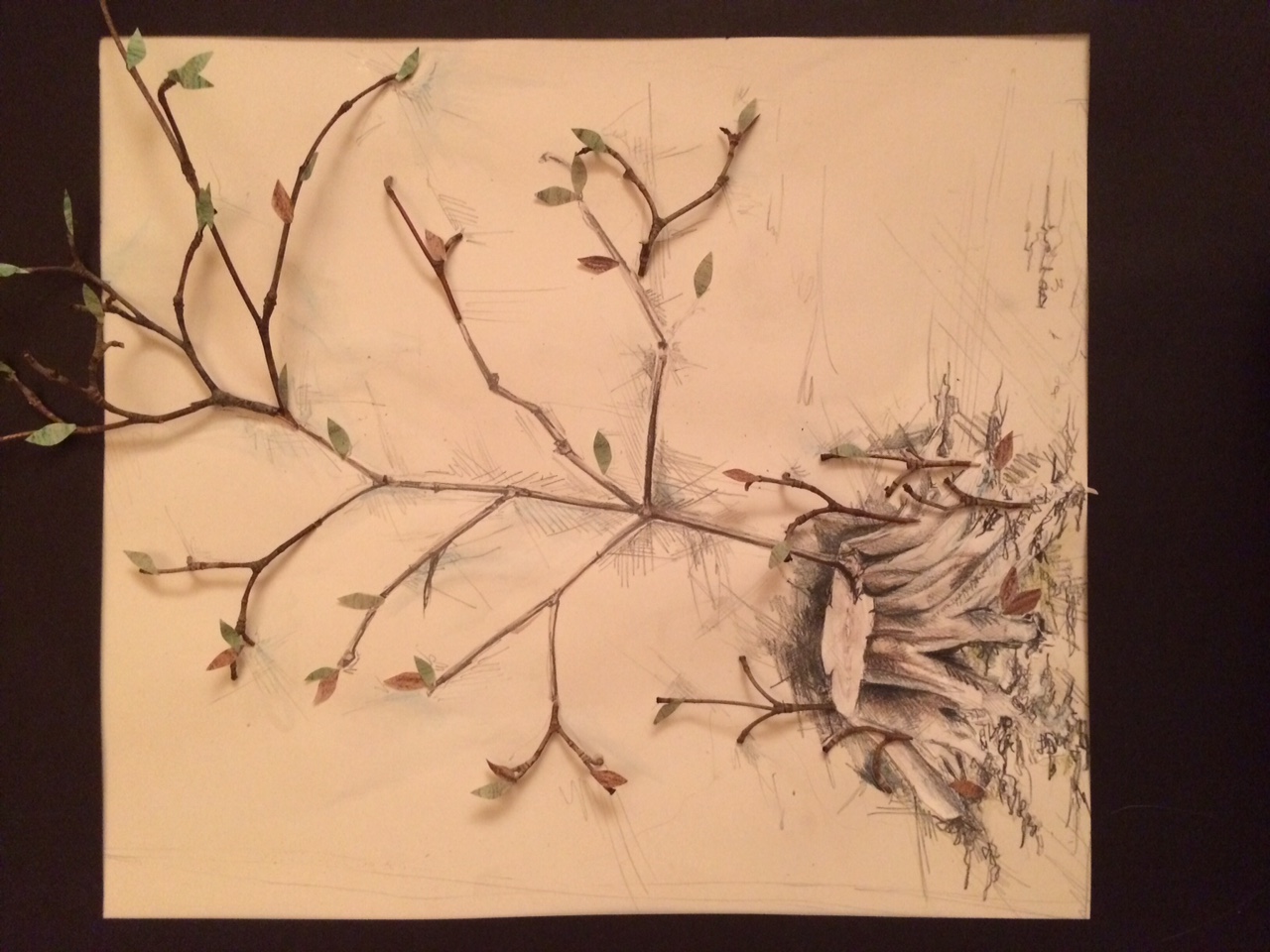
A shoot shall come out of the stump of Jesse, and a branch grow out of his roots.

The spirit of the Lord shall rest on him, the spirit of wisdom and understanding, the spirit of counsel and might, the spirit of knowledge and the fear of the Lord.

His delight shall be in the fear of the Lord. He shall not judge by what his eyes see, or decide by what his ears hear; but with righteousness he shall judge the poor, and decide with equity for the meek of the earth.

He shall strike the earth with the rod of his mouth, and with the breath of his lips he shall kill the wicked. Righteousness shall be the belt around his waist, and faithfulness the belt around his loins.

The wolf shall live with the lamb, the leopard shall lie down with the kid, the calf and the lion and the fatling together, and a little child shall lead them.

The cow and the bear shall graze, their young shall lie down together; and the lion shall eat straw like the ox. The nursing child shall play over the hole of the asp, and the weaned child shall put its hand on the adder’s den.

They will not hurt or destroy on all my holy mountain; for the earth will be full of the knowledge of the Lord as the waters cover the sea.

On that day the root of Jesse shall stand as a signal to the peoples; the nations shall inquire of him, and his dwelling shall be glorious. Isaiah 11:1-10, NRSV

Idyllic: the world of Isaiah’s vision. The meek and poor find justice, and the predator and prey are predator and prey no longer. The wicked are killed – or at least what was wicked in them dies and leaves in its place love. It seems like the chasm between our current world and Isaiah’s peaceful kingdom will never be spanned, no bridge built to take us from here to there. Except that it starts and ends with Jesse, an imperfect and perfectly loved child of God. Just like us.

At its heart, Isaiah’s world is the place where we don’t live at the expense of others. We seek a just world, even when it means we have make sacrifices. Sacrifice expands the heart’s capacity to love and strengthens the spirit within us. When we mean good things for others and sacrifice to bring them to life, we take a step toward Isaiah’s world. Take enough steps, and that chasm just might be spanned.

Riley Anderson’s Stump of Jesse, 2015

Receiving Them

Readings: Psalm 72:1-7, 18-19; Isaiah 40:1-11; John 1:19-28

Give the king your justice, O God, and your righteousness to a king’s son.

May he judge your people with righteousness, and your poor with justice.

May the mountains yield prosperity for the people, and the hills, in righteousness.

May he defend the cause of the poor of the people, give deliverance to the needy, and crush the oppressor.

May he live while the sun endures, and as long as the moon, throughout all generations.

May he be like rain that falls on the mown grass, like showers that water the earth.

In his days may righteousness flourish and peace abound, until the moon is no more.

Blessed be the Lord, the God of Israel, who alone does wondrous things. Blessed be his glorious name forever; may his glory fill the whole earth. Amen and Amen. Psalm 72, NRSV

How many times during the summer months have we not seen rain in a few days and the grass turns a little bit brown? Do we not hope for that refreshing, renewing rain? 

And that’s what Jesus comes to do.

He comes to refresh, renew us, refresh us with the forgiveness of our sins, and refresh us with the gift of everlasting life. 

He wants us to have these things and know how much we are loved.

He wants us to receive them, as that which only he does, to refresh us and renew us.

Waiting to Receive

Will we always flourish on earth? NO.

But when we believe in Jesus Christ as our Lord and Savior we are already flourishing in a spiritual way. We already have been given the greatest gift of all. We have already been given the gift of righteousness, forgiveness, salvation, and eternal life. As we receive and embrace this truth, we are already abounding. And this will not only continue until the moon is no more, but beyond it for all eternity because of Jesus, our Savior, because of our King.

Dear Lord Jesus,

As we remember your first coming, help us to see all that you have done and given, the righteousness that you have showered upon us, as rain upon the earth. Fill us with hope in you, and comfort us with your presence, and sustain us by your gifts, as we wait on you, that we may wait, embracing your love, your goodness, your righteousness, your gift of salvation. Amen.

Words and Image offered by Donna Eby, child of God.