All posts by Johnna

I am a Christian educator and writer.I have worked in churches, denominational offices, and seminaries. I have a PhD in Theology from Princeton Theological Seminary, with a focus on Practical Theology and educating in faith. In 2010, my book, "How the Other Half Lives: the challenges facing clergy spouses and partners," was published by Pilgrim Press. I believe that words can build doorways that lead to encounters with God through the Spirit.

Epiphany

Today is the day for remembering the astronomers/astrologers who followed a star to find the Christ Child. Contrary to Christmas pageant tradition, the Magi didn’t show up on Christmas day or any day soon after: enough time had passed for them to reach Bethlehem by way of Jerusalem and for Jesus to grow from a baby to a child (Matthew 2:1-12). While tradition holds that there were three of them (Casper, Melchior, Balthazar), it doesn’t mention their names or numbers in the Bible. It seems that there are a lot of things that have been read into this story over the past two thousand years, and it isn’t easy to read this sacred story without all the additions and assumptions.

Epiphany in the capital E church sense is a revelation or manifestation of the divine, in this case the revealing of the Christ child to holy travelers outside the Jewish faith. My visual for an Epiphany is a brilliant shaft of light parting the clouds. It’s a beautiful image, even if it’s a cliche.

In the lower case sense, epiphany can mean an illumination, a sudden grasp of truth, and the revelation of something essential revealed or understood. I guess the light-bulb-over-the-head is the cliche image, but it’s not one I can claim. I don’t really have a static picture for it, but I do have a couple of moving ones. The first is looking through a kaleidoscope – seeing the fractured colors become identifiable flowers or figures with a quick aligning turn. What made no sense seconds earlier falls into place and I see its structure and beauty. Two others: adjusting telescopes and microscopes to see what is too big or far away and what is too small or too much a part of me to grasp. In all cases, it’s a change of perspective – a new look at reality that allows me to grasp an essential truth or be grasped by an essential truth.

Like the Magi, I won’t see God-with-Us without leaving behind the comforts and assumptions of home. Epiphany and epiphanies only come when I’m willing to journey beyond my present understandings of God, world, self, and neighbor. Today is as good a day as any to hit the road…

There are far, far better things ahead than any we leave behind. C.S. Lewis

(quoted in Daily Peace: Photos and Wisdom to Nourish Your Spirit, Washington, D.C.: National Geographic, 2015, January 1)

Welcome, New Year

It’s not quite ten hours into 2018. It’s only a degree or two above zero, a degree or two below with the wind chill factor factored in. Birds are flying to and from my bird feeder, squirrels are picking bread crusts and seeds off the frozen ground, and the sun shines down from a brilliant blue sky. There’s just enough snow on the ground and shrubs to make the view out my window an almost perfect vision of a New England winter. Looking out on this downtown Wareham beauty, I wonder what this new year will bring.

I’ve been reading Coates’ We Were Eight Years In Power, a collection of essays written over eight years prefaced with personal notes from the author before each one. In the fifth essay introduction, Coates writes about his joy in seeing his wife, Kenyatta, taking up a new course of study and growing in unexpected ways. Where some would see disruption and the loss of comfortable life patterns and goals, he sees wonder and adventure – a new way to grow together rather than an inevitable (or at least likely) cause of growing apart. What a wonderful way to experience the changes brought to daily life when a beloved leaves behind the old and familiar pursuits.

I don’t think it’s easy, growing together through new directions and stages. It’s easy to become so attached to a specific version of friends and relatives that significant change and growth feels like loss and death rather than gain and new life. There’s something important here for me to learn. With this new year just a few hours old, perhaps I’ve been given my first life lesson of 2018: foster and appreciate the changes and growth of everyone I care about. Love the person, not a particular age or stage. If I can learn how to do this, there’s no telling what delight and adventure I’ll find.

Welcome, New Year. Welcome, New Life Lesson.

Ta-Nehisi Coates, We Were Eight Years In Power (New York: One World Publishing, 2017)

Christmas is Here!

Readings: Isaiah 9:2-7; Psalm 96; Titus 2:11-14; Luke 2

The people who walked in darkness have seen a great light; those who lived in a land of deep darkness – on them a light has shined…For a child has been born for us, a son given to su; authority rests upon his shoulders and he is named Wonderful Counselor, Mighty God, Everlasting Father, Prince of Peace. Isaiah 9:2, 6 NRSV

God has joined us as a baby, born in a manger, beloved child of Mary and Joseph. Of all the amazing things that could have happened, of all the wonderful ways God came to us, this is the most precious.

Thank you, Lord. You came to love us by letting us love you. You showed us what holiness meant by depending on a young mother and her kind husband. Peace and love are ours because you are ours and we are yours. Welcome to our world, welcome to our family, welcome to our hearts. Amen.

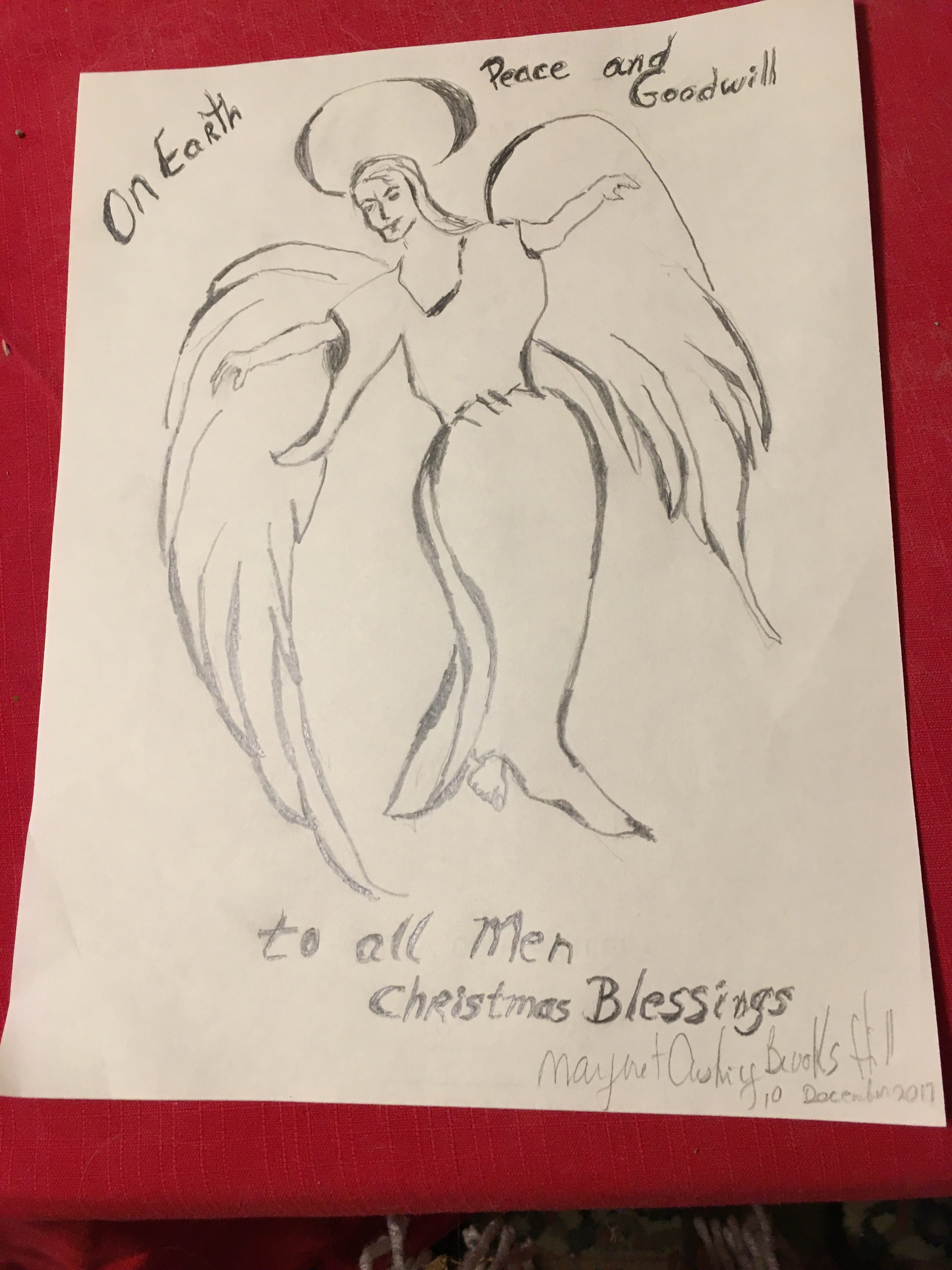
Art by Margaret Hill, grandmother, artist, singer, child of the most holy God.

Getting the Message

Readings: 2 Samuel 7:1-11; Luke 1:46b-55; Romans 16:25-27; Luke 1:26-38

(Drawing offered by Margaret Hill, artist, grandmother, seeker of the Christ Child)

Mary is visited by an angel and steps into God’s sacred story in an unexpected way – by expecting a child. When she goes to visit Elizabeth, another message comes with an in utero leap and an expectant mother’s words: Blessed are you among women, and blessed is the fruit of your womb. And why has this happened to me, that the mother of my Lord comes to me? For as soon as I heard the sound of your greeting, the child in my womb leaped for joy. And blessed is she who believed that there would be a fulfillment of what was spoken to her by the Lord. (Luke 1:42-45)

Then Mary sings her song – a message of hope for the whole world these two thousand odd years: My soul magnifies the Lord, and my spirit rejoices in God my Savior, for he has looked with favor on the lowliness of his servant. Surely, from now on all will call me blessed: for the Mighty One has done great things for me, and holy is his name…

Then Mary’s song changes. It isn’t just about her any more because she knows the glorious truth that transforms everything: God’s visit to one person is never a singular blessing. Good news is for everyone, most especially those in desperate need. Holiness cannot be contained, and was never meant to be hoarded by one person or a single group. Blessing comes into its own when it is recognized for what it is and shared with others.

I don’t know what the messenger will look like – the one who reveals to you the holiness of your own life. Will it be an angel with wings, a scrap of poetry found in a dusty old book, or the look in the eyes of a friend? When you see your messenger, when you receive your message, I hope you tell me about it. After all, sacred stories can’t all be contained in scripture, and I love a good story.

Blessings and Peace to you and yours on this sacred night.

(Boney M, Mary’s Boy Child/O My Lord, (Christmas Album), 1981. Available on iTunes)


A Suitable Savior

Readings: Psalm 89:1-4, 19-26; Judges 13:2-24; John 7:40-52

When they heard these words, some in the crowd said, “This is really the prophet.” Others said, “This is the Messiah.” But some asked, “Surely the Messiah does not come from Galilee, does he?”…Nicodemus, who had gone to Jesus before, and who was one of them (Pharisees), asked, “Our law does not judge people without first giving them a hearing to find out what they are doing, does it?” They replied, “Surely you are not also from Galilee, are you? Search and you will see that no prophet is to arise from Galilee.” John 7:40-41, 50-52 NRSV

Every so often, someone looks different from what his or her voice sounds like. Or, more truthfully, the picture I have in my mind of the person who belongs to the voice doesn’t match the person who actually has that voice. Of course the person and voice do match –  it’s just the image I’ve created for the voice that’s off the mark. But it’s surprising how powerfully my preconceived image objects to correction.

Are the people in today’s passage having the same problem? Do they have a preconceived image of a Messiah that doesn’t want to be corrected by reality? In this case, it isn’t a mismatched voice: it’s an incorrect home address. Are some zip codes holier than others?

Whenever this mismatch happens, it comes with a choice: do I choose to reshape my idea around the reality God has given me or do I attempt to bend or deny reality until it fits my idea?

Dear God, give me enough courage and humility to recognize your prophets…and enough wisdom to see you in the face of Jesus. Amen.

Bruce Cockburn, Soul of a Man, Nothing But a Burning Light, (available on iTunes)


The (un)Usual Suspects

Readings: Psalm 89:1-4, 19-26; 2 Samuel 6:12-19; Hebrews 1:5-14

I have found my servant David;

With my holy oil I have anointed him;

My arm also shall strengthen him.

Psalm 89:20-21

I love a good mystery. Agatha Christie, Arthur Conan Doyle, P.D. James, Elizabeth George, and Martha Grimes have written me into their worlds, and I’ve spent many hours with Miss Marple and Hercule Poirot, Holmes and Watson, Dalgliesh, Lynley, Jury and Plant. While it seems most real life crimes are committed by the usual suspects (spouse, sibling, business partner, etc.), it’s almost never the obvious suspect in a well written mystery. On the rare occasion that the butler/husband/heir did do it, the reasons are never as simple as they often are in real life. A good mystery is exactly that: a mystery.

Life outside criminal investigations is rarely simple or obvious. There isn’t a living being that can be fully understood. It’s difficult to predict what any particular person might do when faced with a challenge or put in a dangerous situation. Who can work under pressure? Who will find an unexpected solution to a vexing problem? Who will find the strength and courage to risk life and limb to save others? It’s almost impossible to know in advance.

The same was true when today’s passages were written. Who would have thought that the poetry writing, dancing-before-God-and-people, youngest son and shepherd would be chosen by God to rule? Who would have thought a poor teenager and a carpenter would be the ones to raise God-With-Us? Why a locust eating backwoods preacher as the forerunner? Why a Nazarene born in a stable?

In this holy world where mystery abounds, God only knows who will be chosen next. Why not you? Why not me?

O Lord, guide my feet on this road to Bethlehem. Amen.

My Mouth Will Proclaim

Readings: Psalm 89:1-4, 19-26; 2 Samuel 6:1-11; Hebrews 1:1-4

I will sing of your steadfast love, O Lord, forever;

with my mouth I will proclaim your faithfulness to all generations.

I declare your steadfast love is established forever;

your faithfulness is as firm as the heavens.

You said, “I have made a covenant with my chosen one,

I have sworn to my servant David:

I will establish your descendants forever,

and build your throne for all generations.”

Psalm 89:1-4

Offered by Colin Fredrickson, artist, college student, child of God.

To See or Not To See

Readings: Psalm 125; Malachi 3:16-4:6; Mark 9:9-13

I have attended church almost every Sunday of my remembered life.
I love the church, the quietness of the space and the holiness of the environments I have been part of throughout the different stages of my life. In each of these church experiences I had my pre-conceived idea of who Jesus was based on the experiences of my life beforehand and what I had been taught and had been willing to take the time to study.

(In the verses just before these, Peter, James, and John have seen Jesus transfigured and heard the voice of God speaking to them)

As they were coming down the mountain, he ordered them to tell no one about what they had seen, until after the Son of Man had risen from the dead. So they kept the matter to themselves, questioning what this rising from the dead could mean. Then they asked him, “Why do the scribes say that Elijah must come first?” He said to them, “Elijah is indeed coming first to restore all things. How then is it written about the Son of Man, that he is to go through many sufferings ad be treated with contempt? But I tell you that Elijah has come, and they did to him whatever they pleased, as it is written about him.” Mark 9:9-13 NRSV

On the way down from the mountaintop experience, Jesus commands these three disciples not to tell anyone what they had  seen; it would not be understood until after the resurrection. These disciples had been so completely schooled in the idea that the Messiah would set up a kingdom on earth that they could not understand what Jesus was saying. When the Cross had taught them what Messiahship meant and when the Resurrection had convinced them that Jesus was the Messiah, then, and then only, could they tell of the glory of the mountain top.

I need to be careful that I am not blind to what God wants to do in and through my life because I have already decided how I want things to turn out. It is so easy to be blind to the truth when I already have a preconceived idea of how I want certain things to be.

This scripture reminds me that there are times when God graciously allows us to take a few steps by sight so that we can continue the journey by faith. Peter, James, and John see Jesus with the two most prominent figures in the Old Testament – Moses the Lawgiver and Elijah the great prophet.  Jesus is briefly transfigured, and they are allowed to see Him in a glorious state. Finally, and most significantly, they hear the voice of God for themselves when He affirms that Jesus is His son. Allowing Peter, James, and John to experience these things was an expression of God’s grace upon them at this point in their journey of following Jesus. They may not understand what they saw, but they did see it.

I wonder if we understand what resurrection means. I am increasingly convinced that our present day equivalent to the disciples wondering, “What does this talk of resurrection mean?” might be “What difference does resurrection make in day-to-day lives?” And if, in the end, we can’t answer that question, then we might also wonder why we say we follow the way of Christ at all.

Yes, we’re familiar with the idea of resurrection. But do we actually expect it and experience it? Have you ever had an experience where God allowed you to take a few steps by sight so that you could continue the journey by faith?

Prayer: Dear God, let the resurrection be real for us, shaping both our faith and our actions in this world. In Jesus’ name,  Amen.

Offered by Donna Eby, photographer, teacher, seeker of the Christ Child.

Power in human hands

Readings: Psalm 125; 2 Kings 2:9-22 (23-25); Acts 3:17-4:4

Now the people of the city said to Elisha, “The location is good…but the water is bad and the land unfruitful…then he went to the spring of water and threw the salt into it, and said, “Thus says the Lord, I have made this water wholesome; from now on neither death nor miscarriage shall come from it.” So the water has been wholesome to this day, according to the word Elisha spoke.

Elijah has been taken up into the heavens, leaving Elisha to pick up his prophet’s mantle. He is a true prophet, having the power to do mighty things in the name of the Lord. Putting grief aside, he manages to cleanse a spring of water – an act that saves the people from illness and death. Prophecy and help don’t die with Elijah because God continues to provide for the people through Elisha. God’s power has passed into new hands. That’s where the story ends when it’s heard in church or listed in daily devotionals, but it’s not the end of the story as written:

He went up from there to Bethel; and while he was going up on the way, some small boys came out of the city and jeered at him, saying, “Go away, baldhead! Go away, baldhead!” When he turned and saw them, he cursed them in the name of the Lord. Then two she-bears came out of the woods and mauled forty-two of the boys. From there he went on to Mount Carmel, and then returned to Samaria. 2 Kings 2:19, 21, 23-25 NRSV

As our weary and grieving prophet heads out of town, a pack of small boys runs alongside, shouting insults and taunting Elisha. Elisha snaps, turning his grief, exhaustion, and annoyance into a curse that leaves dozens of young boys injured and dying. He keeps walking, leaving behind life-giving water and heartbroken families. Human frailty and great power can harm just as easily as it can heal.

Perhaps this is why God-With-Us came to Mary and Joseph – a young woman willing to risk everything to serve God and a man kind enough to refrain from harming her even when he thought she had been unfaithful. God knew they would love him and teach him to act with compassion. For Mary and Joseph were so loving that God gave them his only begotten son…

Come, walk with me to Bethlehem.

Standing Strong

Readings: Psalm 125; I Kings 18:1-18; Ephesians 6:10-17

Those who trust in the Lord are like Mount Zion,

which cannot be moved, but abides forever.

Psalm 125:1

Finally, be strong in the Lord and in the strength of his power.

Put on the whole armor of God, so that you may be able

to stand against the wiles of the devil…therefore take up the whole

armor of God, so that you may be able to withstand on that evil day,

and having done everything, stand firm.

Ephesians 6:10, 13

Stand your ground.

Sometimes, those words are taken as an offensive posture: when fearful, fire first. But that’s not what it means in the Psalms or Ephesians. It isn’t a paraphrase of the best defense is a good offense. This is about finding the courage and the faith to endure the attacks of others without striking back or falling apart. The armor of God is worn to strengthen the self to survive with heart and soul intact, whatever may come. When surrounded by evil, when darkness threatens to overwhelm, the armor of God gives its wearer enough strength and wisdom to stand rather than cower, to hope rather than fall into despair.

Strength and aggression are not the same. True strength enables us to remain who we are – compassionate people of faith who follow a manger born savior – in the face of danger and uncertainty. It allows us to act as we believe, to return compassion for hatred and exercise restraint when threatened. Strength allows us to choose love even on a day when others choose evil.

Standing firm, remaining unmoved, withstanding. When the time of trial arrives, I’ll need the whole armor of God to do these things. Otherwise, in my weakness and fear, I just might be an agent of evil rather than a disciple of the Lord.

Hold my hand, dear Lord. Help me stand.