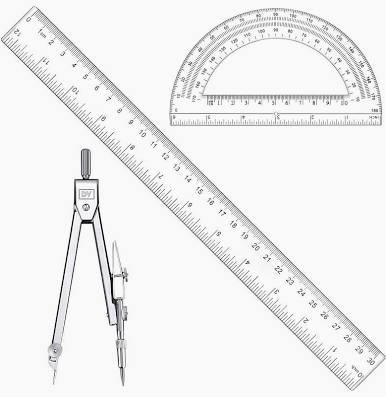
Compass, Ruler, Protractor – required school supplies that are rarely used after graduation. Unless, of course, you are an artist, architect, builder, woodworker, or crafter. These help you draw a good circle, a straight line between two points, and figure out the degree of an angle. With the right notation, a plan drawn on paper – landscape, building, airplane, boat – can be made three dimensional. All that’s needed is the scale.
That’s the thing, though: the scale. What we sketch out in our lives, if not kept in scale, can end up in laughter, a lesson learned, or disaster. Proportion is important. Whether or not we ever use these instruments after graduation…
At the beginning of August, we made the annual trip to Sears, Montgomery Ward, and Porteous Mitchell to pick out clothes and shoes. What we couldn’t find in stores, we found in the pages of the Sears catalog. Just about everyone we know did the same, although the choice of stores might vary. Most everyone got at least one new outfit and a new pair of shoes for the first day of school; after that would come the outgrown hand-me-downs from older siblings. That new outfit heralded the new school year just as much as a new home room and a new grade level.
School shopping is still alive and well; the local Target is full of families preparing for the upcoming year. So is the local LLBean – backpacks and water bottles. But a new outfit for the first day of school isn’t as big a deal – people buy new clothes throughout the year and in larger quantities than in the ’60’s and ’70’s.
I don’t think it’s a bad thing that a new school outfit is no longer a must-have. It must have been an awful way to begin the year for the children who didn’t have them, and heart-breaking for the parents who couldn’t provide them. That doesn’t mean there aren’t judgements made about clothes: now, it’s the designer label rather than the newness that matters. No matter the era, some way of separating those with more than enough from those with enough from those with not enough is in place.
Years ago, when talking with a guest about living into higher levels of compassion and spirituality, Oprah Winfrey remarked that she liked to visit those upper levels of spirituality for tea, but would choose to live on a lower level – because the wardrobe was better there, and she didn’t want to give that up. It got a laugh, of course, but a slightly uncomfortable one.
The first day outfit in elementary school, the team or work uniform, the gowns worn to mark advanced degrees earned, the stoles to mark ordination; all are outward signs of intellectual accomplishment or requirements fulfilled. Is it when we no longer need these, when we put these aside, that we walk through the doors of the house of wisdom and love, comfortable in our own skin and ready to learn?
It’s August 19th. Labor Day is almost three weeks off. But the yellow school buses are out and about: several of the local schools are back in session, with several more welcoming learners next week.
I haven’t darkened the door of a classroom, at least as a student, for a long time. But I’ve spent most of my adult life telling stories and leading classes of one sort or another. It might be fun go back to school – to look at the reading, writing, and (a)rithmetic once again. As well as all the other things…art, music, drama, languages, etc…
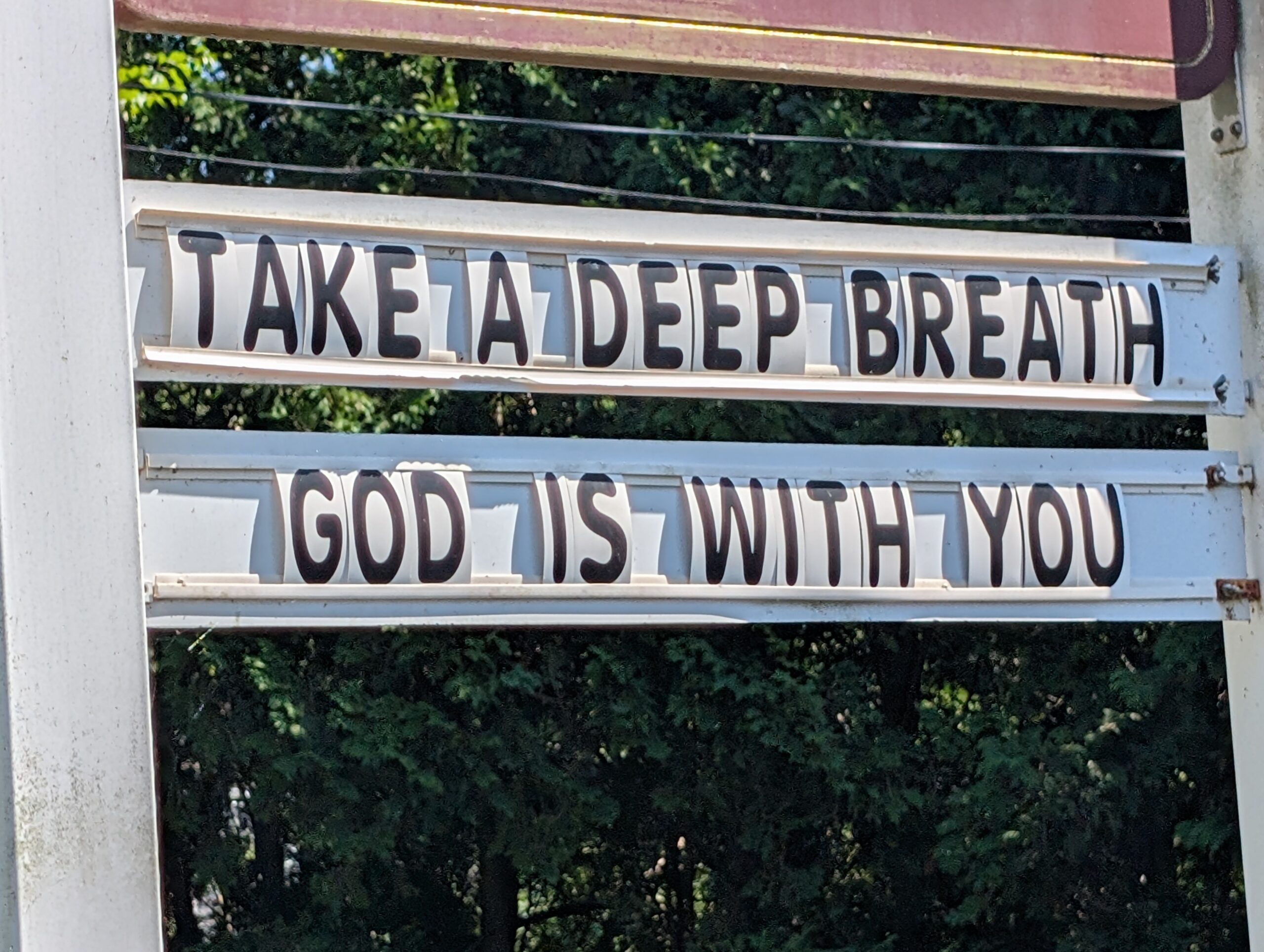
I see them in front of auto repair shops and diners; I see them on front lawns; mostly, I see them in front of churches: the pithy, simplistic, often pietistic messages.
Jesus lets you do what you want to, but your want-to has to change…
Smile! God loves you!
People don’t care how much you know until they know how much you care…
Every time I see one, I wonder who selected the saying, who changes it each week, and what the keeper of the sign hopes to accomplish.
Rarely is one of these signs saying something original or truly thought-provoking. It has to be short enough for someone to see it, read it, and make sense of it in the few seconds it takes for a car to drive past it.
Perhaps it’s too much to expect profundity on a roadside message board. Maybe engaging my mind on a deep level isn’t the point or the purpose. With all the anxiety, with all the inner darkness and turmoil people drive around with every day, maybe a quick note of positivity is a flash of light. Maybe drivers-by will see in these signs what they need to see – a lifeline from someone or someplace that cares.
Help can come from anywhere, even from a sign. If I took the time, I’ll bet I’d find something to take with me, something to ponder, in these signs. The fact that I don’t might say more about me than the signs and their keepers…
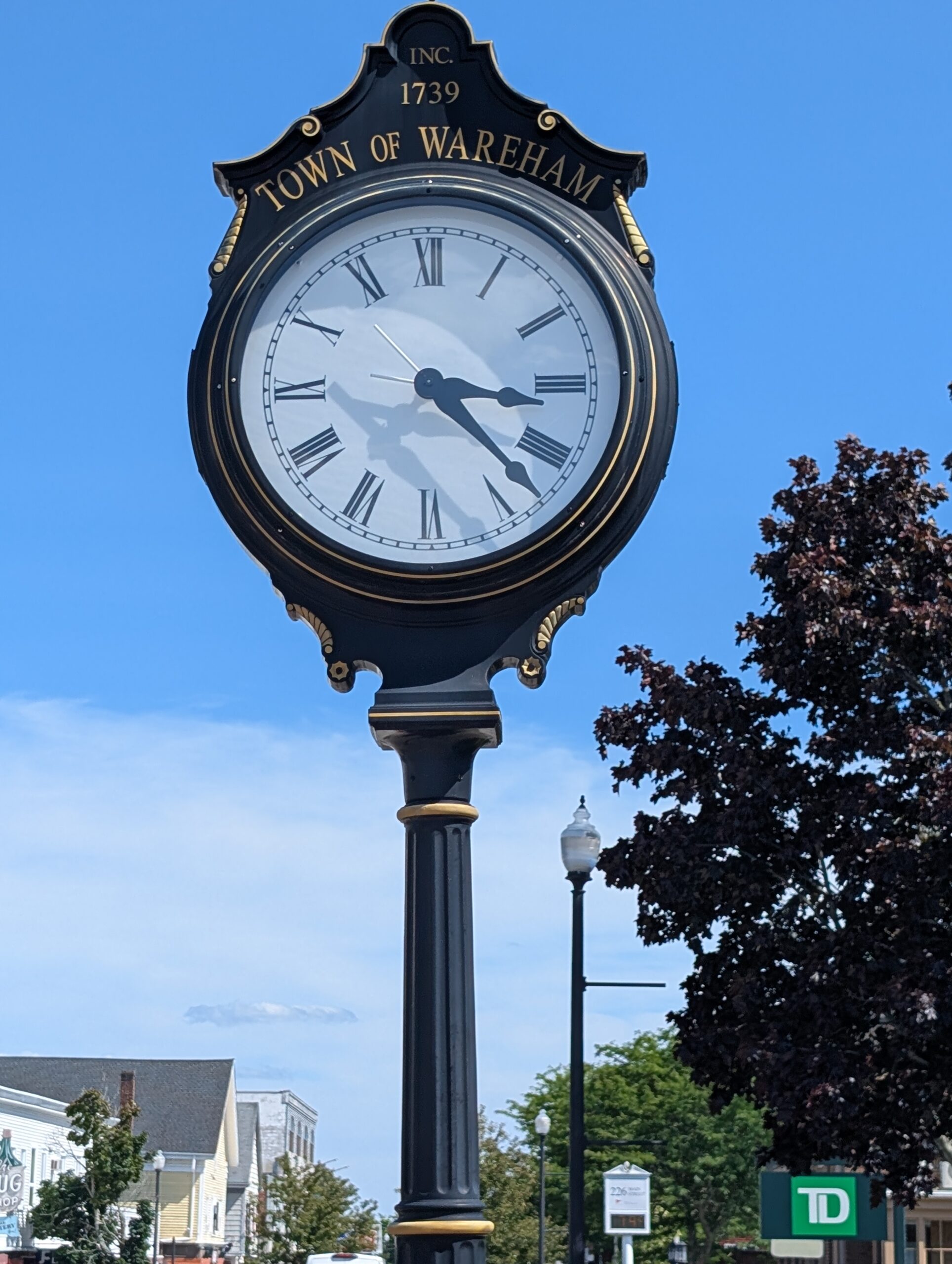
There are two clocks at the center of Wareham. This is the one in front of the Post Office:
The second one is in the background, just to the bottom right of the clock’s pole. It’s in front of a bank building that is no longer occupied.
To adjust or set the time on the analog clock, someone has to get a ladder and manually adjust it. The contrasting colors make it easy to read from a distance. Other than for a few days around the Spring and Autumn time changes, it keeps good time.
To adjust or set the time on the digital requires the push of a button on a computer. On a sunny day, it’s hard to read; at night, it projects the time quite a distance. It can take weeks for the correct time to be on display after the Spring and Autumn time changes. Frequently, it’s off by several minutes; since the bank left town, it is off by hours. They are not synchronized because they aren’t kept (or neglected) by the same people.
Seeing two times at once irritates me more than it should. After all, I can check my phone if I really need the correct time; if I’m phone free, it means there’s no need for me to know the correct time. There’s just something jarring about it.
When I see these two clocks, when the asynchrony bothers my sense of order, I try to remind myself of some larger truths:
The sky will be blue or gray regardless of the Main Street clocks.
The trees offer shade and shelter no matter the time.
How I live my minutes, hours, days, and years can’t be measured or contained by any clock.
The Pan-Mass Challenge brought its annual activity last weekend: thousands of cyclists and thousands of volunteers to help them as they ride from one side of Massachusetts to the other. Every year, I see the riders make the trip, part of the Dana Farber Cancer Institute’s fund and awareness raising. On their backs, the riders bear this sign every year: PMC. These are signs on the move.
During the rest of the year are the other signs, the permanent ones. These, too, are PMC. They mark the route for the riders and for those driving their cars along it. Be aware of the bicycles is the message for the two days of the annual challenge. Be aware of life’s fragility is the message for the other 363 days. Be aware. Look around. See.
I’m not posting a picture of the permanent signs – where’s the fun in that? But if you are ever in Massachusetts, between Worcester and the Cape, keep an eye out. They have a white image on a light blue background…And think of the thousands of people who devote their own time and resources to help others. A sign of the Kingdom?
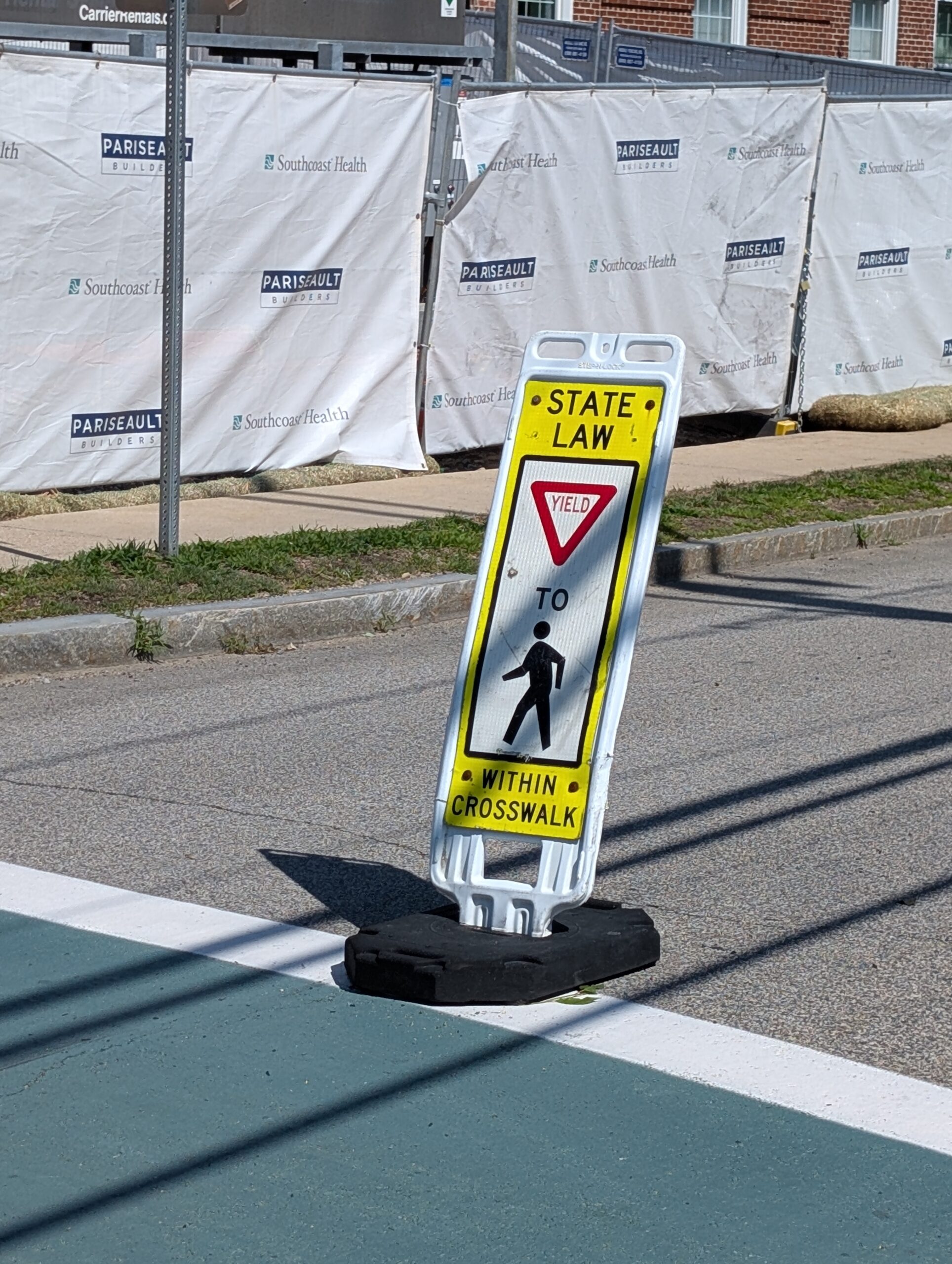
We yield to those in bigger vehicles when we merge into traffic. We yield to the opinions of the higher-ups at the workplace. We even yield the floor to the person running the meeting, allowing someone else to put limits on our time. The ones with more power and influence are the ones to whom we yield. There’s no big surprise here.
To the Pedestrians
But here is a different story. Here the drivers who own the road yield to the ones on foot, giving way for the smaller and more vulnerable. On this green strip between one side of the street and the other, the powerful pause to let the pedestrians pass.
There’s a deeper truth in this, this mandate to stop in our trajectories and defer to the lower and slower, the strangers we will never truly meet and may never set eyes on again. This is yielding not because someone else is more powerful and can make us do it, but because someone is more vulnerable and cannot make us do a damn thing. If we cannot let go of our own machinations long enough to stop and let someone cross the road, we have lost some precious part of humanity. But if we can, if we realize there’s a whole big world full of God’s beloved well beyond our own plans and desires, then every time we stop to let someone cross, if we look, we’ll catch a glimpse of heaven on earth. Perhaps the person we yield to is Jesus the stranger among us; perhaps angels wait on the side of the road to offer us a blessed chance to yield.
Perhaps it’s not only a stairway that goes to heaven, but a green crosswalk as well.
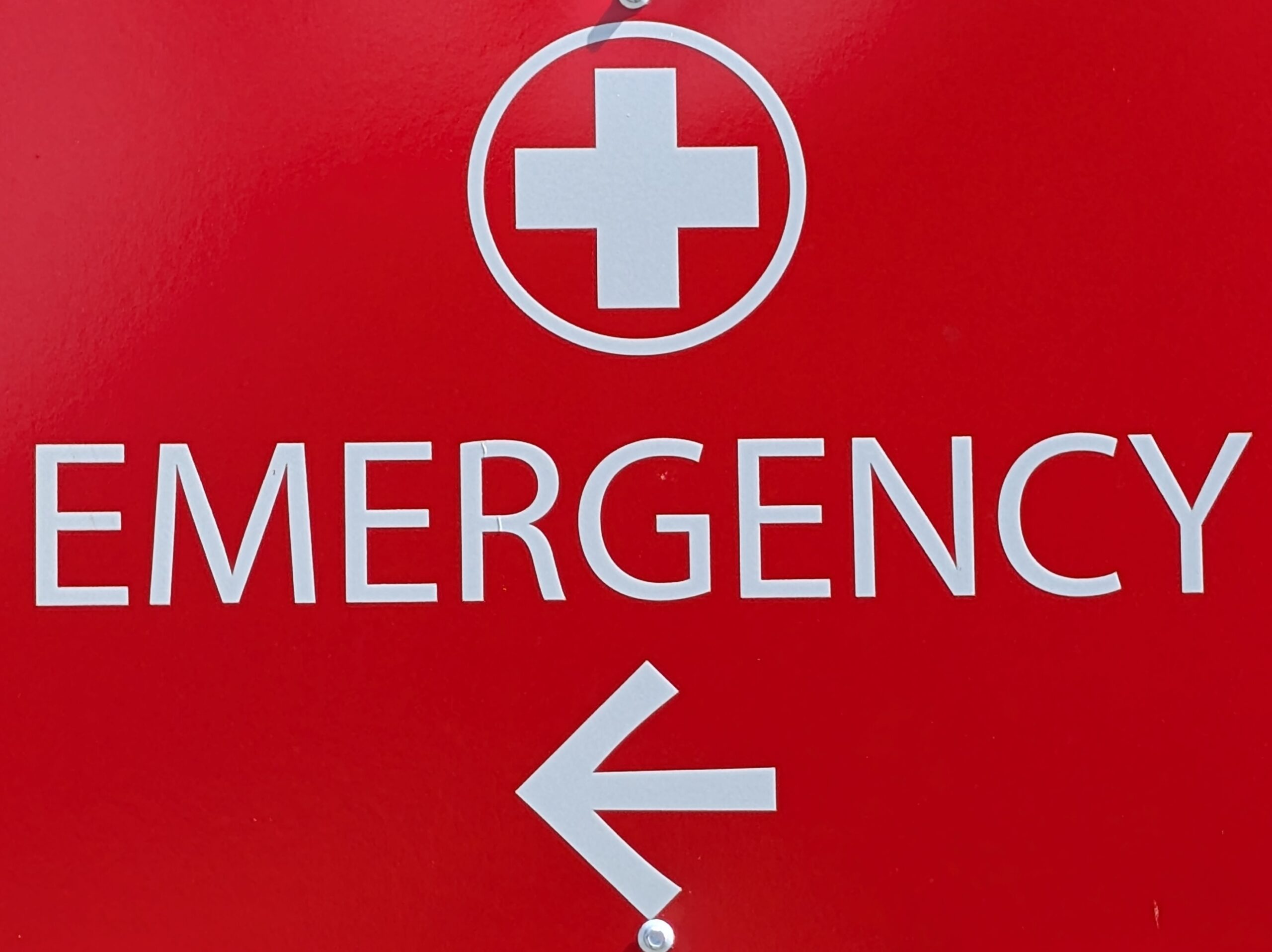
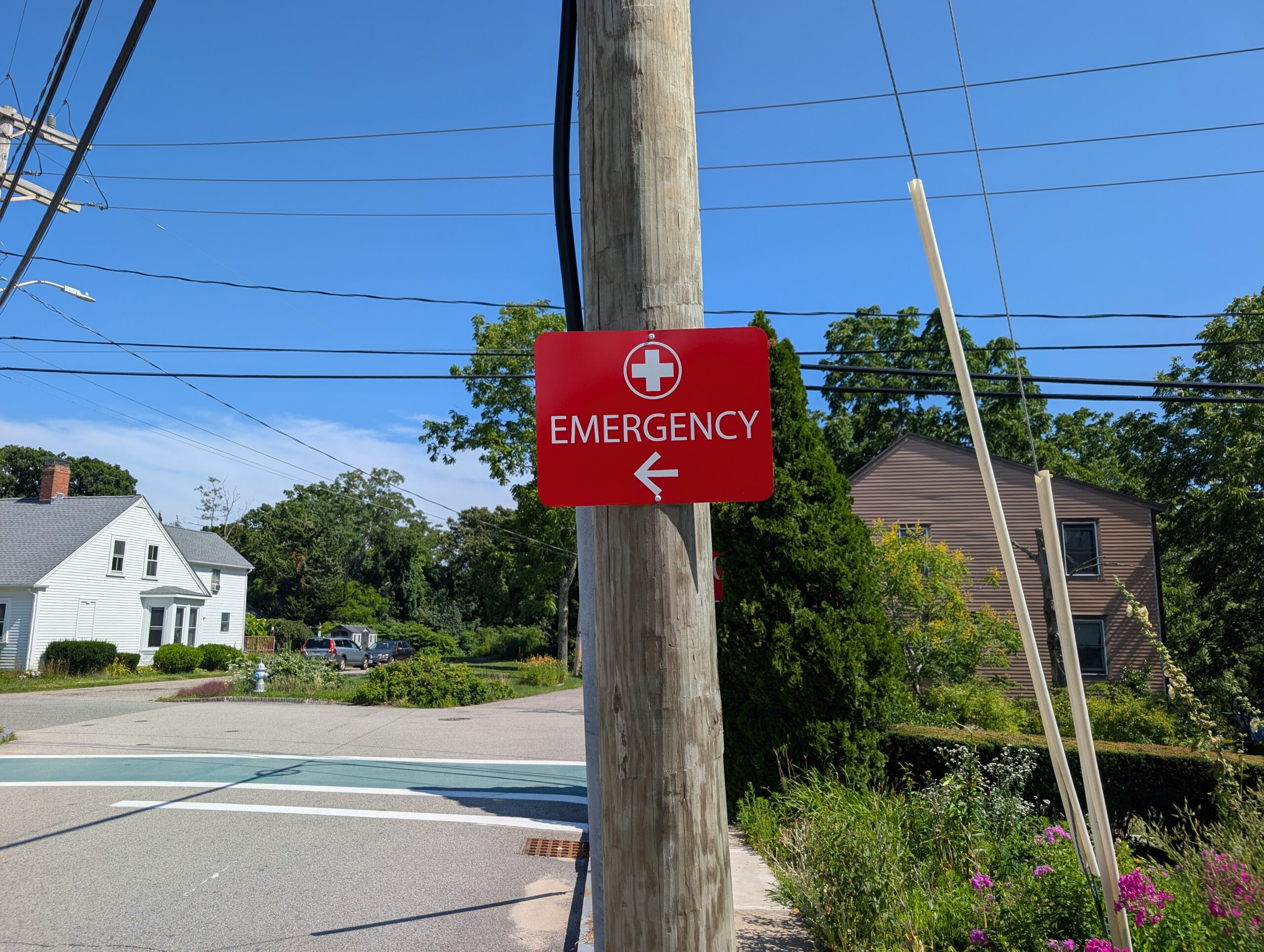
There are several more of these on the streets around Tobey Hospital than there were a few years back, mostly because renovations and expansions involved moving the Emergency room entrance – for walk-ins and for ambulances. While the ambulance drivers are well aware of all the changes over the years, people bringing themselves or relatives in aren’t. It’s not as if most people visit the ER on a regular basis, and the anxiety of needing medical attention makes it very easy to ignore the new entrance and to automatic-pilot it toward where it used to be.
Sign from a distance
This is understandable, but not helpful. Panic doesn’t help the ones in distress or those caring for them – it’s why ER staff remain calm and why certain friends and family members are better than others when an emergency occurs. It’s also why some are better than others at discerning whether the emergency is real or not – practicing triage.
In this ever evolving life, it’s easy to lose my bearings, to ignore changes and new patterns in favor of former conditions. It’s even easier to confuse what is a matter of concern and what is an emergency. Sometimes, my triage skills are wanting; sometimes, I make snap judgements based on prejudice or past experiences that really don’t apply to the situation at hand; sometimes, I forget what is necessary and what is merely important.
I’m using this sign as a touchstone, something that centers and grounds me in the present, something that reminds me to look around and base my actions on what is rather than what was or what I assume might be.
In this God-Self-Neighbor reality, this sign can keep me acting out of love rather than panic.
[This is one in a series, Seeing Signs. Click the words above for more information.]
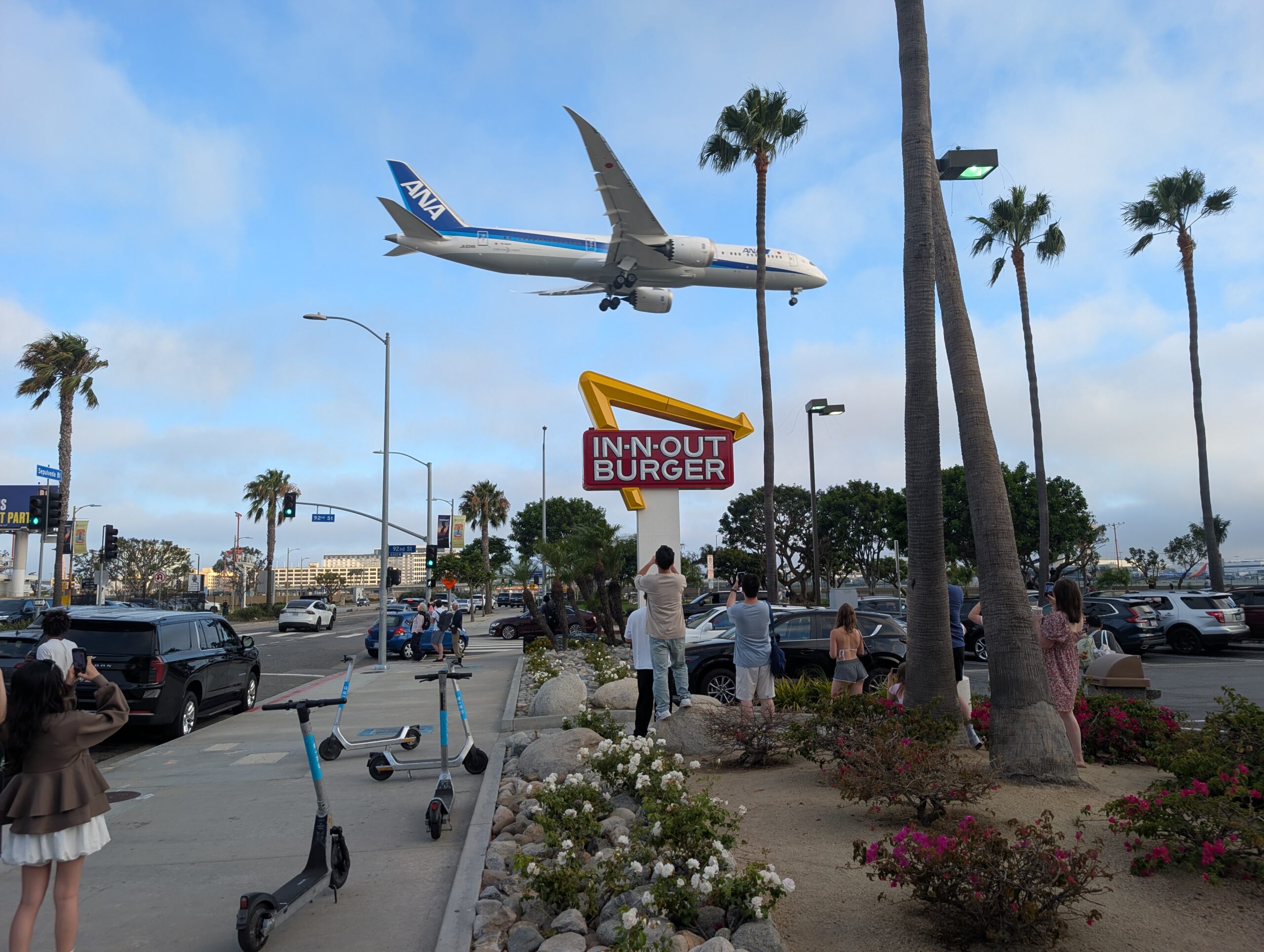
You can’t see it, but just behind the IN-N-OUT BURGER sign, is a small park. To get there, just cross the street on the crosswalk currently occupied by a blue car.
You can’t hear them, but children are laughing, running on the grass as the planes pass over.
You can’t smell the exhaust, but dozens of cars are idling on the road behind the sign, waiting to order burgers and shakes to go. You can’t smell it, but there’s a jet fuel scent on the brisk breeze blowing the palm leaves.
You can’t taste them, but thousands of burgers and fries are being enjoyed by hundreds of people just beyond and around this sign.
You can’t touch them, but this spot is filled with flawed, beautiful, unique people who will make this world a better place because they graced it – and a few whose broken spirits add to the world’s suffering.
Everything you can’t see, hear, smell, taste, or touch is here because of this sign and the planes that fly over it. It’s as good a place as any to ask in an everyday sense and in a profound sense: Why am I here?
When new life comes into the world and when life leaves the world at whatever age, there are witnesses. People gather to welcome the newly born or the newly met into their families and their hearts; people gather to say God-be-with-you and release friends and relatives from this life, handing them back to God. We all come into life as individuals, and we leave it in much the same way – but others bear witness to our initial coming and our final leaving. Life and death may be solo activities, but they are not unseen.
What does it mean to bear witness to the life of another, the death of another? It’s with this question that I leave my ponderings on life and death over the last few weeks. For me, bearing witness is a joyful and sometimes terrible blessing. Life in any form is precious, if I have eyes to see it clearly. Being given life is a holy and finite gift, one given back in the return to the one who bestowed it in the first place.
For the life I have been given, I am grateful beyond words. For the death I will receive some time in the future, I pray for the wisdom to be equally as grateful. The same holds for the lives and the deaths I have born witness to.